

MADISON, Wis.–Credit unions added 96,000 memberships in January, significantly below the 514,000-gain recorded in January 2021, according to CUNA Mutual’s latest Trends Report.
The March Trends Report, which is based on January data, found overall CU lending through January was up more than 7% year over year, driven by two popular categories of loans, while savings actually declined.
Here’s a look at how credit unions performed by category.
Lending
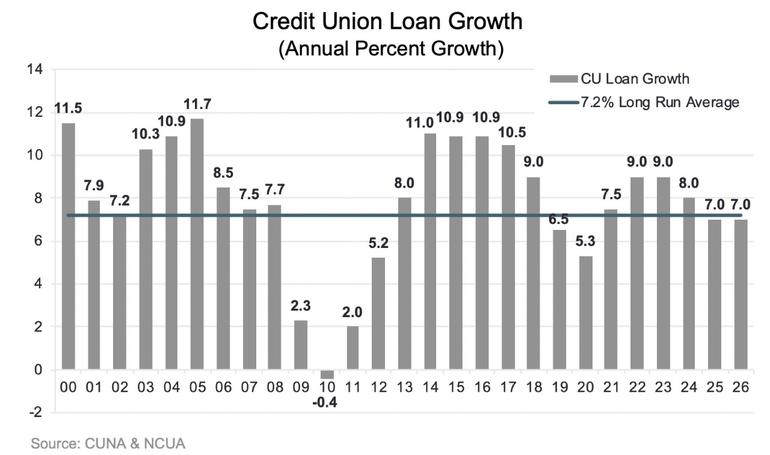
Credit union loan growth rose to 7.5% in 2021, up from 5.3% in 2020, which was slightly above the 7.2% long-run average, CUNA Mutual said.
“Driving the relatively strong performance was strong growth in the two biggest loan categories: fixed-rate first mortgages and used-auto loans,” the analysis states. “Fixed-rate first mortgage loans make up around 35% of all credit union loan balances and rose more than 16% in 2021. So, these loans contributed 5.6 percentage points to overall loan growth. Used-auto loans make up around 20% of all credit union loan balances and rose more than 10% in 2021. So, these loans contributed two percentage points to overall loan growth.”
With assets growing faster than loans during the last 12 months, credit unions’ loan-to-asset ratio fell to 61.3% in January 2021, from 63.1% one year ago and the lowest since July 2014, the Trends Report added, noting fewer loans as a percent of assets during the fourth quarter of 2021 led to the lowest yield-on-asset ratio in credit union history.
Credit unions reported a 2.97% yield-on-assets ratio, down from 3.27% in the fourth quarter of 2020, and 0.7% growth in loan balances in January, up from the 0.1% drop in January 2021.
“Looking forward, February is historically the weakest loan growth month of the year, with seasonal factors typically shaving off 0.6 percentage points from the underlying trend growth rate,” the Trends Report added.
Consumer Installment Credit
According to the Trends Report, credit union consumer installment credit balances (auto, credit card and other unsecured loans) rose 0.3% in January, below the 1.2% rise set in January 2021, due to the paying down of credit card balances by many credit union members.
The data show credit card loan balances fell 0.6% in January, slightly above the 1% drop in credit card balances reported on average over the last 10 years. Members are still using cash-out refinance money to pay down high-rate credit card debt, the Trends Report stated.
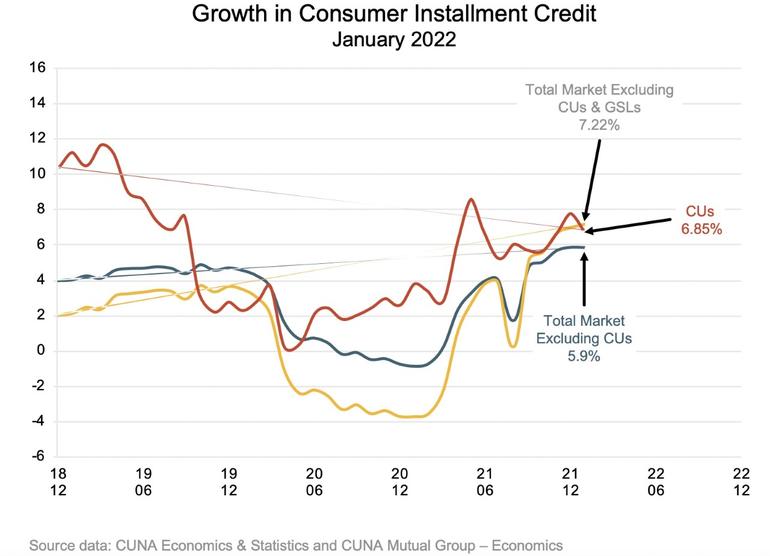
“During the last 12 months, credit union consumer installment credit grew 6.85%, greater than the total market excluding credit unions at 5.9%, but below the total market excluding credit unions and government student loans at 7.22%. Government student loans rose only 3.7% over the last year, the slowest pace since August 2007, CUNA Mutual added.
Vehicle Loans
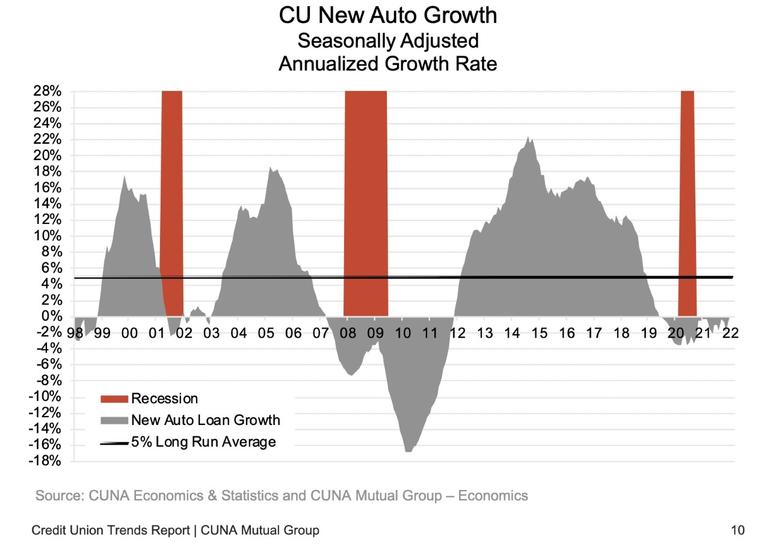
Credit union new-auto loan balances rose 0.3% in January, higher than the 0.2% rise set in January 2021, but fell 1% during the last 12 months, the Trends Report stated.
On a seasonally-adjusted annualized basis, new-auto loan balances fell at a 0.1% pace in January, the 31st month of continuous declines.
“The first quarter of the year is typically the weakest quarter for credit union new-auto loan growth due to various seasonal factors,” the analysis stated.
Vehicle sales were 15.03 million in January, which at a seasonally-adjusted annualized sales rate is 10.4% below the 16.8 million pace set one year earlier.
“When the U.S. new-vehicle market is in balance we should be selling around 17 million vehicles each year, the Trends Report forecast. “The market remains severely constrained by limited production and a lack of inventory. We expect production to increase in the first half of the year and then normalize in the second half. That means sales should approach the 17 million seasonally-adjusted annualized sales rate in the last two quarters. This will buoy credit unions’ new-auto loan growth in the next few months, bringing the seasonally-adjusted annualized growth rate back into positive territory.”
Real Estate
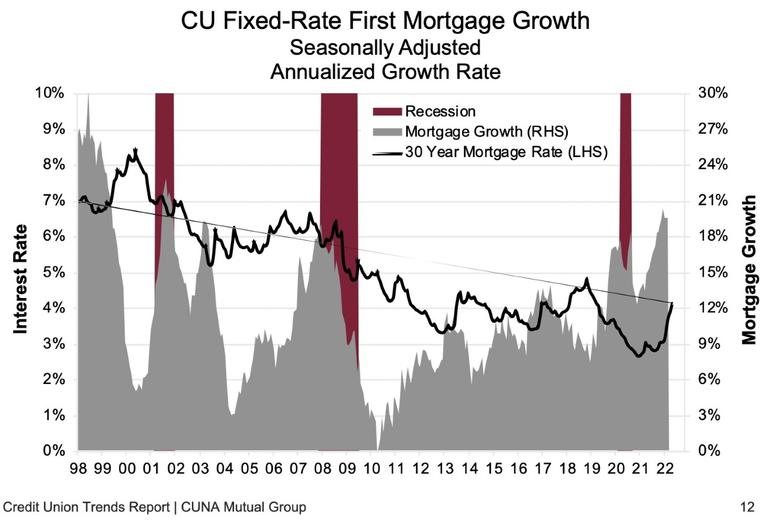
CUNA Mutual’s analysis noted credit union fixed-rate first mortgage loan balances rose 1.0% in January, above the 0.5% increase reported in January 2021, due to credit unions selling off fewer loans to the secondary market.
Credit union fixed-rate first mortgage loan balances rose 19.6% at a seasonally-adjusted annual rate in January.
“The contract interest rate on a 30-year, fixed-rate conventional home mortgage rose to 3.45% in January, up from 3.10% in December and above the 2.74% reported in January 2021,” according to the Trends Report. “The mortgage credit-risk premium (the difference between the 30-year mortgage interest rate and the 10-year Treasury interest rate) averaged 1.51% during 2021, below 2.22% in 2020 and 1.79% in 2019. Expect mortgage interest rates to average 4.25-4.50% for the remainder of the year, effectively ending the mortgage refinance boom.”
Savings & Assets
Credit union savings balances fell 0.1% in January due to members paying down credit card balances (which declined 0.6%) that were built up during the fourth quarter of 2021, according to the Trends Report.
The Report further noted the savings growth rate was less than the 0.7% increase reported in January 2021 when $600 stimulus checks were being deposited in millions of credit union members’ checking accounts.
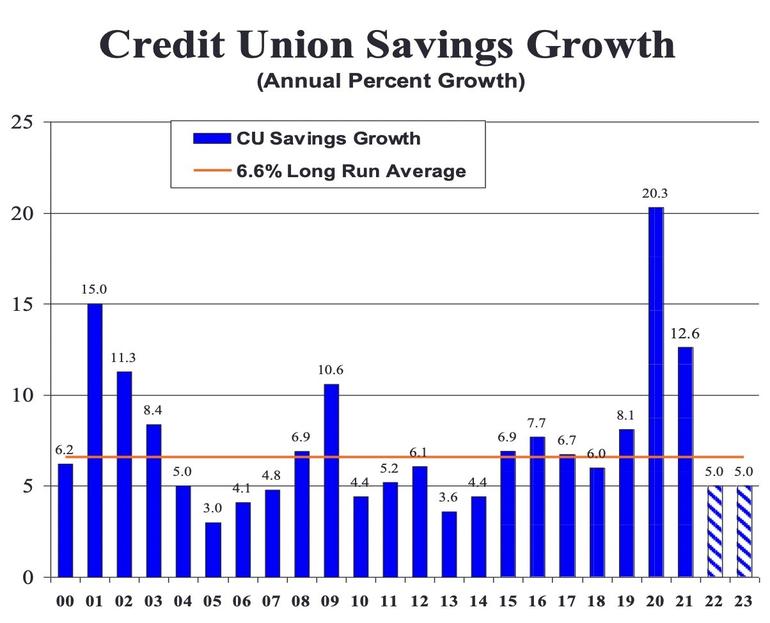
“January savings balances have historically declined 0.2% due to recurring seasonal factors,” the analysis states. “We expect weak savings growth at credit unions in 2022 as members begin to spend down some of their accrued savings balances from the last two years. Currently, the average credit union member has a total of $13,800 on deposit at their credit union, up 25% from the $11,000 they had in January 2020. So, with savings balances rising 20.3% in 2020 and 12.6% in 2021, we expect credit union deposits to increase only 5% this year, below the long-run average of 6.6%.”
Capital & Other Key Measures
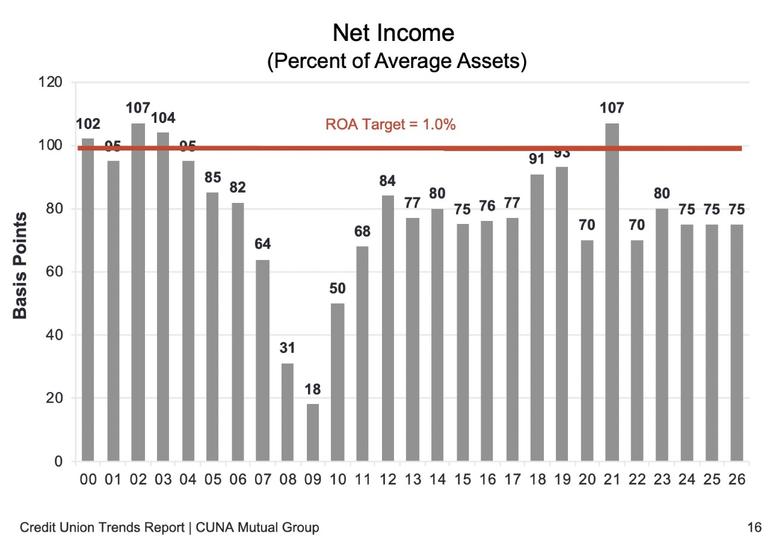
The credit union industry’s net income to average asset ratio, return on assets, rose to 1.07% in 2021, up from 0.70% in 2020.
“A 24-basis point decrease in net interest margins, combined with a three-basis point decrease in fee and other income was more than offset by a 44-basis point decrease in provision for loan losses and a 19-basis point decrease in operating expense ratios,” stated the Report. “Expect return on asset ratios to fall back to 0.7% in 2022 as provision for loan loss ratios return to something closer to normal and yield on assets ratios reach below 3%, the lowest in credit union history.”
The Report further found credit union average return on equity (ROE) ratios rose to 10.4% in 2021, from 6.1% in 2020, due to the rise in return on asset ratios and the jump in the leverage ratio (asset-to-equity ratio).
“The ROE ratio is one of the more important credit union metrics, because it determines the long-run sustainable asset growth rate,” said CUNA Mutual. “For example, credit unions reported ROE ratios of 10.4% in 2021 which is the growth rate of their capital. This indicates their assets can grow 10.4% while maintaining a constant capital-to-asset ratio. But since credit union assets grew 12% in 2021 and capital only grew 8%, credit union capital-to-asset ratios fell from 10.3% to 9.9%.”
Credit Unions & Members
Credit unions added 96,000 memberships in January, significantly below the 514,000-gain recorded in January 2021.
“One factor driving membership growth is job creation. In January, the economy added 481,000 jobs, according to the Bureau of Labor Statistics, less than the 520,000 jobs added in January 2021,” CUNA Mutual said. “Expect monthly job growth to remain strong over the next few months as the economy reopens.”
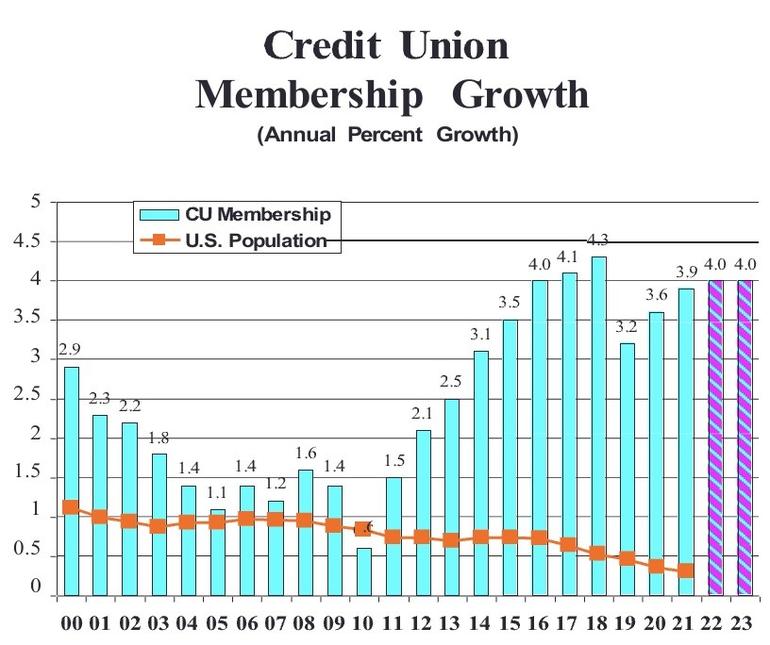
The data show total credit union memberships reached 131.8 million in January 2022, which, in percentage terms, rose 0.07% in January and 3.6% during the last 12 months. With the economy expected to gain more than four-million jobs in 2022 due to the COVID-19 crisis coming to an end, credit unions should expect membership growth to come in around 4%, which is above the 0.3% U.S. population growth.