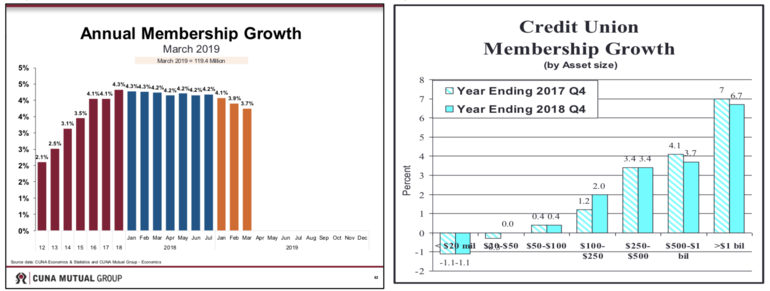
MADISON, Wis.– Credit union membership growth slowed significantly in the first quarter of 2019, with just 800,000 new members, down from the 1.4 million who joined CUs during the first quarter of 2018, according to CUNA Mutual’s latest Trends Report.
Meanwhile, CU loan balances rose 0.3% in March, less than half the 0.8% pace reported in March 2018, while the CUNA Mutual forecast projects surplus funds will fall to 24% of assets by this time next year, the tightest liquidity position since the second quarter of 2000.
Here’s how credit unions performed by category during March, according to the CUNA Mutual Trends Report.
Total Credit Union Lending
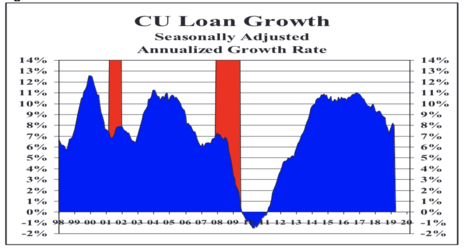
Credit union loan balances rose 0.3% in March, less than half the 0.8% pace reported in March 2018, and 8.1% during the last 12 months, CUNA Mutual reported. It noted March is historically the third weakest loan growth month of the year, with seasonal factors typically shaving 0.24 percentage points from the underlying trend growth rate. The lending season is now in full swing, with stronger loan growth expected from April through September, CUNA Mutual said.
Credit union seasonally-adjusted annualized loan growth fell to 8% in March, down from a 9.3% pace set one year earlier (Figure 1). CUNA Mutual’s economists are projecting loan growth to slow to 7.8% in 2019, from the 9% pace set in 2018, and to slow to 7% in 2020, below the 7.2% long run credit union average.
Credit Union Consumer Installment Credit (CUCIC)
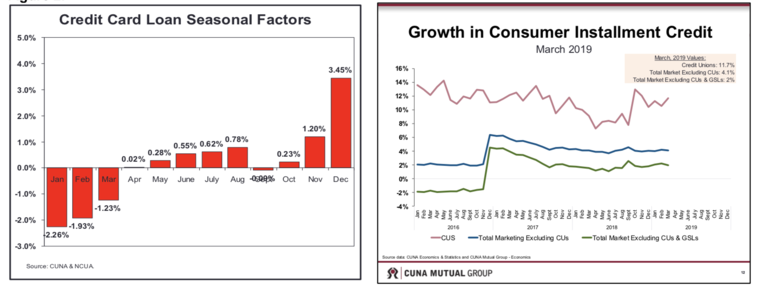
Credit union consumer installment credit balances (auto, credit card and other unsecured loans) rose 0.1% in March, better than the -0.9% pace set in March 2018, due to strong used-auto lending and banks tightening their credit standards, according to the Trends Report.
Credit card balances rose a small 0.1% in March due to seasonal factors that typically shave 1.23 percentage points from the underlying trend growth as members use tax refunds and bonuses to pay down outstanding credit card balances. Credit union consumer installment credit grew 11.7% during the last year, which is better than the 4.1% for the total market excluding credit unions, CUNA Mutual said.
Vehicle Loans
Credit union used-auto loan balances grew 0.5% in March, below the 1.2% reported in March 2018.
“The used-auto buying and lending season begins in March and runs through October, and March’s used-auto loan seasonal factors usually add 0.19 percentage points to the underlying trend growth rate,” CUNA Mutual said. “On a seasonally-adjusted annualized growth rate basis, used-auto loan balances rose 8% in March. Improving consumer fundamentals are driving strong credit union auto loan growth: an improving labor market, low oil prices, faster wage growth, low interest rates, an expanding driving-age population, improving construction activity and better household balance sheets.”
Tapping the brakes on auto sales, according to the Trends Report, are higher interest rates, higher new vehicle prices and less generous sales incentives. Factors pressing the gas on vehicle sales include increasing household formations, the suburbanization of Millennials, low debt burdens, strong job growth and growing hourly earnings. “The aging of the Baby Boomer generation will also create a vehicle sales headwind over the next 10 years as older drivers reduce their vehicle needs,” CUNA Mutual said.

Real Estate Secured Lending – First Mortgages and Other Real Estate
Credit union fixed-rate first mortgage loan balances rose 0.6% in March, slower than the 2% increase reported in March 2018, according to the Trends Report.
“This slower March mortgage volume was due to a 5.4% drop in existing home sales over the last year,” CUNA Mutual reported. “During the last 12 months, fixed-rate first mortgage balances rose 7.5%, faster than the 6.8% increase in adjustable-rate mortgage balances. Improving household balance sheets, rising consumer incomes and a rising capacity to service debt has decreased mortgage credit risk and therefore encouraged credit union lenders to loosen lending standards.”
The report adds, “Long-term interest rates have been falling for the past six months, symptomatic of a movement toward safe financial assets and away from risky investment credit, including for real estate development. A continued downward trend in long-term Treasury rates may herald the onset of reduced investment and recession.”
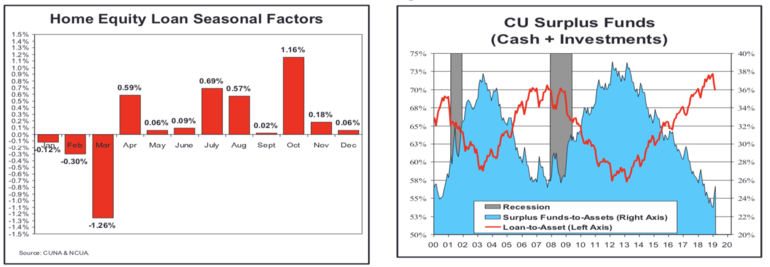
Home equity loan balances fell 0.2% in March as members used bonuses and tax refunds to pay down some of their lines of credit. However, credit union home equity loan balances grew at a 7.5% seasonally-adjusted annualized growth rate in March, due to rising home prices, the strong job market, rising consumer confidence and consumers releasing pent-up demand for durable goods,CUNA Mutual said.
Surplus Funds (Cash + Investments)
Credit union surplus funds as a percent of assets fell to 25.3% in March from 27.2% last year, as credit unions partly funded new loan growth with cash and investments. During March, a 1.8% surge in savings balances funded a 0.3% increase in loans, a 5.5% increase in surplus funds and an 11% reduction in external borrowings, CUNA Mutual reported.
“Surplus funds are expected to fall to 24% of assets by this time next year, the tightest liquidity position since the second quarter of 2000, as loan balances grow 7.8% and savings balances rise only 6%,” the Trends Report states.
Savings and Assets
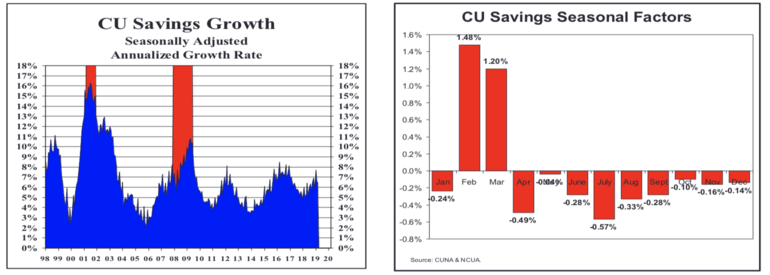
Credit union savings balances surged 1.8% in March, but that was below the 2.3% gain reported in March 2018, due to the seasonal factors of tax refunds and bonuses being deposited in credit union members’ share draft and regular share accounts, which increased 2.3% and 2.1%, respectively, CUNA Mutual said.
The savings-per-member growth rate rose to 1.9% during the last year, up from 0.8% during 2018. “We forecast credit union savings balances to grow 6% in 2019,” CUNA Mutual said.
Capital and Other Key Measures
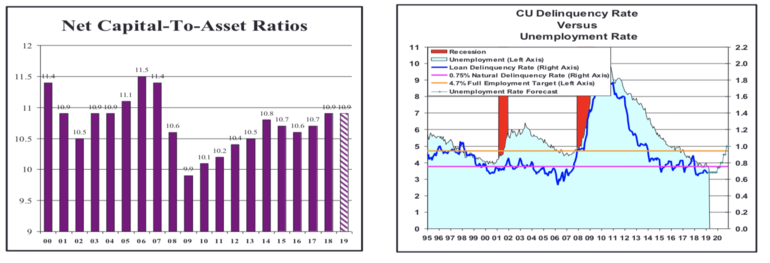
According to the Trends Report, the credit union average capital-to asset ratio rose to 10.9% in March 2019, up from 10.5% in March of 2018. In the year ending in March, credit union capital rose 10.1% while assets grew 6.4%, which increased the capital ratio 4%, or the approximate difference between the numerator and denominator growth rates.
The credit union loan delinquency rate (loans two or more months delinquent as a percent of total loans outstanding) fell to 0.67% in March, down from 0.71% in December 2018, but up from 0.65% in March 2018, the Trends Report stated.
Credit Unions and Members
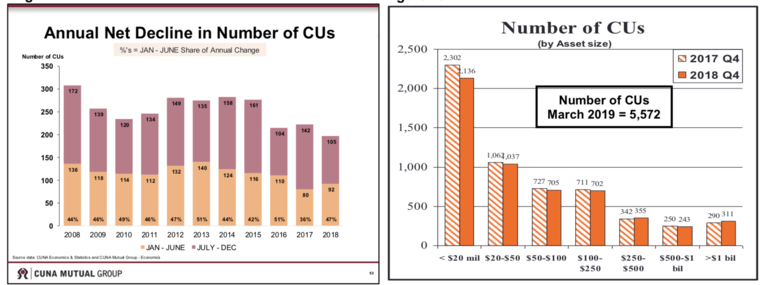
As of March 2019, CUNA estimates 5,572 credit unions were in operation, 11 fewer than February, according to the Trends Report.
“During the last 12 months, the number of credit unions fell by 187, slightly below the 214 annual decline set one year ago. During the first quarter of 2019, the number of credit unions fell by 31, the slowest pace in the last 30 years,” the Trends Report observed. “Greater regulatory compliance burdens from the Consumer Financial Protection Bureau (CFPB) will put additional downward pressure on credit union non-interest fee income and will therefore maintain the number of mergers over the next few years.”
CUNA Mutual noted at the end of 2018, 311 credit unions reported assets greater than $1 billion – 21 more than the year before, with those large credit unions control more than 65% of all credit union loans, but making up less than 5.6% of all credit unions. The number of credit unions with assets less than $20 million fell by 166 to reach 2,136 as these credit unions either grew into the larger asset class or merged with a larger credit union.
The Trends Report found credit union membership growth slowed significantly in the first quarter of 2019, adding 0.8 million new memberships, significantly slower than the 1.4 million added in the first quarter of 2018. On a growth rate basis, memberships are up 3.7% in the year ending in March 2019, below the 4.2% pace set in the year ending in March 2018, the Trends Report said.
“Members are also joining credit unions to get auto loans and other forms of credit,” CUNA Mutual said. “Credit unions should expect membership growth to exceed 3.5% in 2019 and 3% in 2020. Most of the membership growth is taking place at credit unions with assets greater than $500 million due to organic growth and mergers. Credit unions with less than $50 million in assets lost memberships during the last two years.”
The full CUNA Mutuall Trends Report can be found in CUToday.info's the Vault here.