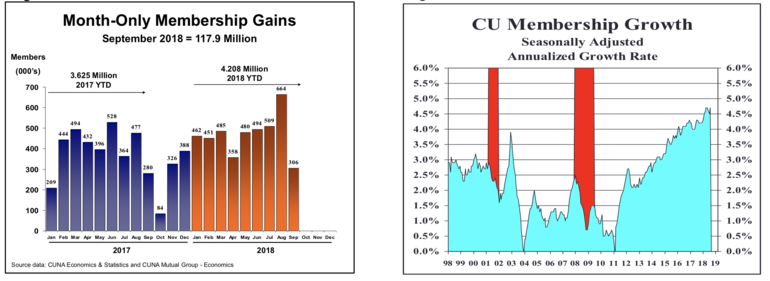
MADISON, Wis.–Credit union membership during September grew at the fastest pace in 25 years, and through the first nine months of 2018 grew at the fastest pace in credit union history, according to new data.
The data, released as part of CUNA Mutual’s monthly Trends Report, show 4.208 million people joined a U.S. credit union through the first three quarters of the year.

Similarly, the credit union community’s average loan-to-share ratio hit 85.5%, its highest level since May of 1980. Credit union loan balances increased $28.9 billion in the third quarter, above the $24 billion in the third quarter of 2017.
But that good news comes with a caveat, with CUNA Mutual’s economists noting “loan-to-savings ratios peak right before recessions and may contribute to the economic slowdown that follows.”
According to the numbers, credit union liquidity fell to the lowest level since July 1980 in September as loan growth outpaced asset growth, the Trends Report shows.
“As we move to the beginning of 2019, the economy is expected to report above- trend growth of 2.3% next year, but this will be slower than the 3% pace reported in 2018,” forecast CUNA Mutual’s economists. “This will push the economy further beyond what economists consider to be its ‘potential’ or normal rate of production, which should drive core inflation above the Federal Reserve’s target of 2% and in turn push interest rates higher.”
Here’s a look at how credit unions performed by category during September, as well as year-to-date and year over year, according to CUNA Mutual’s analysis, which is based on CUNA data.
Total Credit Union Lending
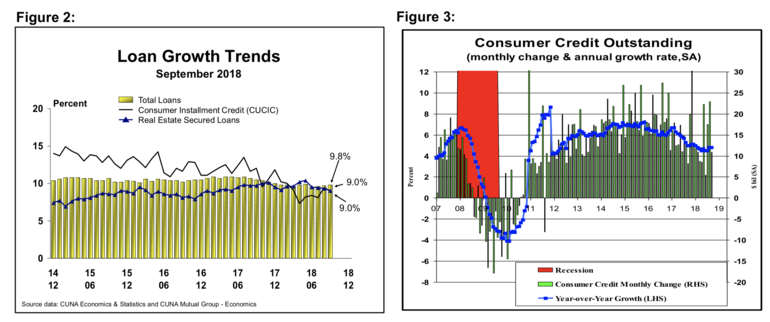
Credit union loan balances rose 0.7% in September, faster than the 0.6% pace reported in September 2017, CUNA Mutual said. Driving overall loan growth was strong growth in unsecured personal loans (1.2%), fixed-rate first mortgages (0.8%) and new-auto loans (0.8%).
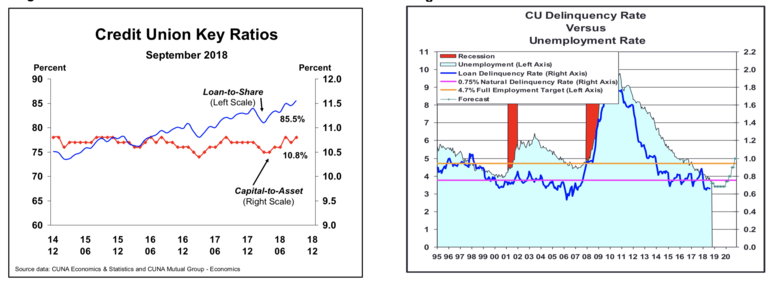
The credit union average loan-to-savings ratio reached 85.5% in September, up from 81.8% in September 2017, the Trends Report added. This is the highest ratio since May 1980.
“Loan-to-savings ratios peak right before recessions and may contribute to the economic slowdown that follows due to tight liquidity from credit unions reducing their pace of lending and high levels of members’ debt reducing their demand for loans,” CUNA Mutual said. “Based on current trends, credit union lending growth could slow slightly to 8% in 2019 while savings balances increase only 7%. This will raise the average loan-to-savings ratio to 86.3% at year’s end 2019.”
CreditUnion Consumer Installment Credit (CUCIC)
Credit union consumer installment credit loan balances (auto, credit card and other unsecured loans) rose 0.7% in September, slower than the 1.1% pace set in September 2017, according to CUNA Mutual. During the last 12 months, credit union consumer installment credit grew 9%.
Vehicle Loans
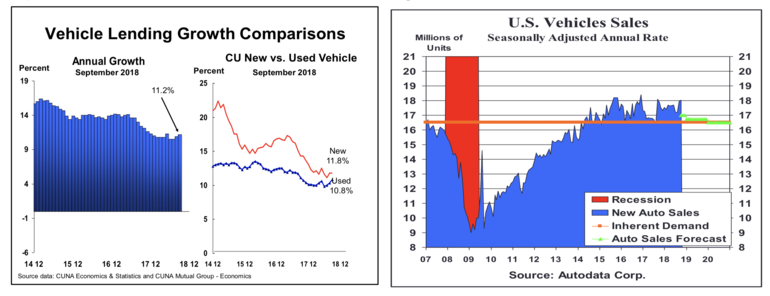
Credit union new-auto loan balances rose 0.8% in September, similar to the 0.7% pace set in September 2017. New-auto loan balances rose 11.8% during the last 12 months faster than the 10.8% increase in used-auto loans, the CUNA Mutual analysis states.
“Total auto loan balances rose 11.2% since September 2017, which is faster than overall loan growth and in turn lead to auto loans making up 35% of the credit union loan portfolio, the highest since March 2007,” according to the Trends Report. “Falling stock prices in November could hinder auto sales going forward since stock sales are often used for vehicle purchases. Moreover, the plateauing construction sector and rising gas prices should weaken light trucks sales for the next year.”
Real Estate Secured Lending – First Mortgages and Other Real Estate
According to the Trends Report data, credit union fixed-rate first mortgage loan balances grew only 0.8% in September, below the 1.4% pace set in September 2017 due to existing-home sales falling 3.4% from August. Adjustable-rate mortgage loan balances rose only 0.4% in September, below the 0.8% pace recorded in September 2017, CUNA Mutual reported.
Meanwhile, home equity lending balances rose 0.4% in September, which is better than the 0.7% drop reported in September 2017. Seasonal factors typically shave 0.21 percentage points from the underlying monthly trend growth rate in September, so the September 0.4% increase in balances indicate credit union members are willing and able to tap into their home equity to satisfy some of their borrowing and spending needs, CUNA Mutual said.
The Trends Report analysis found the contract interest rate on a 30-year, fixed-rate conventional home mortgage rose to 4.63% in September from 4.55% in August, but above the 3.81% reported in September 2017. CUNA Mutual is forecasting the 30-year mortgage interest rate to increase 60 to 80 basis points during the next year, reaching 5.5% by the end of 2019.
Surplus Funds (Cash + Investments)
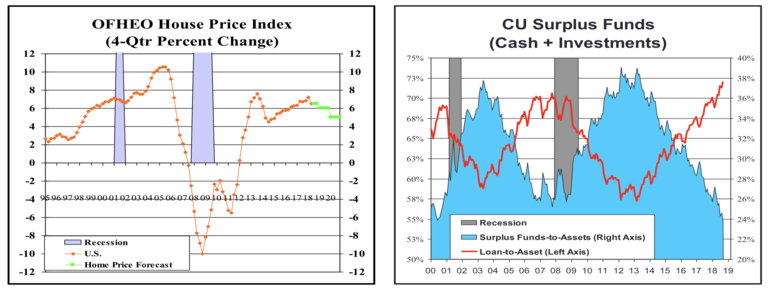
Credit union liquidity fell to the lowest level since July 1980 in September as loan growth outpaced asset growth, CUNA Mutual reported. Credit union surplus funds as a percent of assets declined to 23.7% in September, down from 27% one year earlier due to asset growth (5.2%) outpacing surplus funds growth (-7.8%). Credit union borrowings rose 3.4% over the last year at $1.8 billion due to loan demand outpacing saving supply. Credit union borrowings as a percent of assets stands at 3.7%, below the 4.9% set back in the first quarter of 2009. Loans rose to 72.1% of assets in September, the highest level since July 1980, according to the Trends Report.
CUNA Mutual reported that currently 46.7% of credit union surplus funds have a maturity of less than one year, down slightly from 48% in September 2017. The large holding of shorter maturity investments could be due to credit unions expecting the Federal Reserve to continue raising interest rates in December 2018 and on through 2019, CUNA Mutual said.
Savings & Assets
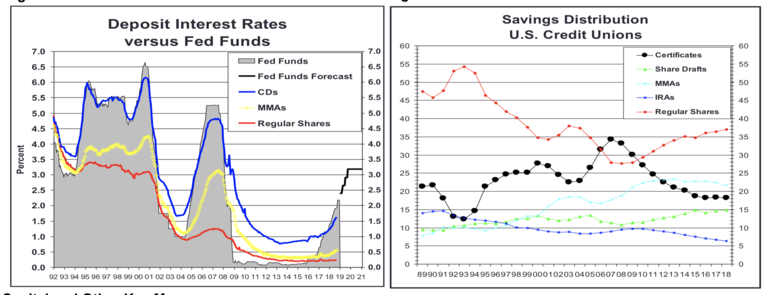
Credit union savings balances fell 0.4% in September, less than the 1% gain reported in September 2017 due to August ending on a payday Friday; therefore, by comparison September balances dropped as members paid their monthly expenses, according to CUNA Mutual.
“September, however, is typically a weak month for savings growth due to seasonal factors such as back-to- school shopping and college tuition payments,” the Trends Report stated. “Savings balances rose a modest 5.1% during the last 12 months due to rising gas prices, a surging stock market and members’ desire to spend rather than save.”
The Trends Report is forecasting credit union cost of funds is expected to rise 10 basis points in 2019 as the Federal Reserve raises the Fed Funds interest rate 0.75%.
Capital and Other Key Measures
The credit union system’s capital-to-asset ratio rose to 10.8% in September, up from 10.7% in August due to a drop in deposits and assets, CUNA Mutual said.The capital ratio is up 0.1% from what was reported in September 2017 due to capital growth of 6.7% outpacing asset growth of 5.2%. The credit union loan-to-share ratio rose over the last year to 85.5% from 81.8% due to loan growth outpacing savings deposits.
Meanwhile, the Trends Report found on-time payment performance of loans is improving in tandem with the labor market. The loan delinquency rate (loans two or more months delinquent as a percent of total loans outstanding) fell to 0.65% in September, down from 0.78% in September 2017 as the unemployment rate falls below what economists now believe is the “full employment rate” of 4.7%, CUNA Mutual said.
Credit Unions and Members
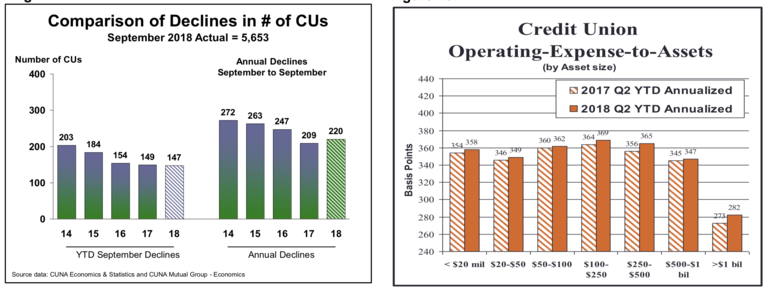
As of September 2018, CUNA estimates 5,653 credit unions were in operation, down 220 from September 2017, according to the Trends Report. Year-to-date the number of credit unions fell by 147, slightly less than the 149 reported in the first nine months of 2016. NCUA’s Insurance Report of Activity showed 52 mergers were approved in the third quarter, with an average asset size of $20.5 million. The average asset size of the continuing credit union was $950 million. Thirty-three of the mergers were due to credit unions wanting expanded services, 13 were due to poor financial condition, two were due to inability to obtain officials, two were due to mergers with a non-federally insured credit union, and one was due to poor management.
The Trends Report noted the pace of consolidation continues in both the credit union and banking industries. The number of FDIC-insured banks fell by 261 during the last 12 months ending in September 2018. This leaves a grand total of 5,477 banks in operation, 176 fewer than the total number of credit unions.
Membership Growth
Credit unions added more than 4.208 million memberships in the first nine months of 2018, the fastest pace in credit union history, and significantly above the 3.625 million added in the similar time period of 2017. Surging demand for credit was the major driver for the upwelling in memberships.
Credit union memberships grew at a 4.7% seasonally-adjusted annualized growth rate in September – the fastest pace in 25 years.
“We expect membership growth to remain strong in 2019, but slow to a more sustainable pace of 3.5%,” the Trends Report stated.