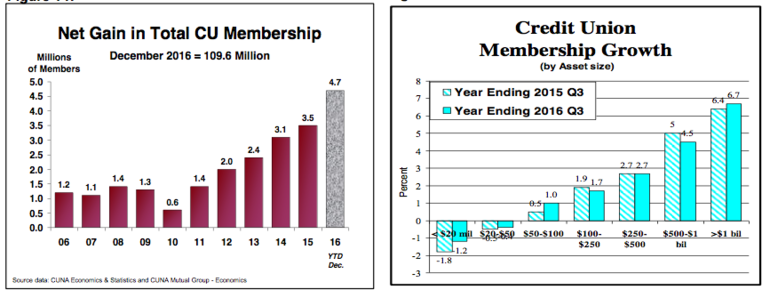
MADISON, Wis.–Credit unions added 485,000 new members in December, bringing the 2016 membership growth to 4.7 million new members and overall credit union membership to nearly 110 million, according to new data released as part of CUNA Mutual’s Trends Report.
That marks the biggest annual increase in credit union history and is four times the pace set a decade earlier, according to CUNA Mutual. On the flip side: the Trends Report is based on findings from credit unions that now number fewer than 6,000.
Below is a look at how credit unions performed overall as of December, 2016, according to the Trends Report.
Total Credit Union Lending
Credit union loan balances rose 1.0% in December, slightly better than the 0.9% pace reported in December 2015, CUNA Mutual said. Driving overall loan growth was strong growth in fixed-rate mortgages (3.6%), credit card loans (2.2%) and new-auto loans (1.9%). December credit card seasonal factors – holiday shopping – typically add 3.1 percentage points to the underlying credit card trend loan growth, according to the analysis.
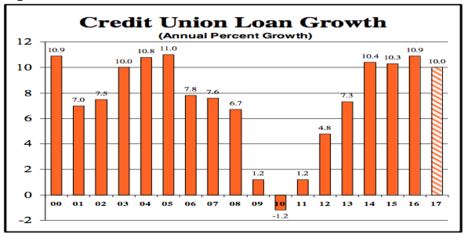
Credit union loan balances rose 10.9% in 2016, up from the 10.3% reported in 2015 due to a surge in new auto, credit card and fixed-rate first mortgage growth rates, CUNA Mutual said. The company is forecasting loan growth will decelerate to 10% in 2017 but remain well above the past 25-year average of 7%.
Credit Union Consumer Installment Credit (CUCIC)
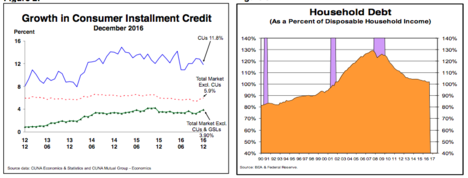
Credit union consumer installment credit balances (auto, credit card and other unsecured loans) rose 0.4% in December, less than the 1.4% pace set in December 2015, CUNA Mutual said. During 2016 credit union consumer installment credit grew 11.8%, faster than the total market excluding credit unions, which grew only 5.9%. If guaranteed student loans are removed, then consumer credit increased only 3.90% for non-credit-union lenders, CUNA Mutual said.
Vehicle Loans
Credit union new auto loan balances rose 1.9% in December, faster than the 1.5% pace set in December 2015, and rose 17.4% for the full year. On a seasonally-adjusted annualized basis, new auto loan balances rose 18.5% in December (Figure 4), and the fastest pace since January 2015, according to the Trends Report.
Real Estate Secured Lending – 1st Mortgages and Other Real Estate
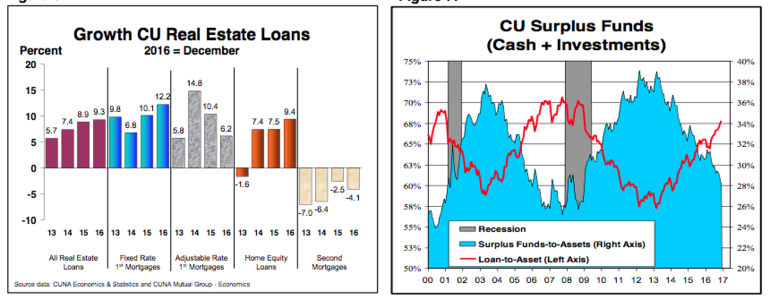
Credit union real estate loan balances grew 9.3% in 2016, the fastest pace since 2008. Second mortgages were the only real estate loan category reporting negative growth in 2016, due to members rolling those balances into refinanced first mortgages, CUNA Mutual said. By year-end, fixed-rate first mortgages made up 29.0% of all loans, up from 22.6% in December of 2007, the beginning of the Great Recession.
“Credit unions are making headway in serving their members’ mortgage needs. Currently 2.4% of members have a first mortgage loan at their credit union, up from 1.9% in 2009,” CUNA Mutual said. “First mortgage credit quality improved significantly in 2016, with delinquency rates falling to 0.63%, down from 0.78% in 2015 and 0.96% in 2014.”
Surplus Funds (Cash + Investments)
Credit union liquidity fell to the lowest level since January 2009 in December. Credit union surplus funds as a percent of assets declined to 28.1% in December, down from 30.5% one year earlier, due to loan growth outpacing savings growth, CUNA Mutual said. The report noted credit unions are increasing the liquidity of their surplus funds. In December, 48.3% of surplus funds had a maturity of less than one year, up from 44.3% one year earlier.
“This portfolio change is an attempt to reduce the interest rate risk exposure of falling investment prices as market interest rates increase.”
Loans rose to 67.8% of assets in December, up from 65.6% one year earlier, which was the highest level since January 2009. With loan and asset balances expected to increase 10% and 6.5%, respectively, in 2017, the credit union aggregate loan-to-asset ratio will reach 70% by the end of this year, CUNA Mutual is projecting.
Savings and Assets
Credit union savings balances rose 1.3% in December, above the 1.2% reported in December 2015, as falling expenditures on gasoline left more of members’ paychecks in their checking accounts at the end of the month. Savings balances typically decline 0.2% in December due to recurring seasonal factors such as holiday spending. Savings balances rose 7.7% for all of 2016, the fastest pace since the Great Recession of 2008-2009, said CUNA Mutual.
Capital
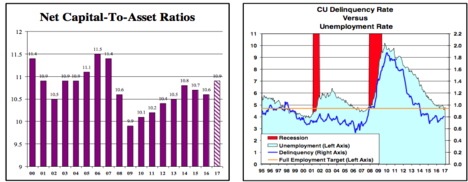
The credit union industry’s capital-to-asset ratio ended 2016 at 10.6%, down slightly from the 10.7% reported at year-end 2015, as asset growth outpaced capital growth. CUNA Mutual is forecasting the capital ratio is expected to rise to 10.9% in 2017.
Credit Unions and Members
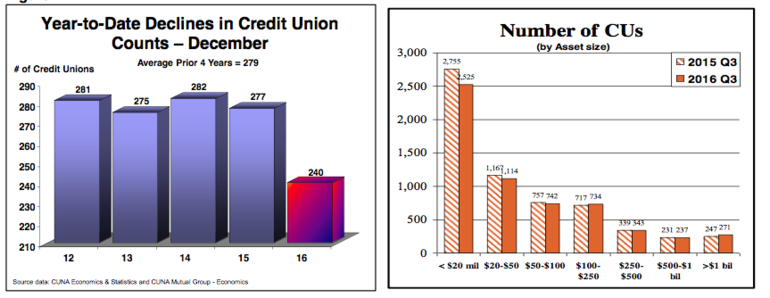
As of December 2016, CUNA estimates 5,996 credit unions are in operation, down 240 from December 2015, the Trends Report stated. The pace of consolidation in the credit union system decelerated in 2016 as the economic backdrop improved for most credit unions, it noted.
Membership
Credit unions added 485,000 memberships in December, bringing the 2016 membership growth to 4.7 million new members, the biggest annual increase in credit union history and four times the pace set a decade earlier. For 2017, CUNA Mutual is projecting another 2.1 million jobs to be created and credit union membership growth to exceed 3.5%.
“Total credit union memberships reached 109.6 million at year-end 2016, which is 33.7% of the total U.S. population of 325 million,” the Trends Report stated. “This is up from 32.5% of the population at year-end 2015. Large credit unions reported the fastest annual growth while credit unions with less than $50 million in assets reported falling memberships.”