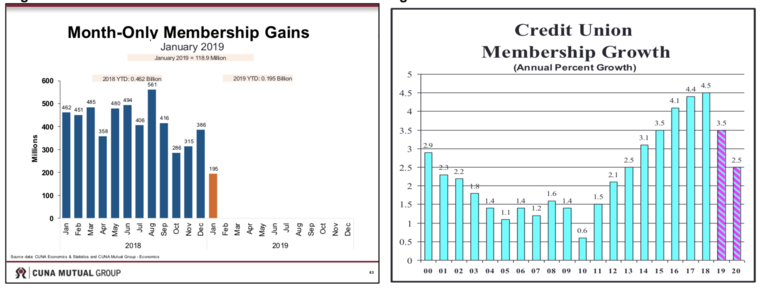
MADISON, Wis.–Credit unions began 2019 with far slower membership growth than experienced during the first month of 2018, with loan balances just slightly behind the pace set a year earlier, as well, according to new data.
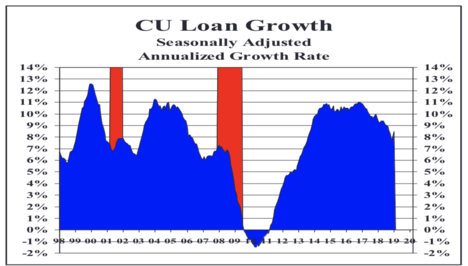
CUNA Mutual’s March Trends Report, which highlights data from January of 2019, is projectingloan growth to slow to 8% in 2019, down from 9.1% in 2018, but as the result of slower savings balance growth, it is projecting the CU community’s average loan-to-savings ratio will climb to more than 86.6% this year.
In addition, the CUNA Mutual report found credit union surplus funds as a percent of assets fell to 23.3% in January, down from 25.7% in January 2018, creating the tightest credit union liquidity position since 1980.
Here’s a look at how credit unions performed by category during January:
Total Credit Union Lending
Credit union loan balances rose 0.3% in January, lower than the 0.4% pace reported in January 2018, and 9% during the last 12 months, according to the Trends Report. Credit union seasonally-adjusted annualized loan growth fell to 8.5% in January 2018, down from the 9.4% reported one year earlier.
“This latest credit cycle boom has moved beyond its apex, which was reached in the fourth quarter of 2016 when lending growth reached 11%,” said CUNA Mutual’s analysis. “Why is this credit boom expected to wane over the next few years? First, higher interest rates are having the intended effect of lowering the demand for credit. Second, strong consumer spending over the last few years has decreased their pent-up demand for cars, appliances and furniture. Expect loan growth to slow to 8% in 2019, down from 9.1% in 2018, which is only slightly above the 7.9% long-run average. With savings balances expected to rise only 7%, the loan-to-savings ratio will climb to more than 86.6%.”
Credit Union Consumer Installment Credit (CUCIC)
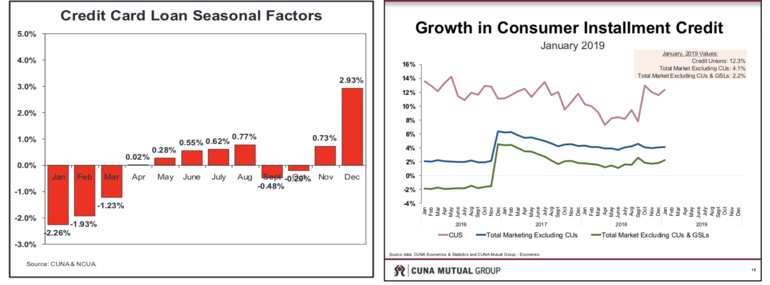
Credit union consumer installment credit balances (auto, credit card and other unsecured loans) rose 0.4% in January, better than the 0.2% decline set in January 2018, due to strong auto lending offsetting falling credit card balances, the Trends Report shows, adding January’s credit card loan seasonal factors are typically the most negative of the year at 2.26%.Credit union consumer installment credit grew 12.3% during the last year, bucking the downward trend of the total market excluding credit unions, which grew only 4.1%, CUNA Mutual added.
Vehicle Loans
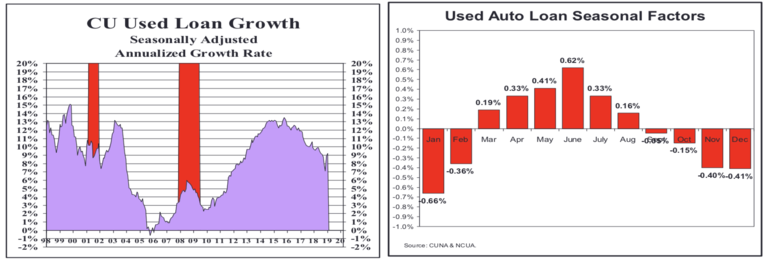
The Trends Report data show credit union used auto loan balances rose 0.6% in January, slower than the 0.9% pace set in January 2018, and rose 9.2% during the last 12 months. “On a seasonally-adjusted annualized basis, used auto loan balances rose at a modest 9.2% in January, a deceleration from the last few years,” CUNA Mutual stated. “Despite high used vehicle prices, strong consumer fundamentals are driving used auto loan growth: an improving labor market, low oil prices, faster wage growth, low interest rates, expanding driving-age population, improving construction activity and better household balance sheets.”
CUNA Mutual added that January’s used auto loan growth is “even more remarkable given that January’s used auto loan seasonal factors are typically the most negative of the year at -0.66%.”
Real Estate Secured Lending – First Mortgages and Other Real Estate
Credit union first mortgage originations slowed to $140.5 billion in 2018, a 0.9% decrease under the $141.8 billion in originations in 2017, according to the January data. Credit unions proceeded to sell off 33.1% of those originations into the secondary market, a lower percentage than the 35.2% reported in 2017,” CUNA Mutual said.
“The stage is set for another year of headwinds slowing credit union first mortgage growth as rising interest rates and low housing inventory put downward pressure on home sales,” according to the Trends Report. “Expect home prices to rise between 3% and 4% in 2019 as the economy adds another 2.2 million jobs, potential homebuyers jump off the fence and purchase as interest rates rise and young adults release some of their pent-up demand for housing.”

Surplus Funds (Cash + Investments)
Credit union surplus funds fell $0.7 billion, or -0.2% in January due to loan originations exceeding deposit accumulation, CUNA Mutual reported. The $2.4 billion surge in borrowings helped to fund modest loan demand ($3.6 billion). Capital grew by $1.6 billion in January and $14.6 over the last year. Credit union capital grew 9.8% over the last year, the fastest pace since the summer of 2014, which was “due in part to NCUSIF’s equity distribution that contributed about five basis points to credit union return-on-asset ratios.
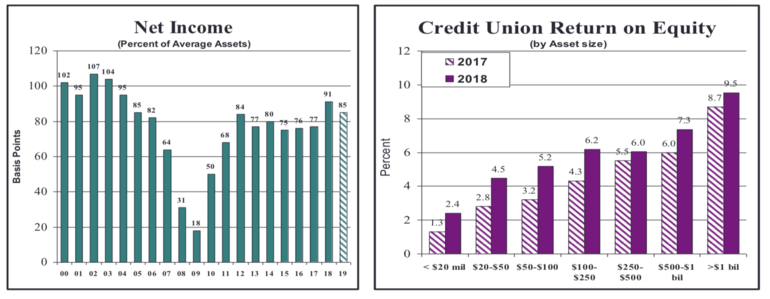
“The growth rate of capital is also known as return-on-equity, a key credit union performance ratio,” the Trends report states. “Over the last 30 years, credit union return-on-equity ratios averaged 8.5%.”
According to the analysis, credit union surplus funds as a percent of assets fell to 23.3% in January, down from 25.7% in January 2018. “This is the tightest credit union liquidity position since 1980. The obverse of the falling surplus funds ratio is the rising loan-to-asset ratio, which reached 72.3% in January, up from 70.1% last January as loan growth outpaced asset growth,” the Trends Report stated.
In addition, borrowings as a percent of assets reached 4.1% in January, up from 3.9% in December 2018. This is close to the record- high borrowing ratio set in January 2009 during the height of the financial crisis, when credit union borrowings made up 4.9% of their balance sheets. “With loan growth expected to outpace savings growth in 2019 and liquidity positions already tight, expect credit unions to depend more on borrowings to meet rising loan demand,” CUNA Mutual said.
Savings and Assets
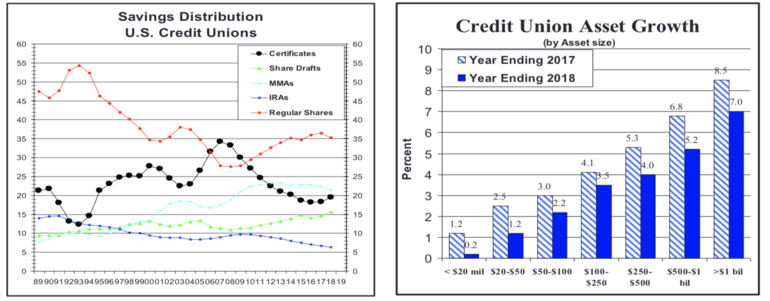
Credit union savings balances fell 0.1% in January, less than the 0.9% decline reported in January 2018, due to a surge in post-holiday consumer spending. January savings balances have historically declined 0.2% due to recurring seasonal factors, CUNA Mutual stated.
As continues to be the case, the Trends Report found credit union asset growth rates vary significantly by asset size. Billion-dollar credit unions reported asset growth of 7% in 2018, around 35 times faster than the smallest credit unions’ growth rate of 0.2%.
Capital and Other Key Measures
The credit union industry’s net income to average asset ratio, return on assets, rose to 0.91% in 2018, up from 0.77% in 2017, according to the Trends Report. A 14 basis point increase in net interest margins, combined with a four basis point increase in fees and other income was more than enough to offset a 6 basis point increase in operating expense ratios, CUNA Mutual said. It added credit unions should expect return on asset ratios to fall to 0.85% in 2019 as CUs are pressured to increase deposit rates faster than loan yields in order to compete for deposits, increasing their cost of funds.
Return on equity (ROE) ratios rose for most credit unions in 2018 due to higher return-on-asset ratios in 2018 versus 2017, CUNA Mutual stated, adding, “The ROE ratio is one of the more important credit union metrics because it determines the long-run sustainable asset growth rate. For example, billion-dollar credit unions reported ROE ratios of 9.5%. This indicates their assets can grow 9.5% while maintaining a constant capital-to-asset ratio.”
Credit Unions and Members
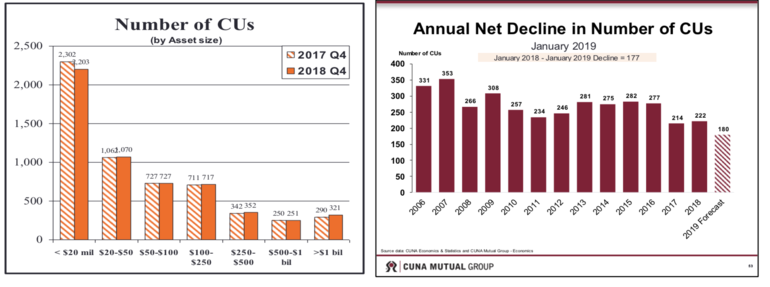
As of January 2018, CUNA estimates 5,613 credit unions are in operation, down 177 from January 2018, the Trends Report states. Year-end 2018 NCUA call report data shows 321 credit unions with assets in excess of $1 billion that held 65% of the credit union system assets and 67% of the loans, while making up only 5.6% of all credit unions.
“This is up from 290 billion- dollar credit unions in 2017 holding 63% of assets and 65% of loans,” CUNA Mutual said. “The median asset size of a U.S. credit union rose to $33.4 million in 2018, a 7.1% increase from the $31.2 million set in 2017.”
CUNA Mutual is forecasting the number of credit unions will decline by 180 during 2019.
Meanwhile, credit unions added 195,000 memberships during January, significantly below the 462,000 gain recorded in January 2018 due to weaker credit demand, according to CUNA Mutual.
“In January, the economy added 311,000 jobs, according to the Bureau of Labor Statistics, significantly more than the 171,000 jobs added in January 2018,” notes the CUNA Mutual analysis. “Rapid job creation is just one sign that the job market is tightening quickly and slack is diminishing. Moreover, average hourly earnings for all employees rose 0.4% in January and 3.4% over the last year due to a low 3.8% unemployment rate.”
The Trends Report found total credit union memberships reached 118.9 million in January 2019. In percentage terms, credit union memberships rose 0.16% in January and 4.2% during the last 12 months. With the economy expected to add another 2.2 million jobs in 2019, credit unions should expect membership growth to come in around 3.5%, CUNA Mutual is projecting.
The full CUNA Mutual Trends Report for January can be found in CUToday.info’s The Vault here.