MADISON, Wis.–Growth in credit union membership only continued to gain speed through the first 11 months of 2017, while the contraction rate in the number of CUs also accelerated a bit in the second half of the year, according to CUNA Mutual’s latest Trends Report.
The Trends Report, which analyzes CU performance through November of 2017, also found strong loan growth driven by first mortgages and unsecured loans, although loans once again grew fastest among the largest CUs.
Here’s a look at credit union performance by category, according to the CUNA Mutual Trends Report:
Total Credit Union Lending
Credit union loan balances rose 0.9% in November, greater than the 0.8% pace reported in November 2016. Driving overall loan growth was strong growth in fixed rate first mortgages (1.7%), unsecured personal loans (1.6%) and credit card loans (1.4%). November seasonal factors typically subtract 0.22 percentage points from the underlying trend loan growth, as winter weather slows auto and home purchases.
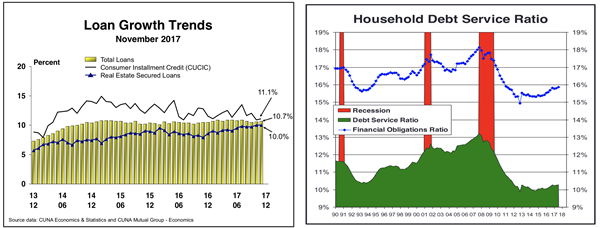
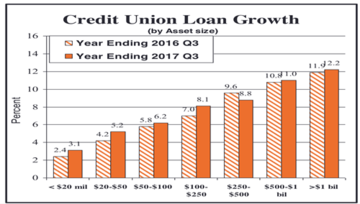
Over the last 12 months, total credit union loan balances rose more than 10.7%, the 39th consecutive month of greater than 10% annual loan growth. “But industry growth rates mask big disparities between large and small credit unions,” CUNA Mutual reminded. “In the year ending in the third quarter of 2017, credit unions with assets greater than $1 billion reported a 12.2% increase in loan balances, which was up slightly from the similar time period one year earlier. Credit unions with assets less than $20 million reported loan growth of only 3.1%, also above the pace set one year earlier.”
Credit Union Consumer Installment Credit (CUCIC)
Credit union consumer installment credit balances (auto, credit card and other unsecured loans) rose 0.6% in November, faster than the 0.4% pace set in November 2016. Consumer installment credit grew 11.1% over the last year, faster than the 10% rise in real estate loans. The household debt service ratio (mortgage and consumer debt payments required to remain current on that debt as a percent of disposable income) was 10.3% in the third quarter, according to the Federal Reserve, slightly above the 10.1% set in the third quarter of 2016.
Vehicle Loans
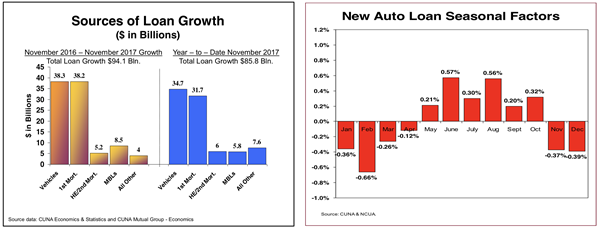
The Trends Report reminded that auto loans remain credit unions’ “bread and butter” loan product, with vehicle loan balance growth outpacing the growth in mortgage and business loans. During the last 12 months, vehicle loan balances increased $38.3 billion (12.7% growth rate), slightly better than the $38.2 billion increase for first mortgage loans (10.8% growth rate). New-auto loan balances rose a robust 1.2% in November, slightly below the 1.4% pace set in November 2016, despite November being typically one of the slower months of the year for auto loan originations.
Real Estate Secured Lending – 1st Mortgages and Other Real Estate
Credit union fixed-rate first mortgage loan balances grew 1.7% in November, double the pace set in November 2016, as existing-home sales rose 5.6% in November from October and are up 3.8% over the last year. Home sales are limited due to a lack of homes for sale, noted the Trends Report.
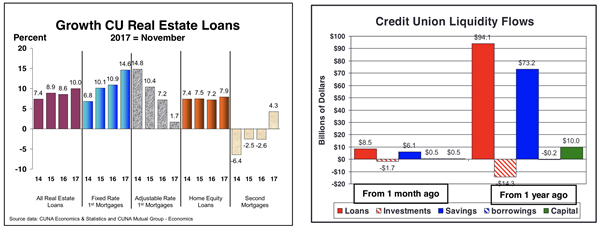
From November 2016 to November 2017, fixed-rate first mortgage loan balances grew 14.6%, significantly above the 1.7% increase in adjustable-rate mortgage balances and higher than the 7.9% growth of home equity balances. Second mortgage balances have broken out of their multiyear funk by growing 4.3% during the last twelve months, CUNA Mutual reported.
Surplus Funds (Cash + Investments)
According to the Trends Report data, credit union surplus funds fell $1.7 billion, or -0.5%, in November to help fund strong loan demand ($8.5 billion). Deposit inflows ($6.1 billion) and additional borrowings ($0.5 billion) were used to fund the remaining loan growth. Credit union surplus funds as a percent of assets fell to 26% in November, down from 28.8% in November 2016, as credit union assets rose 6.4% and surplus funds fell 3.8%. The obverse of the falling surplus funds ratio is the rising loan-to-asset ratio, which reached 69.9% in November, the highest level since September 2008.
“According to third quarter NCUA call report data, average annualized loan yields fell to 4.53% – a record low – during the first nine months of 2017, down from 4.58% for the similar period in 2016, as old higher-rate loans re-priced into today’s lower interest rates,” the Trends Report stated. “Credit union yield-on-asset ratios rose 10 basis points to 3.49% during the first nine months of 2017 due to rising loan-to-asset ratios – the “mix effect” – and slightly higher interest rates, the “rate effect.”
Credit union costs of funds rose 3 basis points during the last year, coming in at 0.54% in the first nine months of 2017. “Net interest margins therefore rose 7 basis points to 2.95% in 2017, the fourth consecutive year of rising margins after hitting a record low of 2.77% in 2013,” the Trends Report added.
Savings and Assets
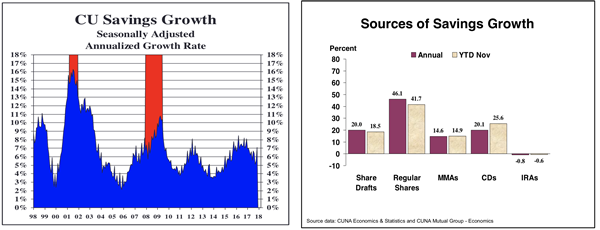
Credit union savings balances rose 0.5% in November, better than the 0.2% gain reported in November 2016. Savings balances are currently growing at a 7.1% seasonally-adjusted annualized growth rate due to strong membership growth and rising household incomes, the analysis found.
The Trends Report further found credit unions reported a savings inflow of $73.2 billion during the last 12 months, a 6.7% increase. Almost 46% of the inflow ($33.7 billion) was deposited into low-cost regular share accounts.
Capital and Other Key Measures
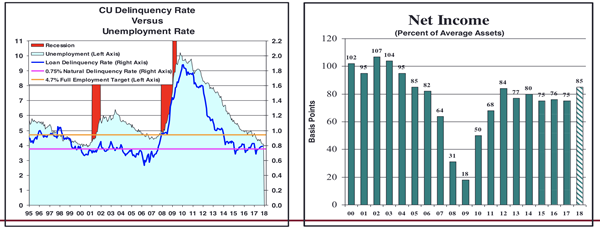
The loan delinquency rate (loans two or more months delinquent as a percent of total loans outstanding) rose to 0.80% in November from the March low of 0.68%, demonstrating its seasonal pattern, according to the Trends Report. On a year-over-year basis, the loan delinquency rate is two basis points lower than the 0.82% reported in November 2016.
“Expect loan quality to improve slightly in 2018 as the unemployment rate falls below 4.0% by the end of the year and loan growth exceeds 10%,” the Trends Report is projecting.
Credit union return-on-asset ratios came in at 0.75% (annualized) for the first nine months of 2016, similar to the rate set during the previous three years, CUNA Mutual said.
Credit Unions and Members
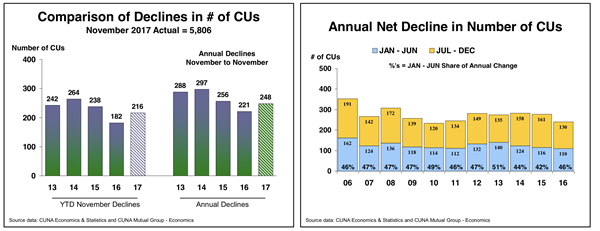
As of November 2017, CUNA estimates 5,806 credit unions were in operation, down 248 from November 2016. Year-to-date the number of credit unions fell by 216, slightly higher than the 182 reported in the first 11 months of 2016. The annual contraction rate of the credit union industry reached 4.1% in 2017, faster than the 3.5% average pace set over the last 25 years.
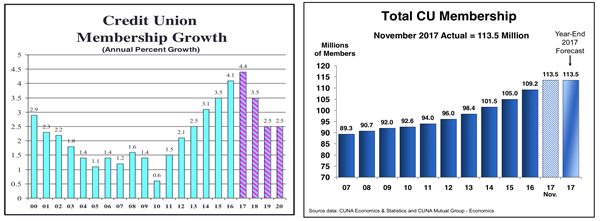
Credit union memberships grew 417,000 in November, or 0.37%, which is much better than the 251,000 new members, or 0.23%, added in November 2016. Year-to-date credit unions added 4.252 million new members, faster than the 3.922 million members added during a similar period in 2016. During the last 12 months, credit unions memberships rose 4.6%, the fastest pace in more than 20 years, the Trends Report stated.
Total credit union memberships reached 113.5 million in November, 4.584 million more than November 2016.