

MADISON, Wis.—Membership growth at credit unions continued to slide as 2020 was nearing its end–with membership in the 12 months ending in November growing at the slowest pace since 2014, according to CUNA Mutual Group’s latest Trends Report.
In addition, once again, the data show “big disparities” remain between large and small CUs, particularly with loan growth. CUNA Mutual Group is forecasting slower overall loan growth this year.
Membership in the country’s credit unions grew 193,000 in November, or 0.15%, which is significantly below the 265,000 new members, or 0.22%, that were added in November 2019, the report states. CUNA Mutual is forecasting membership growth will slow slightly to 3% in 2021.
Through November 2020, credit unions added 3.651 million new members, slower than the 3.934 million members added during a similar period in 2019.
Total CU Lending
Credit union loan balances rose 0.05% in November, below the 0.6% pace reported in November 2019. Driving overall loan growth was strong growth in fixed-rate mortgages (0.9%) and credit card loans (0.9%). November seasonal factors typically subtract 0.22 percentage points from the underlying trend loan growth, as winter weather slows auto and home purchases, CUNA Mutual explained.
Over the last 12 months, total credit union loan balances rose only 5.7%, below the 7.2% long-run average.
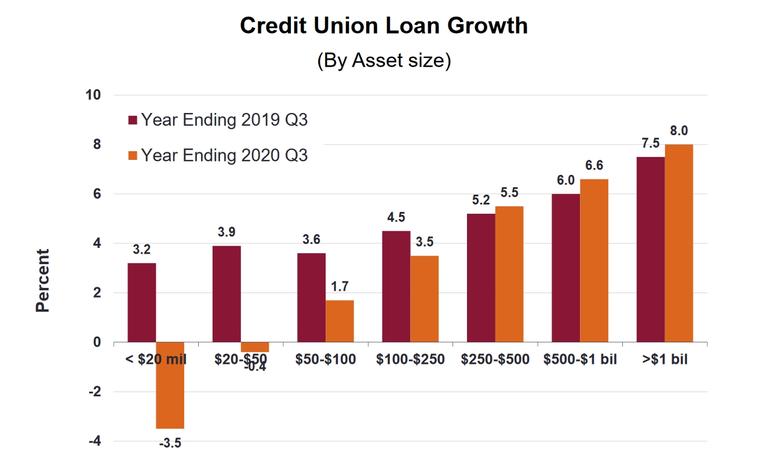
“However, industry growth rates mask big disparities between large and small credit unions,” CUNA Mutual reported. “In the year ending in the third quarter of 2020, credit unions with assets greater than $1 billion reported an 8% increase in loan balances, which was up from the similar time period one year earlier, while credit unions with assets less than $20 million reported loan growth of -3.5%, below the 3.2% pace set one year earlier.
“We expect overall credit union loan growth to slow to 5.5% in 2021,” CUNA Mutual said.
Consumer Installment Credit
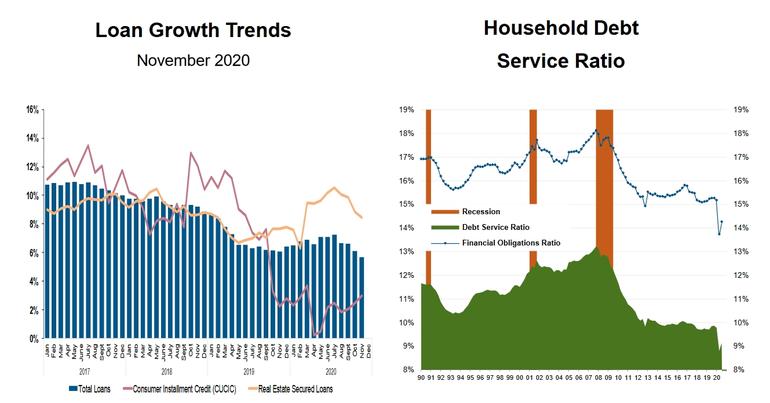
Credit union consumer installment credit balances (auto, credit card and other unsecured loans) rose 0.2% in November, above the 0.4% decrease set in November 2019. Consumer installment credit grew only 3% over the last year, slower than the 8.4% rise in real estate loans.
“The strength in real estate loans explains the weakness in consumer loans because the mortgage refinance boom and many consumers cashing out some home equity is used to pay off higher rate credit card and auto loans,” the report states. “Expect consumer installment credit to grow only 4.5% in 2021, below its 30-year average growth rate of 6.3%, due to the ongoing pandemic and additional early repayments from cash out mortgage refinances.”
The Trends Report found the household debt service ratio (mortgage and consumer debt payments required to remain current on that debt as a percent of disposable income) rose to 9.1% in the third quarter, from the 8.8% record low reported in the second quarter, according to the Federal Reserve. The drop in the debt service ratio was caused by record low interest rates and government stimulus checks.
“This is freeing up household income for spending on goods and services or to increase savings rates. The composition of the debt service ratio changed over the last year as the consumer debt service ratio fell to 5.28% in the third quarter of 2020, down from 5.73% in the third quarter of 2019, while the mortgage service ratio fell to 3.85% from 4.12%,” the company said.
Vehicle Lending
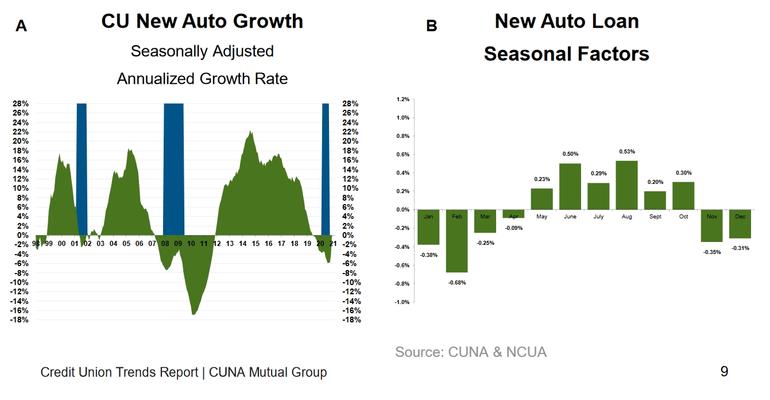
Credit union new-auto loan balances fell at a -4.2% seasonally adjusted annual rate in November, significantly below the double-digit pace set during 2012-2018, “as we typically see during a recession.
“Four factors drove this decline. First, members used ‘cash out’ funds from mortgage refinances to pay off auto loans. Second, past is prologue and rapid loan originations 2-3 years ago precipitate larger loan balance amortization today,” CUNA Mutual’s economists stated. “For example, a member receiving a $30,000 four-year new auto loan originated at a 4% interest rate on January 1, 2017 would have paid approximately $7,000 in repayments during 2017. The repayments would then have grown to almost $8,000 by 2020.Third, new auto sales declined 16% over the last year which leads to a corresponding drop in new auto lending.”
And, finally, the report notes rapid growth into indirect auto lending over the last few years has leveled off, leading to a drop in the growth rate. Looking at seasonal factors, November is typically one of the slower months of the year for new auto loan originations due to normally weak new auto sales in November. Vehicle sales were 15.6 million units (seasonally adjusted annualized rate) in November, down from the 16.3 pace (-4.5%) set in October and 17 million (-8%) set in November one year ago.
“Strength in truck and SUV sales will lead to U.S. new vehicle sales to close the year on a high note. But car sales are a staggering 17% below where they finished at the end of 2019.We expect auto sales to accelerate 15% in 2021 to a 16.4 million pace, up from 14.4 million set in 2020,” the report forecasts.
Real Estate Lending
Credit union fixed-rate first mortgage loan balances grew 0.9% in November, below the 1.5% pace set in November 2019. Existing-home sales fell 2.5% in November from October but marked a 26% rise over the last year due to record low interest rates.
The report reminds the supply of existing homes available for sale is becoming increasingly scarce with the inventory-to-sale ratio running at a record low 1.9 months, below the 5.5 months considered to indicate a balanced housing market.
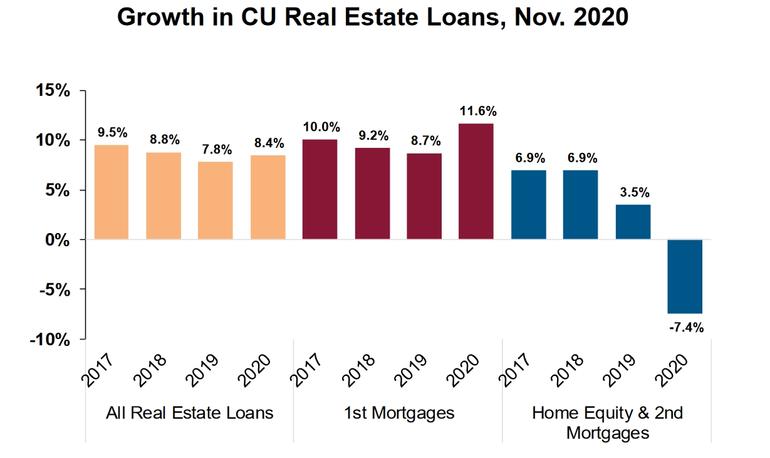
“Today’s homeownership rate is above the 62.9% nadir reported in the second quarter of 2016, but below the 69.2% apex reached in fourth quarter of 2004. From November 2019 to November 2020, first mortgage loan balances grew 11.6%. Home equity and second mortgage balances have declined 7.4% in 2020 due to low mortgage interest rates causing the mortgage refi boom,” the report explained.
The contract interest rate on a 30-year, fixed-rate conventional home mortgage fell to 2.77% in November, from 2.83% in October and below the 3.7% reported in November 2019. With the Federal Reserve expected to keep short-term interest rates unchanged in 2021 but the 10-year Treasury interest rate expected to drift up 25-50 basis points in 2021, expect the 30-year mortgage interest rate to also move higher in 2021 to around a 3% -3.25% range, the report suggests.
“Expect mortgage originations to drop 25% in 2021 as the mortgage refinance boom comes to and end and long-term interest rates rise throughout 2021,” CUNA Mutual added.
Surplus Funds
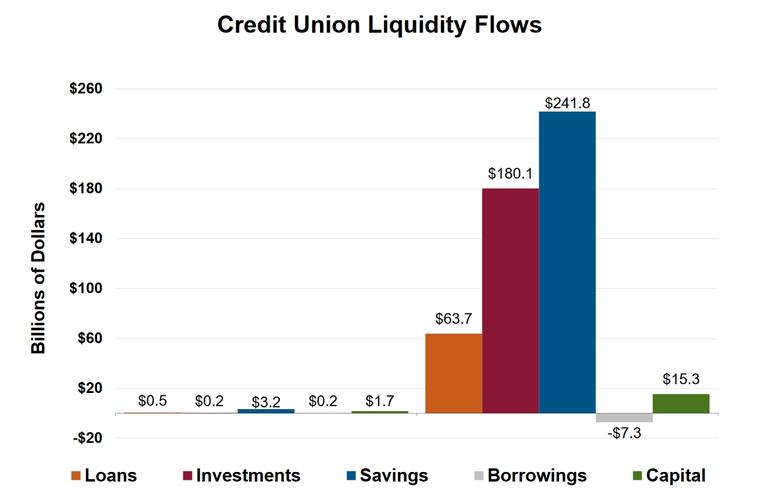
Credit union surplus funds rose a modest $0.2 billion, or 0.04%, in November due to a rise in savings balances exceeding the growth in November loan balances of $0.5 billion. Deposit inflows over the last year ($241.8 billion) funded $180.1 billion in new investments and were also used to pay down borrowings (-$7.3 billion) and fund the $63.7 billion loan growth.
Credit union surplus funds as a percent of assets rose to 31.7% in November, up from 25.5% in November 2019, as credit union assets rose 15.8% and surplus funds rose 44.2%, according to the Trends Report.
“The obverse of the rising surplus funds ratio is the falling loan-to-asset ratio, which fell to 64.2% in November, down from 70.4% set in November 2019. This will push down credit union yield on asset ratios over the next year,” the company said.
According to third quarter NCUA call report data, average annualized loan yields fell to 4.74% during the first nine months of 2020, down from 4.92% for the similar period in 2019, as old higher-rate loans repriced into today’s lower interest rates. Yields on surplus funds fell from 2.25% in 2019, to 1.4% during the first nine months of 2020. Credit union yield-on-asset ratios fell 43 basis points to 3.61% during the first nine months of 2020 from 4.04% set in 2019. Approximately one-third of the drop in yield on assets was due to lower interest rates, or the “rate effect.”
The Trends Report states the other two-thirds was caused by the “mix effect” as the percent of assets in the loan category fell six percentage points over the last year. Credit union costs of funds fell only 13 basis points during the last year, coming in at 0.74% in the first nine months of 2020.
“Therefore, net interest margins fell 30 basis points to 2.87% in 2020, slightly above the record low of 2.77% set back in 2013,” the report explained.
Savings and Assets
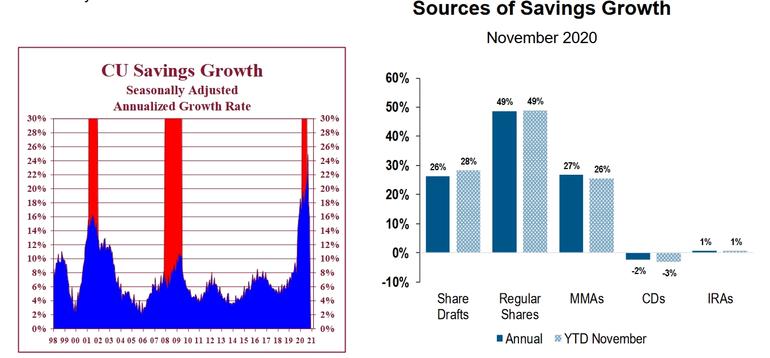
Credit union savings balances rose 0.2% in November, lower than the 1.5% gain reported in November 2019 when the month ending on a payroll Friday. Savings balances typically decline 0.2% in November due to recurring seasonal factors. Savings balances are currently growing at a 15.6% seasonally adjusted annualized growth rate due to a slowdown in consumer spending, low gas prices, fears of a recession, enhanced unemployment insurance benefits and government stimulus checks, according to the Trends Report. Approximately 80% of stimulus checks sent out in March 2020 were either saved or used to pay down debt. These two member behaviors resulted in excess credit union liquidity and lower yield-on-asset ratios.
“Expect credit union savings balances to rise 14% in 2021 due to additional stimulus checks this spring, COVID-19 induced uncertainty, low gasoline purchases, aging demographics and job and income insecurity,” the report forecast.
Credit unions reported a savings inflow of $241.8 billion during the last 12 months, an 18% increase. Almost half of this inflow (49% or $127 billion) was deposited into regular share accounts, CUNA Mutual said.
Share certificate account growth turned negative in 2020 as maturing CD balances were being placed in liquid share accounts due to falling interest rates. Credit union one-year CD interest rates fell 75 basis points during the 12 months ending in November: 2% to 1.25%. Expect credit union CD interest rates to fall below 1% in the next few months and to stay below 1% for the next few years; like what we saw during the 2012-2016 period, the report predicts.
Capital and Other Key Measures
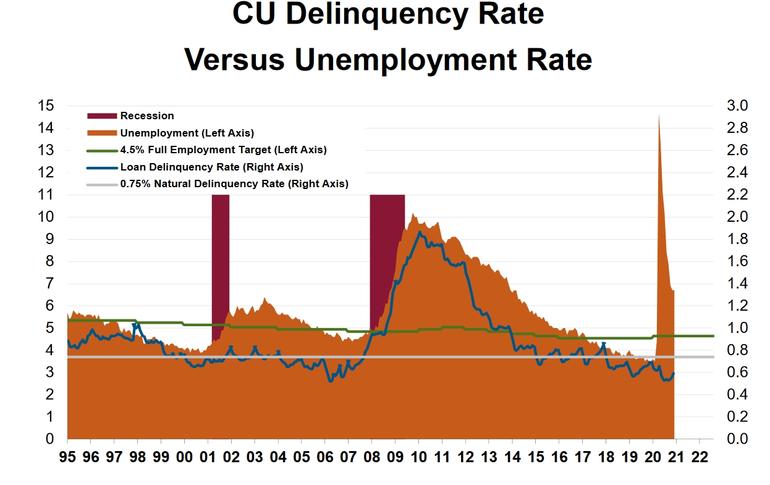
The loan delinquency rate (loans two or more months delinquent as a percent of total loans outstanding) rose to 0.6% in November from 0.57% in October.
“This is in line with the traditional seasonal pattern. Delinquency rates typically reach their nadir in the first quarter as members use their tax refunds and bonus checks to catch-up on any late loan payments,” the report states. “As the year progresses, delinquency rates slowly rise and reach their apex late in the fourth quarter. On a year-over-year basis, the loan delinquency rate is 10 basis points lower than the 0.7% reported in November 2019. Expect loan quality measures to deteriorate over the next few quarters as loan forbearance programs come to end and the unemployment rate remains elevated.”
Credit union return-on-asset ratios came in at 0.65% (annualized) for the first nine months of 2020, the lowest since 2010, due to lower net interest margins, lower fee income and higher provision for loan losses. Expect credit union return-on-asset ratios to fall further in 2021 to 0.60% as margin compression continues and the mortgage refinance boom comes to an end, the Trends Report stated.
Credit union capital balances grew 8.6% in the year ending in November, above the 7% average set over the last 20 years, but below the 11.6% pace set in 2019. The growth rate of capital is also known as the return on equity ratio, an important measure of credit union financial performance.
Credit Unions
As of November 2019, CUNA estimates 5,302 credit unions were in operation, down 188 from November 2019. Year-to-date the number of credit unions fell by 158, more than the 113 reported in the first eleven months of 2019. The annual contraction rate of the credit union industry came in at -3.4% in November 2020, above the -2.2% set in the year ending November 2019 but still below the -3.5% average pace set over the last 40 years, the Trends Report stated.
“This acceleration in the rate of contraction can be explained by the fact that 82% of credit unions reported positive earnings in the third quarter of 2020, down from 89% in the third quarter of 2019.Starting in 2006, 46% of the annual decline in the number of credit unions took place in the first half of the year and 54% in the second half. Slightly more mergers in the second half may be attributable to the timing of the fall strategic planning session and credit unions attempting to close merger deals before the end of the year,” the report explained.
Credit Union Membership
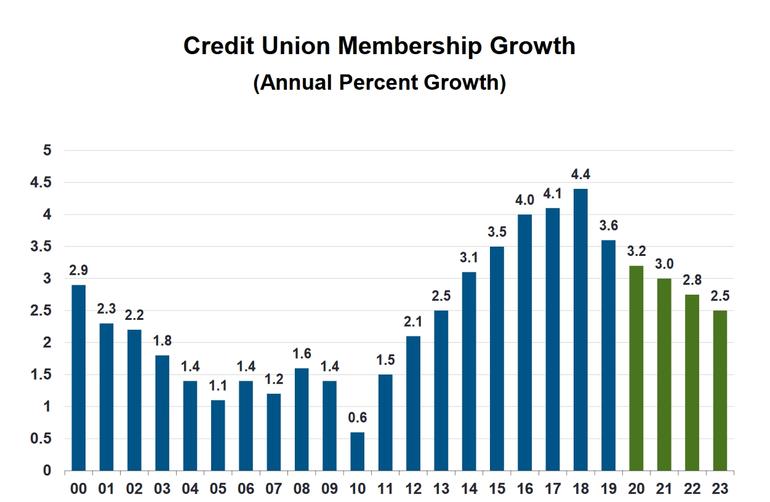
As previously stated, credit union memberships grew 193,000 in November, or 0.15%, which is significantly below the 265,000 new members, or 0.22%, that were added in November 2019. Year-to-date, credit unions added 3.651 million new members, slower than the 3.934 million members added during a similar period in 2019. During the last 12 months, credit unions memberships rose 3.2%, the slowest pace since 2014, CUNA Mutual reported.
Total credit union memberships reached 126.4 million in November, 3.945 million more than November 201.
“Strong mortgage lending is the major factor driving the rise in credit union memberships. Job growth is another factor determining credit union membership growth,” the report states. “The U.S. economy lost 9.37 million jobs during 2020, according to the Bureau of Labor Statistics. For 2021, expect 4.4 million new jobs to be created as the economy exits the COVID-19 pandemic and recession. As the mortgage refinance boom ends in 2021, job growth will become more of a factor in membership growth.
“We expect membership growth to slow slightly to 3% in 2021,” CUNA Mutual added.