

MADISON, Wis.–In the year ending with November 2022 membership in credit unions grew at its fastest pace since 1985, but that growth is projected to slow in 2023, according to CUNA Mutual’s newest Trends Report.
The Report, based on data through November of last year, also projects loan growth will rise to 8.0% in 2023, while savings deposit growth will slow over the next few years.
According to the Trends Report, here’s a look at how credit unions performed by category:
Total CU Lending
Credit union loan balances rose 1.2% in November, above the 0.7% pace reported in
November 2021, according to the Trends Report.
Driving overall loan growth was strong growth in credit card loans (2.6%), adjustable-rate mortgages (2.4%) and home equity lending (2.1%). November seasonal factors typically subtract 0.22 percentage points from the underlying trend loan growth as winter weather slows auto and home purchases.
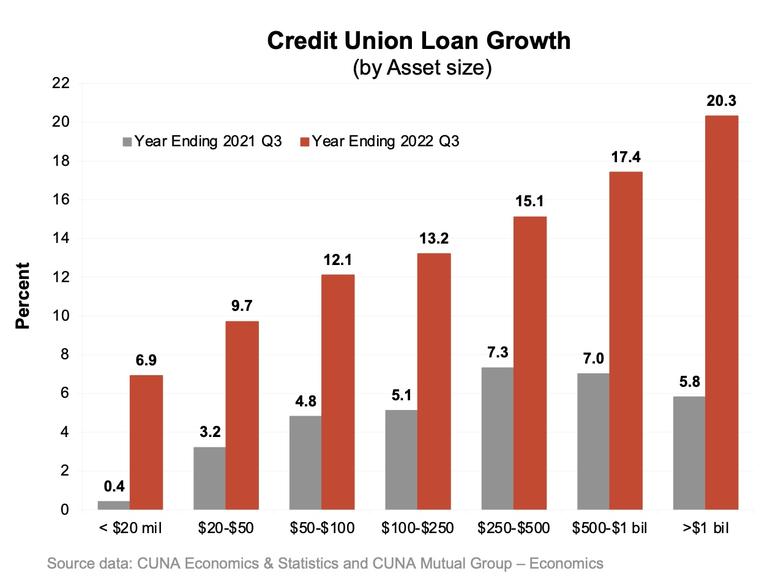
“Over the past 12 months, total credit union loan balances rose a remarkable 19.3%, above the 7.2% long-run average,” the Trends Report states. “However, industry growth rates mask big disparities between large and small credit unions. In the year ending in the third quarter of 2022, credit unions with assets greater than $1 billion reported a 20.3% increase in loan balances, which was up from a similar period one year earlier. During the same period, credit unions with assets less than $20 million reported loan growth of 6.9%, which is above the 0.4% pace set a year earlier.”
CUNA Mutual Chief Economist Steve Rick is forecasting credit union loan growth will rise to 8.0% in 2023.
Consumer Installment Credit
Credit union consumer installment credit balances (auto, credit card and other unsecured loans) rose 0.3% in November, below the 1.0% jump set in November 2021, as consumer spending ebbed in the fourth quarter of 2022, the Trends Report analysis shows.
Credit union consumer installment credit grew 17.2% over the last year, which is above its 30-year average of 6.3%, and much faster than the 1.7% rise in real estate loans, the report added.
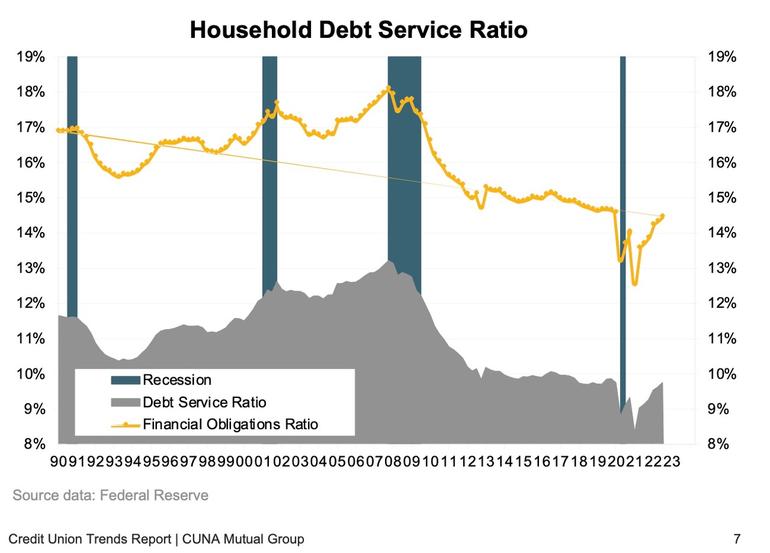
“The household debt service ratio (mortgage and consumer debt payments required to remain current on that debt as a percent of disposable income) rose to 9.7% in the third quarter, from the 9.6% reported in the second quarter, and above the record low of 8.37% reported in the first quarter of 2021, according to the Federal Reserve,” the Report states. “The record-low debt service ratio was caused by record-low interest rates and government stimulus checks, which were used to pay off debt. Higher interest rates in the future will mean higher spending on servicing debt which will reduce household disposable income for spending on goods and services or will decrease the national savings rates.”
Vehicle Loans
The Trends Report analysis, which is based on data collected by CUNA, shows credit union new-auto loan balances rose at a 20.1% seasonally-adjusted annual rate in November, significantly above the double-digit pace set during 2012-2018, as is typically seen during a post-recession period.
While November is typically one of the slower months of the year for new-auto loan originations, the Report states four factors are driving the rapid credit union growth pace:
- Credit union new-auto loan interest rates are significantly lower than other lenders’ interest rates, leading to a competitive advantage
- Many other lenders have either run low of liquidity or are tightening their lending standards which has reduced the availability of credit
- New auto prices have increased 5.9% over the last year, increasing the size of the auto loan to finance the auto purchase.
- Rapid growth into indirect auto lending over the last year has boosted credit unions’ loan growth rate
The seasonally-adjusted annualized rates for U.S. new-vehicle sales declined to 14.1 million in November from 15.1 in October, down 6.5%, but up 7.9% from November 2021.
Real Estate Information
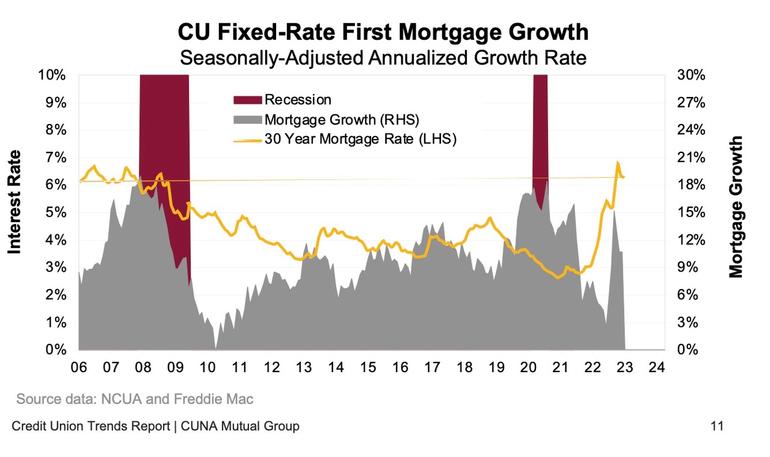
The new Trends Report shows credit union fixed-rate first mortgage loan balances grew 0.8% in November, below the 1.3% pace set in November 2021.
“Existing home sales fell 7.7% in November from October and fell 35% over the last year due to high interest rates and poor affordability,” the Report states. “Fixed-rate mortgage loan balances are currently growing at a robust 10.7% seasonally-adjusted annualized growth rate as credit unions choose to hold more of their first mortgage originations on their own balance sheet.”
The Report is predicting that with the Federal Reserve expected to raise short-term interest rates 50-75 basis points in 2023, but the 10-year Treasury interest rate expected to remain around 3.5%, the 30-year mortgage interest rate will remain in the low 6% range for the rest of 2023.
The Report further notes that the national homeownership rate rose to 66.0% in the third quarter of 2022, above the 65.4% reported in the third quarter of 2021.
“Today’s homeownership rate is above the 62.9% nadir reported in the second quarter of 2016, but below the 69.2% apex reached in the fourth quarter of 2004,” the report adds. “Expect mortgage originations to drop 10% in 2023 as the economy enters a mild recession and mortgage interest rates remain above 6% throughout 2023.”
Savings & Assets
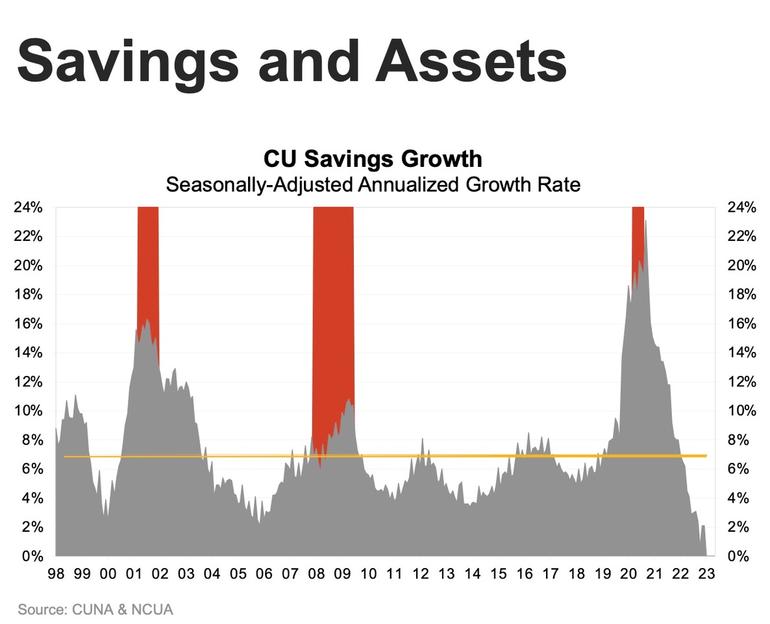
Credit union savings balances fell 0.3% in November, slightly below the 0.1% gain reported in November 2021, as credit union members continue to spend their excess savings accumulated during the last two years, the Trends Report adds, noting savings balances typically decline 0.2% in November due to recurring seasonal factors.
“Savings balances are currently growing at an anemic 2.1% seasonally-adjusted annualized growth rate, which is above the 7% long-run average,” the report states. “Members are saving less than normal due to the increased spending on leisure and hospitality after the COVID-19 pandemic ebbed.
The analysis shows the average credit union member was sitting on $13,587 in deposits in November 2022, up from $10,978 in November 2019, before the COVID-19 pandemic and the resulting three stimulus checks.
“This $2,609 in additional liquidity, a 24% increase, has provided members with significant additional spending power,” the report states. “These excess savings will reduce the desire of many credit union members to keep building their savings balances, which will ultimately reduce credit union deposit growth to below the 7% long-run average over the next few years.”
The Trends Report is forecasting that credit union savings balances will rise only 6% in 2023 and 2024, the slowest pace since 2013, due to lower COVID-19 fears, increased spending on leisure and hospitality, and above average inflation.
Capital & Other Key Measures
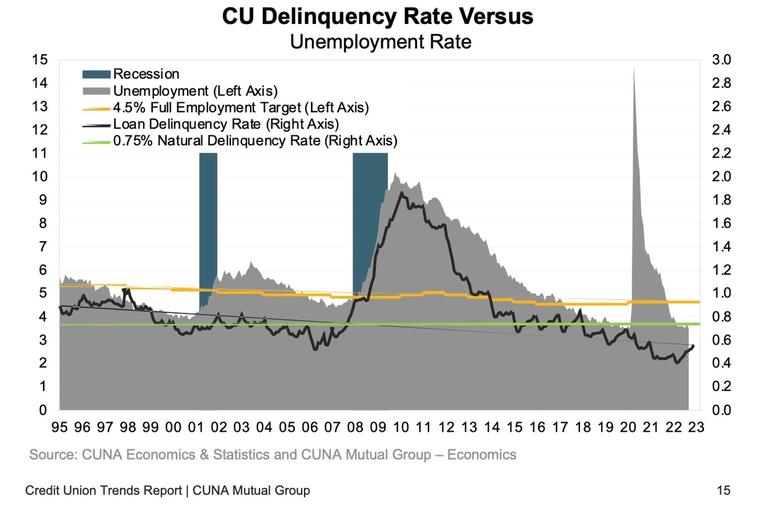
The credit union loan delinquency rate (loans two or more months delinquent as a percent of total loans outstanding) rose to 0.56% in November from 0.47% in November 2021, according to Rick’s analysis, adding that’s in line with the traditional seasonal pattern.
In addition, the Trends Report shows credit union loan delinquency rates are significantly below the 0.75% long-run natural delinquency rate because of past stimulus checks, enhanced unemployment benefits, loan forbearance programs, very low unemployment rates and a rather large denominator effect due to loan balances rising over 19% during the last 12 months.
“But the numerator of the delinquency rate, delinquent loans, rose 43% during the last year, as high inflation is reducing real incomes of consumers and putting financial pressure on low-income households,” the Report states. “Expect loan quality measures to deteriorate during 2023 due to rising interest rates, a slowing economy and falling real household incomes.”
Credit Unions & Members
During November CUNA Mutual said the data show credit union memberships grew 231,000, or 0.17%, which is below the 320,000 new members, or 0.24%, that were added in November 2021.
Year-to-date, credit unions added 5.553 million new members, faster than the 4.901 million members added during a similar period in 2021, the data indicate.
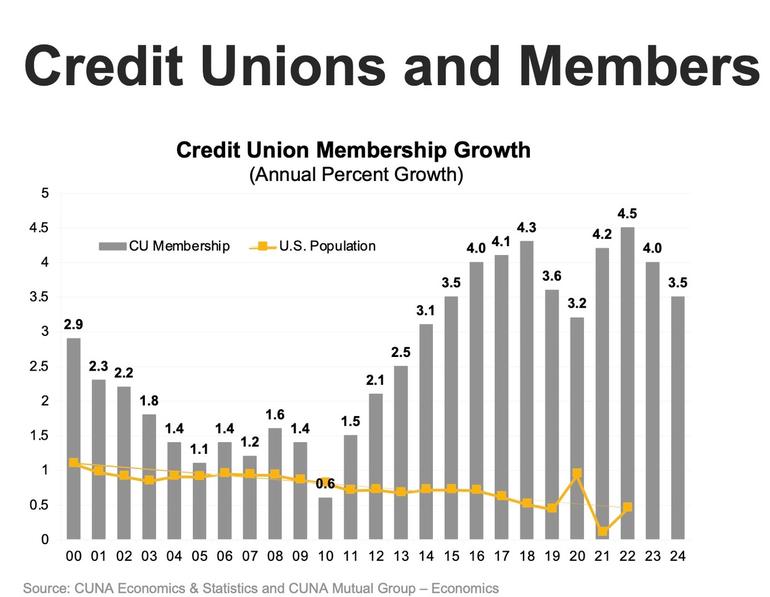
“During the last 12 months, credit union memberships rose 4.5%, the fastest pace since 1985,” CUNA Mutual reported. “Credit union membership growth of 4.5% is outpacing the 0.45% growth rate of the U.S. population.”
According to the analysis, total credit union memberships reached 137.6 million in November, six-million more than November 2021. Strong auto and home equity lending and the surge in job hirings are two major factors driving the rise in credit union memberships, the Report added.
The Role of Job Growth
“Job growth is a major factor determining credit union membership growth,” according to the Trends Report. “The U.S. economy gained 4.5 million jobs during 2022, according to the Bureau of Labor Statistics. For 2023, expect only 1.6 million new jobs to be created as the economy slows and maybe experiences a mild recession in the second half. Slower job growth will weigh on membership growth while new-auto indirect lending will be a major factor supporting membership growth. We expect membership growth to fall slightly to 4% in 2023 and then to 3.5% in 2024.”
It’s Called Fresh for a Reason. And We Offer Home Delivery. For Free!
The biggest, best and freshest news reporting in credit unions remains free in ’23! Each morning CUToday.info delivers its daily Fresh Today news update offering the latest headlines and breaking news right to your email, with the easy-to-read headlines format allowing you to click on the stories that interest you most in order to learn more.
If you haven’t yet signed up for the new email solution on which CUToday.info has partnered with ResponseGenius, you can do so here. Signing up requires less than one minute of your time—and it’s free!
Please note that after signing up you may need to go to your Spam/Junk folder and mark the morning headlines email as safe. CUToday.info does not provide its list of readers and emails to outside parties, and we will not be contacting you to sell you an extended warranty or sending you any links so you may cash in on an inheritance you didn’t know was coming.
And did we mention it’s free?
Please note and/or make your IT department or email administrator aware the emails will be coming from the domains CUTodayinfo.com and CUTodayinfoReply.com