MADISON, Wis.–Credit union membership grew by more than a half-million during July alone, while the overall CU loan-to-share ratio hit a 37-year high, according to new data.
Although it has slowed slightly, a new forecast predicts strong loan growth will continue, including for automobiles and mortgages, according to a forecast in CUNA Mutual’s latest Trends Report, which is based on CU data through July 2018.
The credit union community’s loan-to-asset ratio hit 71.5% as of July, above the 68.8% reported in July 2017, and the highest since October 1981, CUNA Mutual reported. A greater proportion of loans on the balance sheet during the last year increased the yield-on-asset ratio 25 basis points to 3.72% in the second quarter of 2018, compared to the second quarter one year earlier.
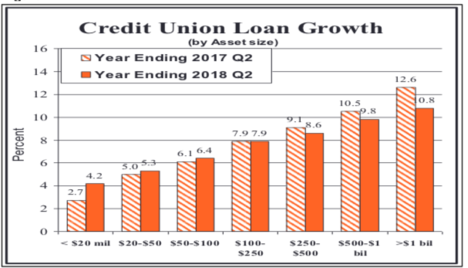
However, as has consistently been seen in the data in recent years, CUNA Mutual noted the industry average loan growth rates “mask big disparities” between large and small credit unions. In the year ending in the second quarter of 2018, credit unions with assets greater than $1 billion reported a 10.8% increase in loan balances. Meanwhile, credit unions with assets less than $20 million reported loan growth of only 4.2%.
Here’s a look at how credit union performed by category, according to the CUNA Mutual Trends Report:
Credit Union Consumer Installment Credit (CUCIC)
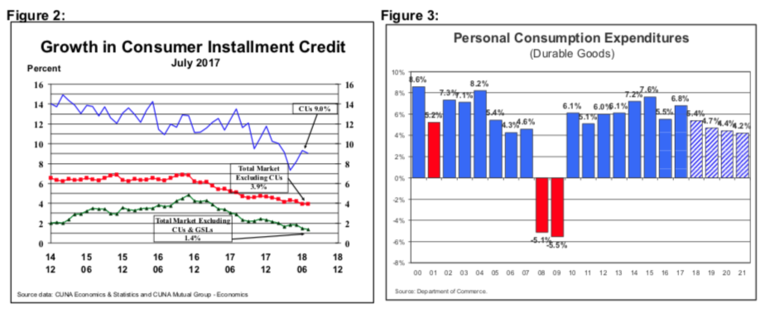
Credit union consumer installment credit loan balances (auto, credit card and other unsecured loans) rose 2% in July, above the 1.8% pace set in July 2017, CUNA Mutual said. During the last 12 months, credit union consumer installment credit grew 9% about twice as fast as the total market excluding credit unions of 3.9%. CUNA Mutual’s economists said they are forecasting consumer expenditures on durable goods – autos, appliances, furniture – to increase 5.4% in 2018 and then decelerate to 4.7% in 2019, as households will have exhausted their pent up demand built up during the Great Recession and its aftermath.
Vehicle Loans
Credit union new-auto loan balances rose 0.7% in July 2018, below the 1.3% pace set in July 2017, according to the Trends Report. Currently, new-auto loan balances are rising at a 17.1% seasonally-adjusted annualized growth rate, CUNA Mutual noted, which is up from the slowdown in the second half of 2017. “With the labor market at full employment and the quit rate picking up, wage growth will begin to accelerate along with productivity growth, enticing more Americans to purchase new cars and trucks,” the report forecasts.
Real Estate Secured Lending – First Mortgages and Other Real Estate
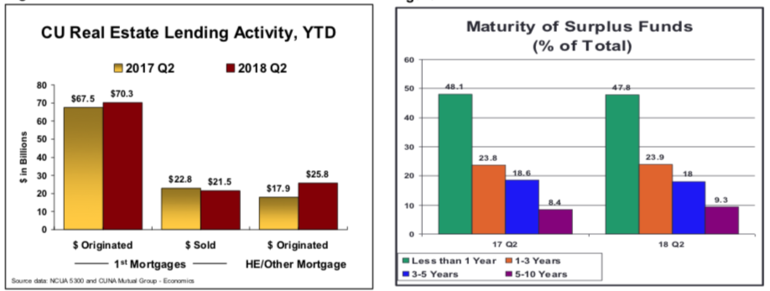
Credit unions originated a record $70.3 billion in the first half of 2018, a 4.1% increase over the $67.5 billion in originations in the first half of 2017, the Trends Report states. “Credit unions then proceeded to sell off 30.6% of those originations into the secondary market, a lower percentage than the 33.8% in 2017,” according to CUNA Mutual. “The stage is set for another strong year of credit union first mortgage growth as rising purchase activity offsets slower refinance business.”
Credit unions originated $25.8 billion of home equity and second mortgages in the first half of 2018, a 44% increase from the same time period last year. Credit unions now hold $508 billion of total real estate loans (first and second mortgages) on their books, which are 4.9% of the entire mortgage market, up from 4.6% in June 2017, CUNA Mutual said.
Surplus Funds (Cash + Investments)
Credit union surplus funds fell $21.3 billion, or 5.6%, in July to reach $354.8 billion, which helped fund the run off in savings balances of -$10.2 billion, the Trends Report states. To fund the additional $11.2 billion in loans, credit unions borrowed $4.3 billion and capital increased $2.1 billion. Credit union surplus funds as a percent of assets fell to 24.4% in July, down from 27.3% in July 2017 and the tightest liquidity since August 2000, CUNA Mutual said. During the last year, credit unions funded $96 billion in additional loan balances with $62.7 billion of additional savings balances and 9.4 billion in additional capital. The yield on surplus funds rose slightly to 1.81% in the first half of 2018 compared to 1.5% during the first half of 2017. Investment yields remain significantly below the 4.6% yield on loans in the first half of 2018, which is up from the 4.5% reported in the first half of last year, CUNA Mutual reported.
Credit unions are keeping the maturity of their investment portfolio short term due to expectations that the Federal Reserve will continue to raise interest rates in the fourth quarter of this year, the Report added.
Savings and Assets
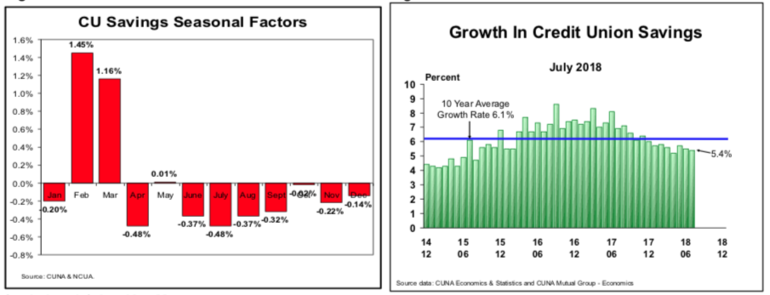
Credit union savings balances fell 0.8% in July, below the 0.7% decline in balances in July 2017, as payback for the 1.4% surge in June when that month ended on a Friday payday, according to the Trends Report.
“July is normally the weakest month of the year for savings growth due to seasonal factors such as vacation spending and auto loan down payments. Credit union savings seasonal factors will remain as negative factors for rest of the year,” the Trends Report states. “However, during the last 12 months, savings balances rose only 5.4% due to rising consumer confidence and a desire by many households to spend rather than save.”
Capital and Other Key Measures
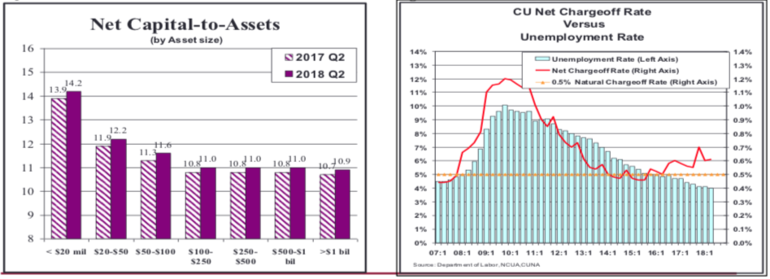
The Trends Report notes that the industry’s weighted average capital-to-asset ratio rose to 10.7% in July from 10.6% for the same time period last year, according to NCUA call report data, due to capital growing faster than assets (6.4% vs. 6.1%). Credit unions with assets less than $100 million typically have capital-to-asset ratios above 11%, while larger credit unions have ratios below 11%, the Report indicates.
The credit union loan net charge-off rate rose to 0.61% in June, up from 0.56% in June 2017, the Report states. It also predicts the charge-off rate will fall to 0.5% in the third quarter, which is historically the quarter with the lowest charge-off rate of the year, due to rapid loan growth over the summer months.
“We expect the charge-off rate to increase five basis points to 0.55% in the fourth quarter as loan growth slows and delinquent loans increase,” CUNA Mutual’s economists stated.
Credit Unions and Members
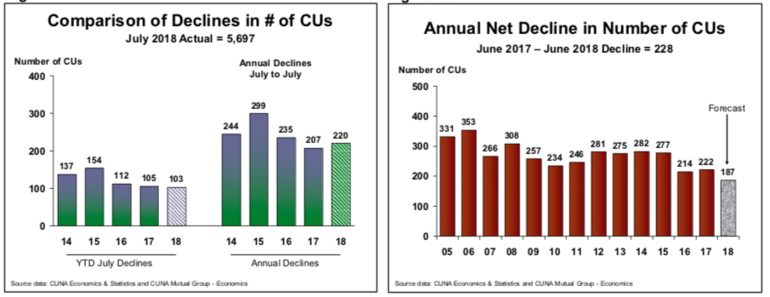
As of July 2017, CUNA estimates 5,697 credit unions are in operation, down 17 from June, the Report said. Through July, the number of credit unions fell by 103, which is less than the 105 reported in the first seven months of 2017. NCUA’s Insurance Report of Activity showed 44 mergers in the second quarter with an average asset size of $23.7 million, five fewer mergers than reported in the second quarter of 2017, with an average asset size of $8.4 million.
Recently released mid-year NCUA call report data shows 305 credit unions with assets in excess of $1 billion and 246 credit unions with assets greater than $500 million, but less than $1 billion. The greater than $1 billion asset category represents 5.4% of all credit unions, but more than 64.3% of the credit union system’s assets and 66.7% of the loans. The median asset size of a U.S. credit union rose to $32.9 million in mid-year, up from $30.5 million at mid-year 2017, the Report notes.
Credit union memberships grew a strong 506,000 in July, or 0.4%, above the 364,000 new members added in July 2017. Year-to-date, CUNA Mutual said, credit unions added 3.2 million new members, faster than the 2.9 million members added in 2017. Total credit union memberships reached 116.8 million in July, 4.2% above the level recorded last year.
“This is the fastest membership growth in more than a generation, largely driven by the 147,000 new jobs added to the U.S. economy in July and the record level of loan originations, according to the Bureau of Labor Statistics,” the Trends Report states. “We forecast credit union memberships to grow 4% in 2017 and 3.5% in 2018, due to job gains exceeding 2.2 million each year and more Americans reaching out to credit unions in search of loans to satisfy their pent-up demand for durable goods.”