

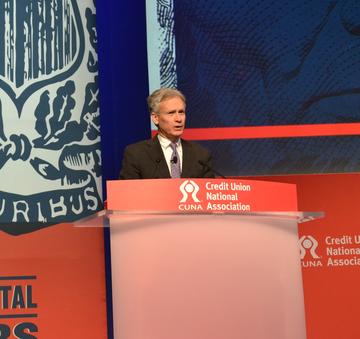
Mark McWatters
Washington–In his first address since his designation as acting NCUA board chairman, Mark McWatters informed credit unions they can anticipate a “thoughtful loosening” of regulations, a streamlined agency budget, and the possible closure of the Temporary Corporate Credit Union Stabilization Fund in 2017.
“NCUA should acknowledge that it’s 2017, not 2008, and that it is time to consider the thoughtful loosening of the regulatory regime appropriately placed on the corporate credit unions during the darkest days of the financial crisis,” McWatters said during CUNA’s GAC. “We must focus on today’s challenges and risks while preparing for the future. Absent safety and soundness concerns, NCUA must not stand in the way of your efforts to develop and execute your business plan, meet the expectations of your members, and build a robust and dynamic credit union community.”
McWatters also addressed the possibility of the agency’s closing the Temporary Corporate Credit Union Stabilization Fund in 2017—four years before the currently scheduled closing—and moving money into the Share Insurance Fund in order to avoid charging a premium. NCUA has projected the Share Insurance Fund’s equity ratio, already below the 1.30% operating level, will continue to decline, and staff last November projected a possible premium of three to six basis points.
“It is important the agency maintain a strong Share Insurance Fund and avoid or minimize any premiums, whenever we can do so responsibly,” McWatters said. “We have a potential opportunity to accomplish both by closing, in 2017, the Stabilization Fund into the Share Insurance Fund.
“I must emphasize there are accounting, legal and financial issues that we must thoroughly research and evaluate before the board may vote to close Stabilization Fund,” McWatters said. “In addition, the Share Insurance Fund would need to hold sufficient reserves to absorb the downward trend in the equity ratio and potential declines in the value of the legacy assets. If our research determines the agency can properly and prudently satisfy these requirements, I will support closing the Stabilization Fund into the Share Insurance Fund in 2017.”
If conditions permit, McWatters said, NCUA would begin a multi-year process of rebating Stabilization Fund assessments to credit unions, adding this would be his top priority for 2017.
Turing back to loosening regulations, McWatters described 15 issues he wants to address to reduce regulatory burdens while ensuring safety and soundness in the credit union system, including:
- Revisiting the agency’s pending risk-based capital rule, scheduled to go into effect in January 2019
- Continued review of an extended examination cycle
- Re-evaluation of the stress-testing rule for the largest credit unions
- Streamlining the agency’s budget
- Doing more to help credit unions serve members better.
“NCUA must faithfully execute our duties as a prudential regulator while ensuring the safety and soundness of the Share Insurance Fund and the viability of the credit union system,” McWatters said. “Nonetheless, we must slow, if not substantially stop, the machine that grinds out a relentless flow of new regulatory burdens. We must also do much more to improve how we regulate and consider the costs, as well as the benefits, of each new regulation.”
NAFCU and CUNA said they support McWatters' plan.
“Regulatory relief, prudent management of the operating budget, and rebates from the Temporary Corporate Credit Union Stabilization Fund are at the top of NAFCU's advocacy agenda for 2017," said President and CEO Dan Berger. "NAFCU and our members applaud Chairman McWatters' commitment to addressing each of these issues, and we look forward to working with him in executing his strategy."
“CUNA and our League partners thank Acting NCUA Board Chairman J. Mark McWatters for giving his first speech as acting chairman today and his comments about the direction of the agency which may allow credit unions to be more effective in providing products and services to their members,” said Bill Hampel, CUNA chief policy officer. “We’re pleased that Acting Chairman McWatters’ laid out his top priorities, including his plan for 2017 is to merge the share insurance and stabilization funds to be able to begin rebating stabilization assessments this year – something for which CUNA and our members have long advocated.”
The complete list of regulatory issues to address, as outlined by McWatters at GAC, are below:
1)The Share Insurance Fund’s equity ratio ended 2016 at 1.27%, below the board-approved normal operating level of 1.30%. There are a variety of pressures on the equity ratio. These include strong insured share growth, the low interest rate environment, and potential losses from troubled credit unions. The equity ratio may very well continue to decline over the next few years given these pressures.
It is important that the agency maintain a strong Share Insurance Fund for the mutual benefit of the credit union community and the taxpayers. It is also important for the NCUA to avoid or minimize any insurance fund premiums, whenever the agency may do so responsibly, and keep that money at work in the credit union community. We have a potential opportunity to accomplish both of these objectives by closing, in 2017, the Temporary Corporate Credit Union Stabilization Fund into the Share Insurance Fund.
However, I must emphasize there are accounting, legal, and financial issues that we must thoroughly research and evaluate before the board may vote to close the Stabilization Fund. In addition, the post-closing Share Insurance Fund would need to hold sufficient reserves to absorb the downward trend in the equity ratio, any future losses to the Share Insurance Fund, and potential declines in value of the corporate credit union legacy assets. If our research determines the agency can properly and prudently satisfy these requirements, I will support closing the Stabilization Fund into the Share Insurance Fund in 2017.
Additionally, to the extent actual performance of the post-closing Share Insurance Fund permits, this action would begin the multi-year process of rebating surplus funds to federally insured credit unions, putting this money back to work in the community as soon as possible and, preferably, before the end of this year. This is my top priority for 2017.
2)The agency should revise and finalize the second proposed field-of-membership rule, and promulgate—after carefully analyzing the comments generated from the recently issued advance notice of proposed rulemaking—a proposed rule on supplemental and secondary capital, all in strict compliance with the Federal Credit Union Act and other applicable law. The final field-of-membership rule should also afford enhanced due process rights for those that wish to register public comment regarding certain proposed community-based field-of-membership applications prior to definitive action by the agency.
3)The NCUA should revisit the risk-based net worth regulation and other needlessly burdensome rules.
4)The NCUA should continue its review and analysis of the extended examination cycle for well-run credit unions and the agency’s examination processes and procedures, including the feasibility of incorporating a virtual-examination approach. The agency should also consider steps it can take to improve examiner training and the examination culture, while eliminating the reliance on “best practices,” that are without statutory or regulatory support.
5)The agency should re-evaluate whether the stress-testing rule for the largest credit unions is calibrated properly and whether it should move this critical function in-house and reduce its reliance on expensive third-party contractors.
6)NCUA should also review how it can streamline its budget and align agency priorities with budget expenditures through greater transparency, including an analysis of the agency’s regional office structure.
7)The NCUA should develop an improved appeals process for examinations and other matters of controversy, which is an effort I have strongly supported since joining the board more than two years ago.
8)The agency should form a Credit Union Advisory Council in order to hear—and learn—directly from the credit union community as we work collaboratively to identify needless regulatory burden and create cost effective solutions.
9)The NCUA should consider how it could work more closely with the Consumer Financial Protection Bureau, other agencies, and the Financial Accounting Standards Board by providing technical expertise to help ensure that the cooperative, not-for-profit spirit and other unique attributes of the credit union community are not overlooked in their rules, guidance, and enforcement actions.
10) The NCUA should find additional ways to work with state regulators to strengthen and enhance the dual-chartering system and examination efficiency and effectiveness.
11) The agency should consider whether there is more it can do to assist credit unions in serving their members, including helping more low-income credit unions qualify as community development financial institutions so they can receive grants and loans from the U.S. Department of Treasury. This process has been refined and simplified and the agency’s Office of Small Credit Union Initiatives is ready, willing, and able to assist.
12) The agency should diligently work to preserve small credit unions, as well as minority- and women-operated credit unions. In addition, the agency should require all merger solicitation documents to provide, without limitation, a discussion of any change-in-control payments and other management compensation awards and agreements, and that such disclosures are written in plain language and delivered to voting members in a reasonable time prior to the scheduled merger vote.
13) The NCUA should acknowledge that it’s 2017—not 2008—and that it is time to consider the thoughtful loosening of the regulatory regime appropriately placed on the corporate credit unions during the darkest days of the financial crisis.
14) The agency should continue its efforts to negotiate a fair and transparent modification of its corporate credit union-related legal services agreements, where outside counsel has received, to date, over $1 billion in fees. This is the highest contingency fee ever paid by the federal government to private sector law firms.
15) NCUA should work with Congress to update the Federal Credit Union Act to facilitate credit union operations and growth, and reflect the way people share common bonds today.