

UNCASVILLE, Conn.–NCUA Chairman J. Mark McWatters covered everything from quoting the Rolling Stones to discussing third-party vendor oversight during comments to credit unions gathered here.
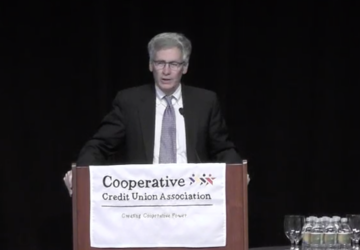
Mark McWatters addresses the meeting
In remarks to the Cooperative Credit Union Association’s annual meeting convention at the Mohegan Sun resort here, McWatters said any outsider in Washington looking into its Alexandria, Va., headquarters might see a “deadlocked board.”
“We have one Democratic member (Rick Metsger) and one Republican member (McWatters). If we followed the traditional 2018 D.C. model we would be accomplishing very little. We would be carping at one another,” McWatters told the meeting. “When Rick became chair it struck me and it struck him that we needed to change the tenor that had occurred under the chair prior to Rick. It was a bit embarrassing to me. Rick and I sat down and decided we were going to turn the page and work with each other from a collegial perspective. And collegiality means respect, that reasonable minds may differ, but if you have a principled position I will respect it. And if you respect mine, we can negotiate.
Not a Pie in the Sky
“It also means collaboration and working together and trying to achieve something,” McWatters continued. “And, lastly, it means compromise. As Mick and Keith said, ‘You may not always get what you want, but you will get what you need.’”
McWatters said that while that description may sound “pie-in-the-sky-ish,” for the past two and a half years he and Metsger have been able to make it work.
Other points made by McWatters, whose chief of staff, Sarah Vega, is leaving to become president and CEO of the Cooperative Credit Union Association, during his remarks included:
The Role of Regulation
“My goal is targeted regulation. People who are lazy or incompetent don’t know who they regulate and they are fearful of something blowing up on their shift, so they create shotgun regulations in the hope it will hit something along the way. I prefer to know what I’m doing, target it, and allow you who run credit unions to do it on a regular basis.
“In addition to being targeted, regulations need to be as simple as they can be. I am regulating a lot of credit unions that are very small. They don’t have the time or money to lawyer-up, CPA-up. They need to be able to read the regulation and proceed with it. And to the greatest extent possible those smaller CUs should be exempted from the regulations, as they don’t present the same risk to the insurance fund as the largest CUs do.”
Issues Before the Board
McWatters outlined various issues the board has faced or is facing, including closure of the Temporary Corporate CU Stabilization Fund and the resulting payout; progress made on field of membership revisions; changes made to its risk-based capital proposal, which will be on its board agenda later this month and will delay the rule until Jan. 1, 2020 and also raise the asset threshold for compliance; the updating of CU bylaws; a supplemental capital proposal he said should be ready for the board agenda for either the November or December meeting, and extended exam cycles and off-site exams.
He added the agency is “beginning to think” about a rewrite of its derivatives rules and also rules around corporates.
“This is not 2008-09,” he said. “I know some corporates made some horrific mistakes, but the shackles put in place in 2008, 2009 are not necessarily where they need to be today.”
Third Party Oversight
As CUToday.info reported here, McWatters recently testified before the Senate and again called for NCUA to be given oversight authority over third-party vendors.
Asked by an audience member whether NCUA can add that authority without substantially increasing costs, McWatters responded, “The truth is I really don’t know, and that’s because I don’t know how much of a problem this really is. The need for vendor authority, particularly in the tech area, is there. If there is a problem it could ripple through the credit union community and the reputational risk to CUs could be well in excess of the risk to the NCUSIF. Will Congress actually give us this authority? I have no idea. I’m not the first person to ask for this.”
As for the ongoing budget increases at NCUA, McWatters said, “We are losing about a credit union a day, so you would think the budget should be dropping accordingly. I get that argument. At the same time, the credit union community in just the time since I joined it four years ago has gone from just over $1 trillion in assets to one-trillion, 500 billion dollars. That’s stunning.”