CHARLOTTESVILLE, Va.–U.S. bank margins fell again in the third quarter, retrenching to levels not seen since the first quarter of 2018, according to S&P Global Market Intelligence.
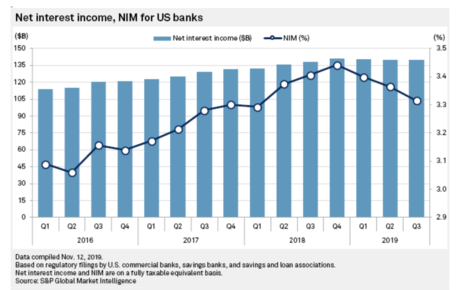
After declining three basis points in the second quarter, bank margins fell four more basis points in the third quarter, with the industry's taxable equivalent net interest margin falling to 3.32% from 3.36%, S&P reported in its latest analysis.
“Higher interest rates lifted bank margins in 2017 and 2018, but that ceased in 2019 as long-term interest rates plunged and the Federal Reserve pivoted to lowering short-term rates,” the company said. “Even before the Fed eased rates, the shift and decline in long-term rates limited expansion in earning-asset yields while funding costs continued to rise.”
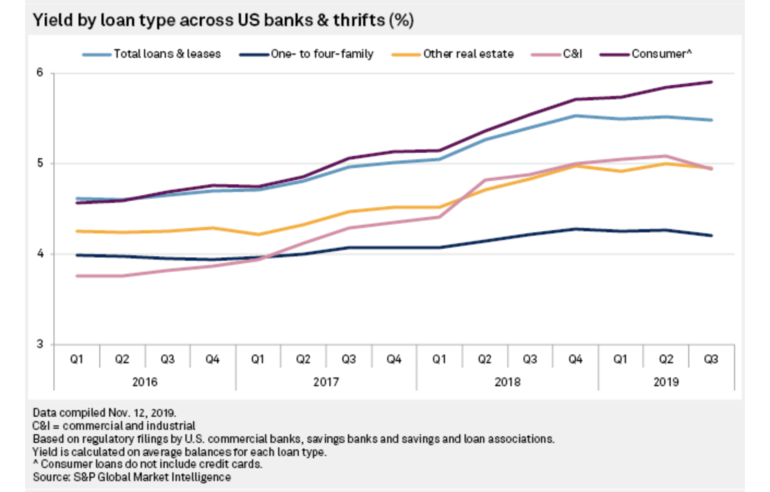
Loan yields dropped three basis points sequentially in the third quarter, falling to 5.48%, led by contraction in yields on commercial and industrial credits, which tend to be tied to short-term rates.
The Findings
Among the other findings released by S&P Global Intelligence in its new analysis:
- The average effective fed funds rate in the third quarter rose 25 basis points from a year earlier but dropped 22 basis points from the prior quarter, with the pair of rate cuts by the Fed in late July and September.
- Yields on commercial and industrial loans rose from year-ago levels given the year-over-year increase in short-term rates, but the metric climbed only 6 basis points from a year earlier. The expansion in C&I yields fell well short of increases in short-term rates due to competition and the changing rate environment. For C&I loans, the beta — or percentage of changes in fed funds over the last 12 months that banks passed on to borrowers — was 24%, down from 39% in the second quarter and 66% in the first quarter, the company said.
- C&I yields seem likely to fall in the coming quarter given the recent decline in short-term rates.
- Spreads had expanded three quarters ago, ending 35 straight periods of weakening. The most recent survey focuses on changes in lending standards and terms and featured responses from 76 domestic banks and 22 U.S. branches and agencies of foreign banks. In the survey, a net 20.5% of banks responding reported weaker spreads on C&I loans to large and midsized firms, relative to the lenders' cost of funds. That compares to 26.8% of respondents reporting stronger spreads in the previous quarterly survey, from July.
- Banks in the survey also reported far weaker demand for C&I loans from large and middle-market firms. The decline represented the fifth consecutive quarter of weaker demand for C&I credits, according to S&P Global Market Intelligence
- Yields on other asset classes, save for consumer loans, also declined in the third quarter. “Steady decreases in long-term rates added to pressure on loan rates, with the average yield on the benchmark 10-year Treasury falling another 50 basis points in the third quarter amid continued fears over a global economic slowdown and the trade war between the U.S. and China. The yield on the 10-year averaged 2.17% through the first nine months of 2019, down 75 basis points from 2018.”
- Yields on longer-dated credits, such as one- to four-family mortgages, have declined this year, falling another five basis points sequentially in the third quarter.
- While loan yields declined, deposit costs held flat with the prior period, but rose 30 basis points from a year ago. The deposit beta jumped above 100% in the third quarter from 63% in the second quarter and the 45% level experienced in the year-ago period.
- Meanwhile, the beta on total loans and leases was far lower than the deposit beta in the third quarter. The overall loan beta was 35% in the third quarter, compared to 38% in the prior quarter and 56% in the year-ago period.
Forecast for Loan Yields
“Loan yields might not decline as much in the fourth quarter with the Fed seemingly on hold and long-term rates rebounding from the recent lows experienced in the summer,” the company said in its analysis. “However, newly originated credits still likely will carry lower rates than loans made a year ago. Deposit rates, meanwhile, might have peaked, but how quickly they could decline remains up for debate. Until funding costs began to decline notably, bank margins could remain under pressure.”