

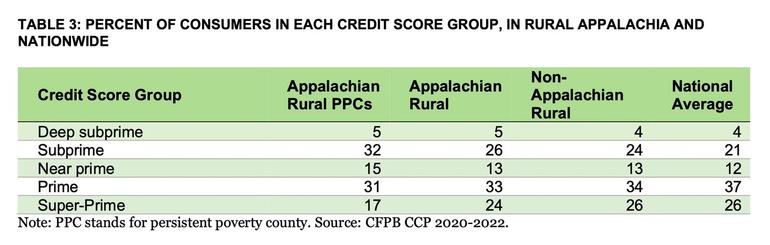
WASHINGTON–A new report from the CFPB that focuses on rural Appalachians found people in the region tend to earn less than consumers in other rural areas, have higher rates of subprime credit, and, in particular, see a much higher rate of medical debt collections.
As a result of the latter, Appalachian residents often experience difficulties making ends meet on other financial obligations, according to the CFPB, which said the report is the first in what will be a series of reports focusing on the finances of consumers living in rural areas.
The CFPB’s report finds that nearly 24% of rural Appalachians have a medical debt in collections, compared to just 17% nationally. Moreover, rural Appalachians with medical debt collections have over double the rates of delinquency for other credit products compared to those without medical debt collections in each category.
“For example, while 12% of rural Appalachians had auto loans that were delinquent, those with medical debt collections had a 29% rate of auto loan delinquency,” the CFPB said.
Primary Findings
According to the CFPB, the report’s primary findings include:
- 15% of rural Appalachians had a credit card delinquency, while 37% of rural Appalachians dealing with a medical debt collection also had a credit card delinquency.
- 18% of rural Appalachians had student loans that were delinquent, while rural Appalachians with a medical debt collection had a 37% rate of student loan delinquency.
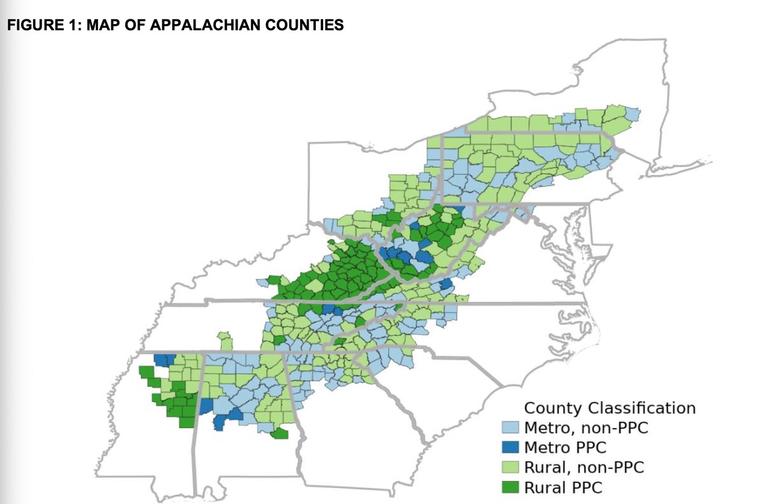
- In the region covered in the report—primarily rural portions of 13 states—33% of the nearly 26 million Appalachians live in a rural county, compared to 14% of people nationwide. “More than two-million Appalachians live in Persistent Poverty Counties (PPCs), which are defined as counties that have had poverty rates of 20% or higher for the past 30 years. Consumers in PPCs often encounter higher interest rates and fewer financial offerings due to the increased credit risk in the county,” the CFPB said.
Additional Findings
Other findings in the CFPB’s report include:
- Only 71% of rural Appalachians and 63% of rural Appalachians living in PPCs have an active credit card, compared to 80% of consumers nationally. “Consumers that do not have access to credit cards often have to turn to more costly alternatives for credit, such as payday loans and pawn shops.”
- The median of student loan balances as a percentage of household annual income is 41% for rural Appalachians, compared to 32% for the nation. Auto loan balances account for 31% of household annual income for rural Appalachians, compared to 21% nationally.
- Denial rates for mortgage applications in rural Appalachia (21%) were almost twice the rate of mortgage applications nationally (11%). For rural Appalachian PPCs, the denial rates were 35%.
- Rural Appalachians endured higher home loan interest rates for home purchases in 2021 compared to the nation. The national average was 3.13%, while rural Appalachians had an average rate of 3.41%. Rural Appalachian PPCs had average rates of nearly 4% (3.86).
The full report can be found here: Consumer Finances in Rural Appalachia