

ALEXANDRIA, Va.–The NCUA board was given an update on the status of minority depository institution (MDI) credit unions, which, although they represent 10% of all credit unions, are “sadly disappearing,” according to one board member.
Several of the board members pledged various levels of support for MDIs, with Board Member J. Mark McWatters even proposing the agency act in a “matchmaker” role as one means of making the institutions more viable.
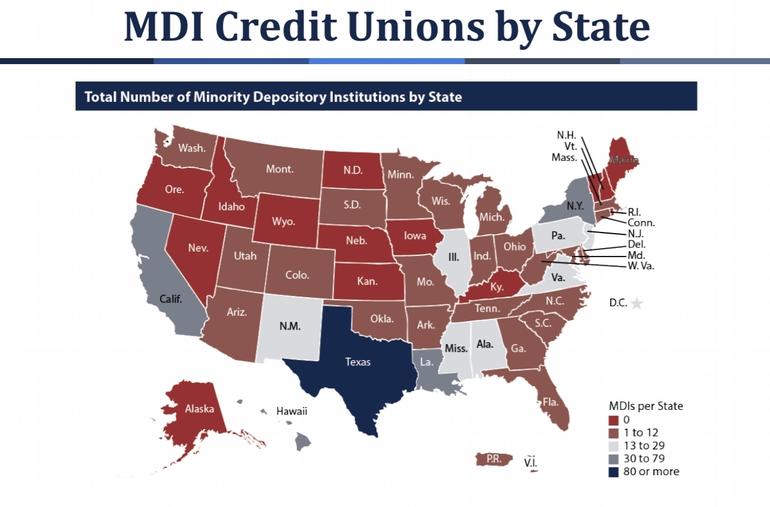
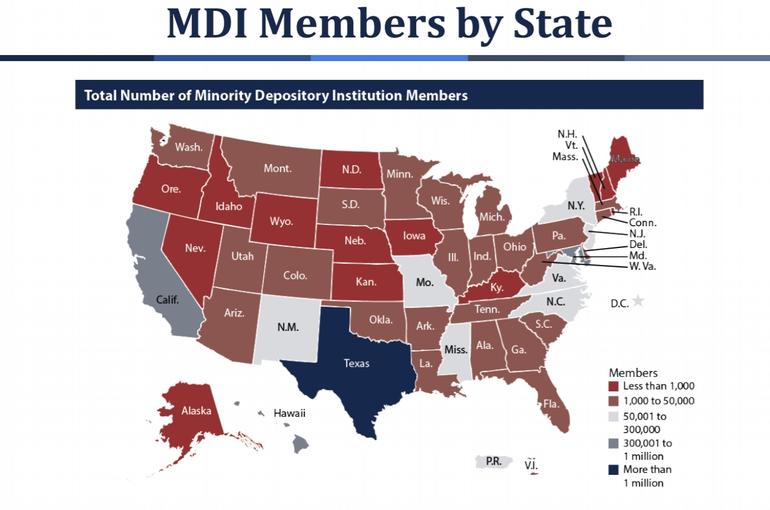
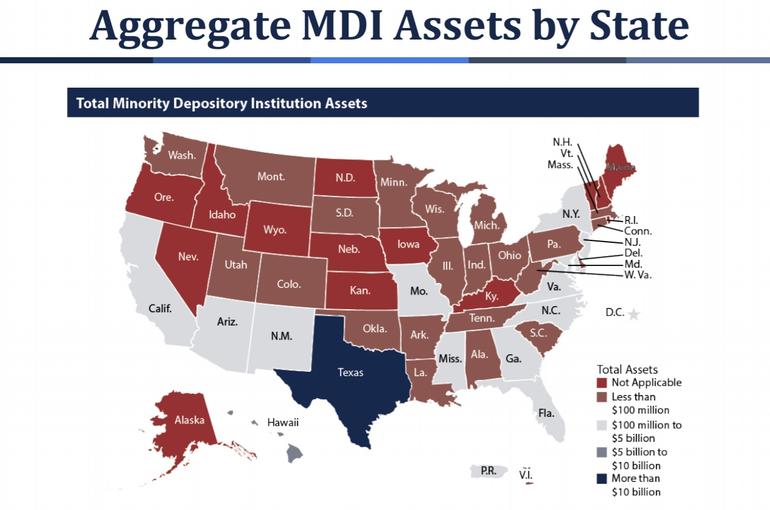
During a presentation by agency staff, the board was told there are currently 514 MDI CUs operating in 36 states, the District of Columbia, Puerto Rico and the U.S. Virgin Islands. The institutions are typically small, and the combined assets of those more than 500 institutions is approximately $40 million.
NCUA Chairman Rodney Hood said MDIs, and all credit unions, can play a role in addressing some of the diversity, racial and equality issues that have been much in the news across the United States over the past month.
NCUA Board Member Todd Harper called MDIs a “critical part” of the system of cooperative credit, shared the story of his own visit to one MDI, and said he witnessed how vital the work being done is and said he is “fully committed” to support for the institutions.
Harper said he will continue to urge Congress to provide more funding NCUA’s Revolving Loan Fund, and he further urged credit unions to apply for grants available from NCUA.
The Key Takeaway
Following the NCUA staff presentation on MDIs, NCUA Board Member J. Mark McWatters offered several proposals related to the viability of MDIs, including an opportunity for the agency to play “matchmaker.”
“The key takeaway from today’s presentation is that MDIs are disappearing, institution-by-institution, and that’s the unfortunate reality we face today. This paradigm presents two questions for our consideration: Why are MDIs disappearing? And, what can we do about it? I do not know the definitive answers to these inquiries, but will offer my thoughts for your consideration.”
McWatters said MDIs are principally disappearing because they cannot operate at the necessary economies of scale to support the business plan and model that are demanded by consumers of financial services today. Those services include specific loan and account programs and other services that younger members, in particular, expect from their financial institutions, he said.
“Most notably, today’s members expect to conduct a distinct majority of their financial services from their smartphones,” McWatters said. “This includes not only reviewing their account balances but also depositing checks; transferring funds; monitoring activity in their checking, savings, IRA, 401(k), and other accounts; applying for automobile, mortgage, and other loans; paying their credit card, utility and other invoices; as well as engaging in an emerging and expanding array of other financial activities.”
Proposals Made
McWatters said he visits his own primary financial institution less than once per year, as do his two twenty-something sons.
“In my view, any financial institution that doesn’t offer these services places itself at risk, as today’s younger generation transitions to middle-age consumers with their enhanced needs for seamless access to hassle-free financial services,” McWatters said.
McWatters said he believes the “problem” is relatively simple, and that is maintaining such sophisticated financial services in a secure environment requires the deep pockets that most MDIs simply don’t have.
“While many, if not most, MDIs certainly appreciate the acute need to adopt these platforms, they don’t because they can’t afford the personnel, advisors, and consultants that are necessary to stand up and maintain the computer systems and networks serving as the back-office for the most consumer friendly financial services computer applications,” McWatters said. “Operating through a CUSO or another third party, while often more cost effective, nevertheless presents a financial challenge to many MDIs.”
One Potential Risk
McWatters said one approach to consider would be mergers between financially weaker MDIs and other larger and more financially robust credit unions, although that brings with it a risk.
“This approach may solve one issue – the financial challenges of the MDIs – but it may create another problem – the closing of MDI branches that leave minority communities as financial deserts where residents do not have access to federally insured financial institutions within a reasonable distance.”
Another approach to consider, suggested McWatters, would be having two MDI credit unions, merge, with the surviving MDI credit union continuing to serve the fields of membership of both credit unions without abandoning either minority community to payday lenders and other similar institutions.
“These mergers only work if one of the merging MDIs is sufficiently financially viable so as to assist the merging partner,” said McWatters.
The board member also offered a third option to consider, and that is the merger/consolidation of three or more MDI credit unions.
“I would think that the NCUA, wearing the slightly unorthodox hat of matchmaker could offer introductions to an array of struggling MDIs with compatible fields of membership and relative geographic proximity,” said McWatters. “At the end of the day, for example, five $100-million MDI credit unions could consolidate into one $500 million MDI institution with economies of scale and market force. As necessary, a non-MDI credit union that offers financial stability, together with viable IT and related expertise, could join the group provided the surviving credit union qualifies as an MDI.”
‘Financial Pacman’
McWatters acknowledged the proposed suggestions are easier said than done for a variety of reasons.
“The reality, as I see it today, is that we are going to have far fewer MDI credit unions within the next few years. We can wait on the sidelines and let larger non-MDIs gobble up smaller MDIs like a game of Financial Pacman or we can work together to help orchestrate the consolidation of MDIs into much larger, more financially stable, institutions that are committed to serving minority communities as financially formidable MDI credit unions,” said McWatters.