

MADISON, Wis.–Credit union loan balances were up 0.5% in September, while CU membership growth continues to be anemic, according to the latest CUNA Mutual Trends Report.
The November Trends Report, which is based on CU data through September, is now projecting the economy will grow at a 4% annualized rate in the fourth quarter and 3% during 2021.
“The probability of a double dip recession this winter is rising as the number of daily new COVID-19 cases rises,” the report states. “Government mandated shutdowns of non-essential businesses and stay-at-home orders could result in job losses in the first quarter of 2021.”
Here’s a look at how credit unions performed by category, according to the Trends Report:
Total Credit Union Lending
Credit union loan balances rose 0.5% in September, slower than the 0.6% pace reported in September 2019, the Trends Report found. Driving overall loan growth was strong growth in unsecured personal loans (2%), fixed-rate first mortgages (1.5%) and used-auto loans (0.5%).
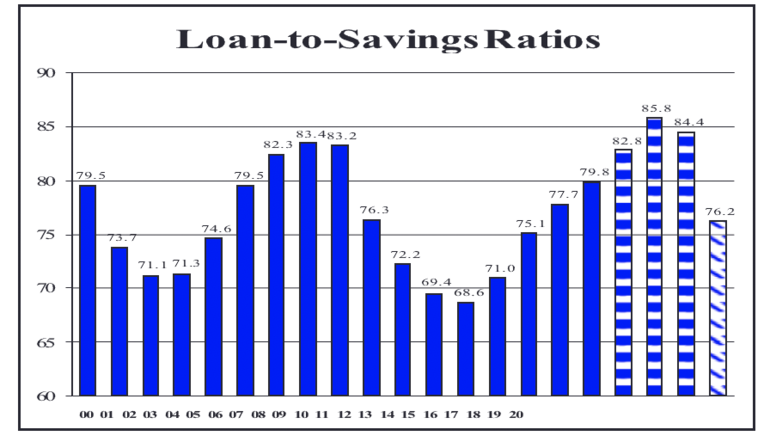
The analysis found the credit union average loan-to-savings ratio fell to 76.2% in September, down from 84.6% in September 2019 due to deposit growth exceeding loan growth.
“This decline is like the drop experienced during 2008-2009,” CUNA Mutual said. “Loan-to-savings ratios peak right before recessions and may contribute to the economic slowdown that follows due to tight liquidity from credit unions reducing their pace of lending and high levels of members’ debt reducing their demand for loans. Based on current trends, credit union lending growth is expected to rise 6.5% in 2021 while savings balances increase 8%. This will drop the average loan-to-savings ratio to 75% at year’s end 2021, equal to the long run average.”
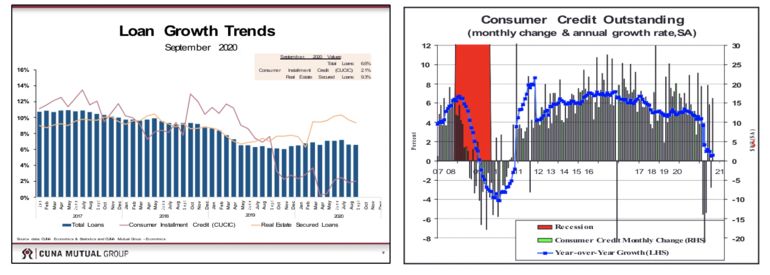
Credit Union Consumer Installment Credit (CUCIC)
Credit union consumer installment credit loan balances (auto, credit card and other unsecured loans) rose 0.5% in September, faster than the 0.2% rise set in September 2019, according to the Trends Report.
“We expect consumer credit growth to be subdued over the next few years due to strong credit growth during the last few years and consumers savings more of their income,” CUNA Mutual’s economists said.
Vehicle Loans
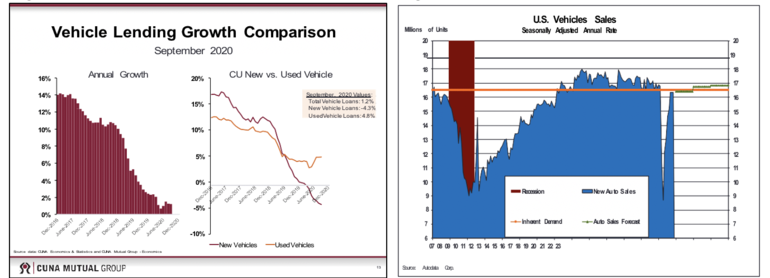
Credit union new-auto loan balances were unchanged in September, below the 0.3% growth pace set in September 2019. New-auto loan balances fell 4.3% during the last 12 months, significantly below the 2.2% increase set in the year ending in September 2019.
“Recently, credit unions lost two percentage points of the new vehicle loan origination market to the banking sector,” the Trends Report states. “Large banks have turned to the auto lending market as commercial lending volume tapers off.” The report found auto loan balances have risen 1.2% since September 2019, which is slower than overall loan growth, and in turn has led to auto loans making up only 32.5% of the credit union loan portfolio, down from 34.2% last year.
Real Estate Secured Lending
Credit union fixed-rate first mortgage loan balances grew 1.5% in September, above the 1% pace set in September 2019 due to existing-home sales rising 9.4% from August, according to the Trends Report.
Adjustable-rate mortgage loan balances fell 0.7% in September, below the 1.1% gain recorded in September 2019.
CUNA Mutual reported home equity lending balances fell 1.5% in September, which is significantly below the 0.1% gain reported in September 2019. “Some credit union members are paying down their outstanding balances with funds obtained from refinanced first mortgage loans faster than other members are tapping into their home equity,” CUNA Mutual said.
“We expect the 10-year Treasury interest rate to remain below 1% for the next year and the mortgage loan risk premium to fall below 2% over the next few months,” the Trends Report stated. “Therefore, we can expect the 30-year mortgage interest rate to hover in the 2.75% to 3% range over the next year.”
Home Price Bubble?
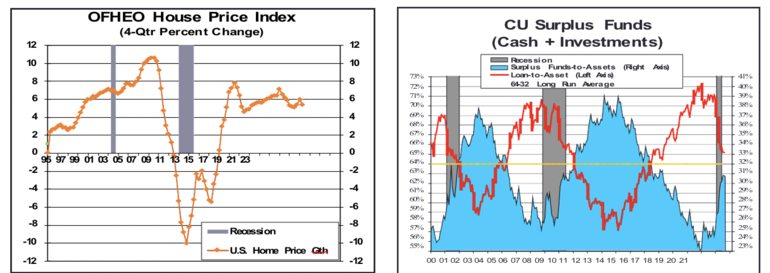
CUNA Mutual noted some people are concerned that home prices are becoming overvalued again and creating another home price bubble.
“One way to measure overvaluation is to compare today’s home price-to-income ratio and home price-to-rent ratio to their historical averages. Historically, a house in the U.S. cost around 3 to 3.5 times the median annual income,” CUNA Mutual’s economists said. “During the housing bubble of 2004-2005, the median price for a single-family home cost more than 5.1 times the median annual household income in November 2005. Today, that ratio stands at 4.6. This ratio is heavily influenced by interest rates, and when interest rates go down, the affordability of a house goes up, so people spend more money on a house.”
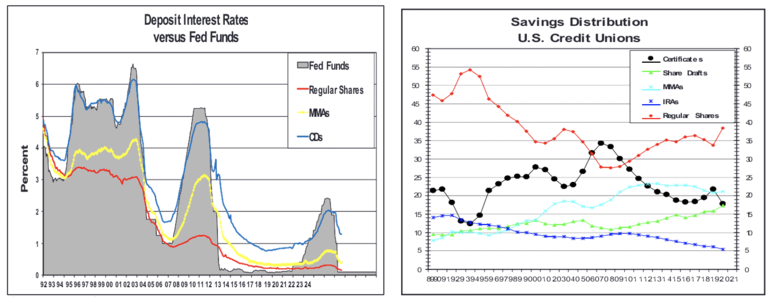
Surplus Funds (Cash + Investments)
Credit union liquidity rose over the last year while loan growth fell below asset growth. Credit union surplus funds as a percent of assets rose to 30.7% in September, above the 24.5% reported one year earlier due to surplus funds growth (46%) outpacing asset growth (16.3%), CUNA Mutual reported.
Credit union borrowings fell 13% over the last year ($7.2 billion) due to loan demand being weaker than saving supply. Credit union borrowings as a percent of assets stands at 2.7%, the lowest percentage of assets since March 2014. Loans fell to 65.2% of assets in September, below the 71.1% set one year ago. The loan-to-asset ratio is approaching its long run average of 64%, CUNA Mutual said.
The Trends Report found currently, 57% of credit union surplus funds have a maturity of less than one year, up from 52% in September 2019.
“The large holding of shorter maturity investments was due to expectations of future deposit withdrawals when the pandemic subsides, and the economy bounces back,” the Trends Report stated. “The shift to shorter-maturity investments reduces credit unions’ exposure to falling investment values when interest rates rise sometime in the future. But this interest rate risk reduction comes at a cost, specifically an opportunity cost, or what is given up.”
Savings and Assets
Credit union savings balances rose 0.7% in September, more than the 0.3% drop reported in September 2019 due to Americans increasing their savings as a percent of their income, according to the Trends Report.
“September, however, is typically a weak month for savings growth due to seasonal factors such as back-to-school shopping and college tuition payments,” the report states. “Savings balances rose a strong 18.3% during the last 12 months due to $1,200 stimulus checks, COVID-19 induced uncertainty, falling gasoline purchases, aging demographics and fears of recession.”
The Trends Report added credit union cost of funds is expected to fall 15 basis points in 2020 due to the Federal Reserve lowering the Fed Funds interest rate 0.1%. Credit unions also followed suit and lowered interest rates on share certificates and money market accounts, similar to what they did in 1998, 2001 and 2008.
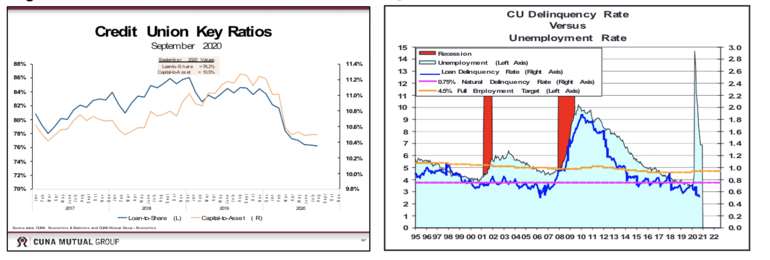
Capital & Other Key Measures
The credit union system’s capital-to-asset ratio fell to 10.5% in September, down from 11.3% in September 2019 due to a surge in deposits and assets and a slowdown in earnings. The capital ratio is down 0.8% from what was reported in September 2019 due to asset growth of 16.3% outpacing capital growth of 8.3%, the report states.
The Trends Report added loan forbearance programs kept loan delinquency rates at near record low levels. The loan delinquency rate (loans two or more months delinquent as a percent of total loans outstanding) fell to 0.53% in September, down from 0.67% in September 2019 even though the unemployment rate stood at 7.9%, well above the “natural unemployment rate” of 4.5%.
“We expect loan delinquency rates to rise in the fourth quarter and charge offs to rise in quarter one of 2021,” CUNA Mutual said.
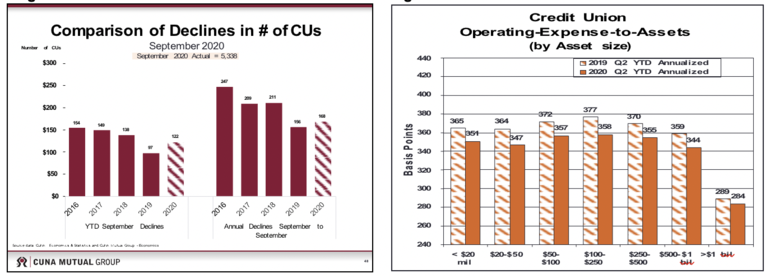
Number of Credit Unions
As of September 2020, CUNA estimates 5,338 credit unions were in operation, down 168 from September 2019. Year-to-date, the number of credit unions fell by 122, slightly faster than the 97 decrease reported in the first nine months of 2019, CUNA Mutual reported.
NCUA’s Insurance Report of Activity showed 34 mergers were approved in the third quarter, with an average asset size of $45 million, the Trends Report stated. The average asset size of the continuing credit union was $1.5 billion. Twenty-nine of the mergers were due to credit unions wanting expanded services, four were due to poor financial conditions and one was due to loss/declining field of membership.
“The pace of consolidation continues in both the credit union and banking industries,” the Trends Report states. “This consolidation trend will lead to larger and more efficient depository institutions with lower operating expense ratios and a more competitive financial services industry.”
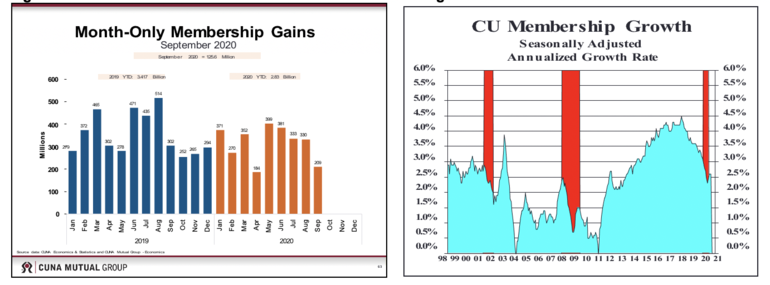
Credit Union Membership
Credit unions added more than 2.8 million memberships in the first nine months of 2019, significantly below the 3.4 million added in the similar time period of 2019, the Trends Report found.
“Slowing demand for credit was the major driver for the slowdown in memberships,” the CUNA Mutual analysis states. “Credit union consumer loan balances increased $11.2 billion in the first nine months of this year, below the $14.4 billion for the similar time period in 2019. Also driving the slowdown in memberships was the slowdown in job creation in the U.S. During the first nine months of 2019, the economy added approximately 1.5 million jobs, compared to losing 10.2 million jobs so far this year.”
Credit union memberships grew at a 2.5% seasonally-adjusted annualized growth rate in September – a significant slowdown compared to the last few years, CUNA Mutual said, adding, “We expect membership growth to rise in 2021 to around 3% as consumer credit growth rebounds.”