MADISON, Wis.–Credit union loan growth remained strong through November 2018—although once again there are strong disparities between large and small CUs–whileaverage annualized loan yields rose to 4.66% as old lower-rate loans repriced.
Credit union memberships, meanwhile, grew 227,000 in November, significantly below the 326,000 new members during November 2017. Still, year-to-date credit unions added 4.625 million new members, faster than the 4.035 million members added during a similar period in 2017, according to the latest data released as part of CUNA Mutual’s Trends Report for January of 2019.
Here's a look at how credit unions performed by category through November 2018, according to CUNA Mutual’s Trends Report.
Total Credit Union Lending
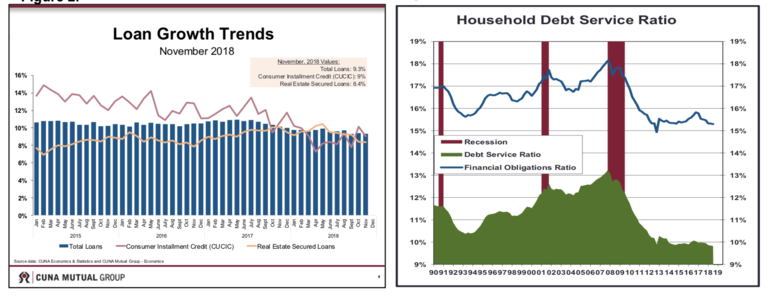
Credit union loan balances rose 0.6% in November, less than the 0.7% pace reported in November 2017. Driving overall loan growth was strong growth in credit card loans (1.3%), unsecured personal loans (1.1%) and home equity loans (0.8%), CUNA Mutual reported. The company’s economists said November seasonal factors typically subtract 0.22 percentage points from the underlying trend loan growth, as winter weather slows auto and home purchases.
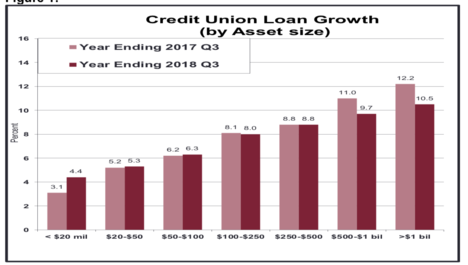
“Over the last 12 months, total credit union loan balances rose more than 9.3%, above the 7.9% long-run average,” CUNA Mutual said. “But industry growth rates mask big disparities between large and small credit unions. In the year ending in the third quarter of 2018, credit unions with assets greater than $1 billion reported a 10.5% increase in loan balances, which was down slightly from the similar time period one year earlier. Credit unions with assets less than $20 million reported loan growth of only 4.4%, above the pace set one year earlier. We expect overall credit union loan growth to slow to 8% in 2019.”
Credit Union Consumer Installment Credit (CUCIC)
Credit union consumer installment credit balances (auto, credit card and other unsecured loans) rose 0.5% in November, slower than the 1.5% pace set in November 2017, CUNA Mutual reported. Consumer installment credit grew 9% over the last year, faster than the 8.4% rise in real estate loans.
Vehicle Loans
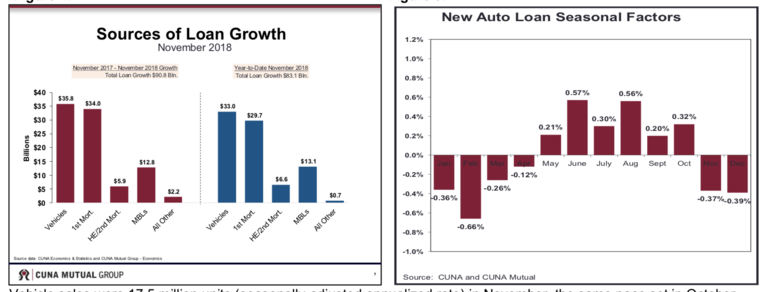
Auto loans remain credit unions’ “bread and butter” loan product with vehicle loan balance growth outpacing the growth in mortgage and business loans, the CUNA Mutual analysis shows. During the last 12 months, vehicle loan balances increased $35.8 billion (10.7% growth rate), slightly better than the $34 billion increase for first mortgage loans (8.7% growth rate), CUNA Mutual added. New-auto loan balances rose a modest 0.3% in November, below the 0.7% pace set in November 2017. November is typically one of the slower months of the year for auto loan originations.
Real Estate Secured Lending – First Mortgages and Other Real Estate
Credit union fixed-rate first mortgage loan balances grew 0.4% in November, below the 1.3% pace set in November 2017, as existing-home sales rose 2% in November from October, but are down 7% over the last year, the Trends Report pointed out. As CUToday.info has reported and the Trends Report confirmed, home sales are limited due to a lack of homes for sale.
“The national homeownership rate reached 64.4% in the third quarter of 2018, above the 63.9% reported in the third quarter of 2017,” according to CUNA Mutual. “Today’s homeownership rate is above the 62.9% nadir reported in the second quarter of 2016, but below the 69.2% apex reached in fourth quarter of 2004.”
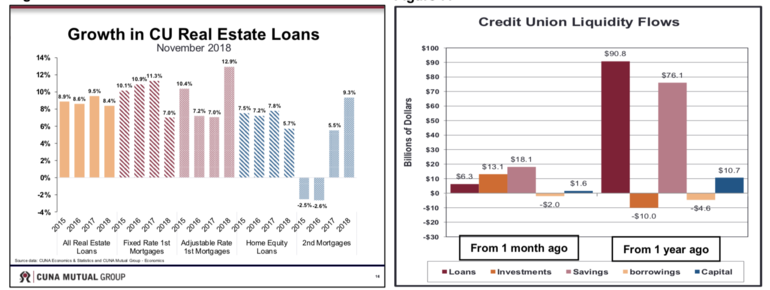
The Trends Report said from November 2017 to November 2018, fixed-rate first mortgage loan balances grew 7%, significantly below the 12.9% increase in adjustable-rate mortgage balances but higher than the 5.7% growth of home equity balances. Second mortgage balances have broken out of their multi-year slump by growing 9.3% during the last twelve months.
The contract interest rate on a 30-year, fixed-rate conventional home mortgage rose to 4.87% in November, from 4.83% in October, and above the 3.92% reported in November 2017.
“With the Federal Reserve expected to raise short-term interest rates 50 basis points in 2019, along with the running-down of their holdings of Treasury securities, expect the 30- year mortgage interest rate to move higher in 2019,” the Trends Report forecasts.
Surplus Funds (Cash + Investments)
Credit union surplus funds rose $13.1 billion, or 3.8%, in November due to a surge in savings balances caused by the month ending on a payroll Friday. Deposit inflows ($18.1 billion) were also used to pay down borrowings (-$2.0 billion) and fund the $6.3 in loan growth, CUNA Mutual reported.
Credit union surplus funds as a percent of assets fell to 24.2% in November, down from 26.4% in November 2017, as credit union assets rose 6.1% and surplus funds fell 2.7%. The obverse of the falling surplus funds ratio is the rising loan-to-asset ratio, which reached 71.5% in November, the highest level since October 1981.
“According to third quarter NCUA call report data, average annualized loan yields rose to 4.66% – a record low – during the first nine months of 2018, up from 4.53% for the similar period in 2017, as old lower-rate loans re-priced into today’s higher interest rates,” CUNA Mutual reported. “Credit union yield-on-asset ratios rose 25 basis points to 3.74% during the first nine months of 2018 due to rising loan-to-asset ratios – the ‘mix effect’ – and slightly higher interest rates, the ‘rate effect.’”
Credit union costs of funds rose 10 basis points during the last year, coming in at 0.64% in the first nine months of 2018. Net interest margins therefore rose 15 basis points to 3.1% in 2018, the fifth consecutive year of rising margins after hitting a record low of 2.77% in 2013, the report added.
Savings and Assets
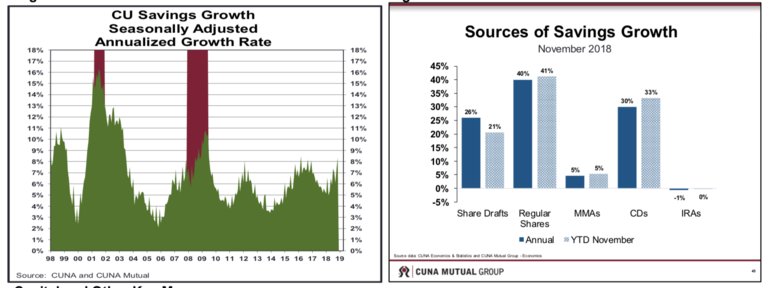
Credit union savings balances rose 1.5% in November, better than the 0.4% gain reported in November 2017, due to the month ending on a payroll Friday. Credit unions reported a savings inflow of $76.1 billion during the last 12 months, a 6.5% increase. Almost 41% percent of this inflow ($31.2 billion) was deposited into low-cost regular share accounts, according to the Trends Report.
Capital and Other Key Measures
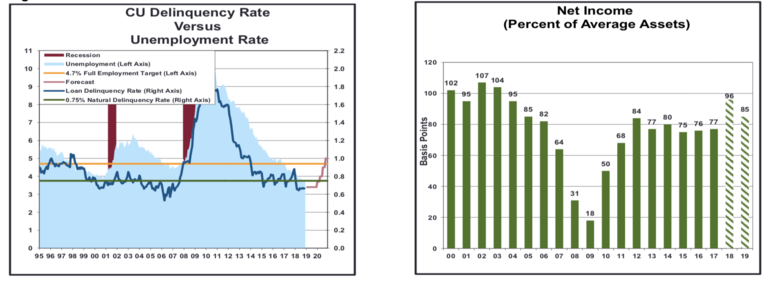
The loan delinquency rate (loans two or more months delinquent as a percent of total loans outstanding) has remained at 0.66% from March to November, CUNA Mutual said.
“This breaks from the traditional seasonal pattern,” the analysis states. “Delinquency rates typically reach their nadir in the first quarter as members use their tax refunds and bonus checks to catch up on any late loan payments. As the year progresses, delinquency rates slowly rise and reach their apex late in the fourth quarter. On a year-over-year basis, the loan delinquency rate is 19 basis points lower than the 0.85% reported in November 2017. Expect loan quality to remain below the 0.75% long-run natural delinquency rate in 2019 as the unemployment rate remains below the 4.7% full employment rate and loan growth exceeds 8%.”
Credit union return-on-asset ratios came in at 0.96% (annualized) for the first nine months of 2017, above the rate set during the previous seven years since the Great Recession, due to the NCUA Corporate Stabilization refund, CUNA Mutual said. The company’s economists said credit unions can expect credit union return-on-asset ratios to come in at 85 basis points in 2019 as net interest margins increase.
Credit Unions and Members
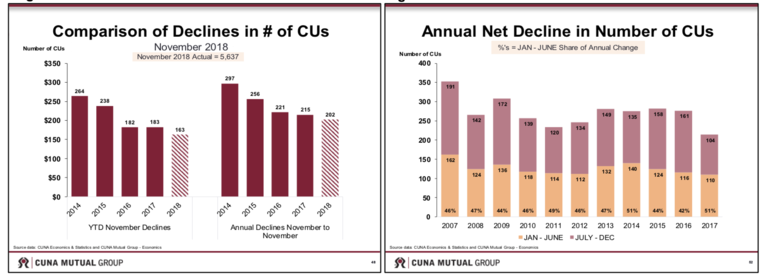
As of November 2018, CUNA estimates 5,637 credit unions were in operation, down 202 from November 2017. Year-to-date the number of credit unions fell by 163, slightly lower than the 183 reported in the first 11 months of 2017, CUNA Mutual said.
The annual contraction rate of the credit union industry reached 3.5% in 2018, equal to the 3.5% average pace set over the last 25 years. NCUA’s Insurance Report of Activity showed 53 mergers were approved in the fourth quarter with an average asset size of $29 million for the merging credit union and $947 million for the continuing credit union. This is up from the 50 mergers reported in the fourth quarter of 2017 with an average merging asset size of $23 million, CUNA Mutual said.
Starting in 2006, 46% of the annual decline in the number of credit unions took place in the first half of the year and 54% in the second half.
Credit union memberships grew 227,000 in November, or 0.19%, which is significantly below the 326,000 new members, or 0.29%, added in November 2017, according to the Trends Report. Year-to-date credit unions added 4.625 million new members, faster than the 4.035 million members added during a similar period in 2017. During the last 12 months, credit unions memberships rose 4.4%, the fastest pace in more than 20 years.
According to the Trends Report, total credit union memberships reached 118.3 million in November, 5.013 million more than November 2017. For 2019, CUNA Mutual is forecasting credit union membership growth to be at 3.5%, slightly below the 4.4% pace in 2017.