

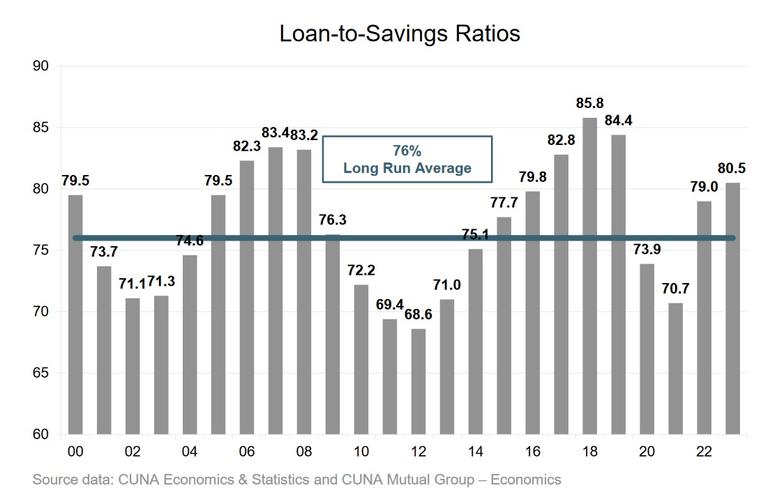
MADISON, Wis.–Lending at credit unions should grow 8% in 2023 with the average loan-to-savings ratio to 80.5% at year’s end, according to the forecast in CUNA Mutual’s new Trends Report.
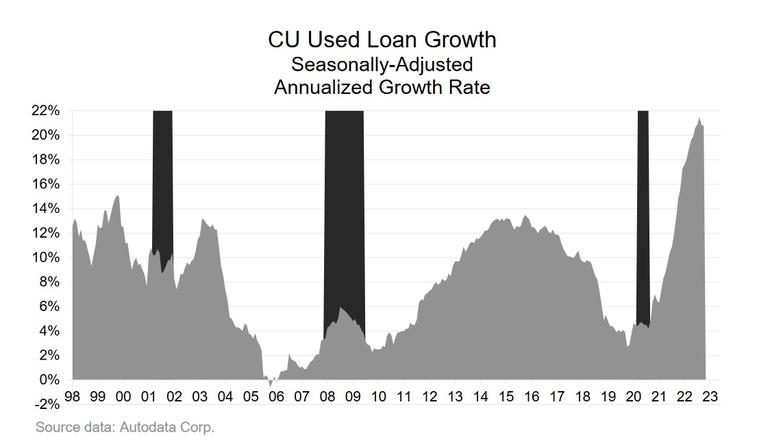
The findings come as auto lending at credit unions remains in the left lane, with used car balances growing at the fastest pace on record, according to the November Trends Report, which is based on CU performance data through October.
Meanwhile, the Report is forecasting credit union cost-of-funds ratios to rise 100 basis points during the next year as credit unions raise their certificate and money market account interest rates.
Here's a look at how credit unions performed by category according to the CUNA Mutual Trends Report:
Total Credit Union Lending
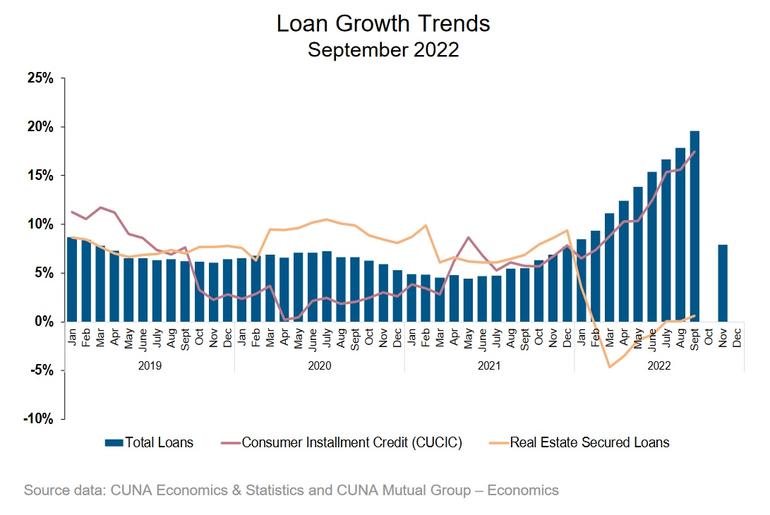
Credit union loan balances rose 2.1% in September, faster than the 0.6% pace reported in September 2021. Driving overall loan growth was strong growth in home equity loans (3.8%), new auto loans (3.1%), used auto loans (1.9%) and unsecured personal loans (1.9%), the Trends Report analysis shows.
According to the report, the credit union average loan-to-savings ratio rose to 79% in September, up from 70.4% in September 2021, due to loan growth (19.6%) exceeding deposit growth (6.6%).
“Loan-to-savings ratios peak right before recessions and may contribute to the economic slowdown that follows due to tight liquidity from credit unions reducing their pace of lending and high levels of members’ debt reducing their demand for loans,” the Trends Report states. “Based on current trends, credit union lending growth is expected to rise 8% in 2023 while savings balances increase only 6%. This is expected to raise the average loan-to-savings ratio to 80.5% at year’s end of 2023, significantly above the 20-year average of 76% and indicating many credit unions are seeing their liquidity positions tighten as interest rates rise and deposit growth slows.”
Consumer Installment Credit
Credit union consumer installment credit loan balances (auto, credit card and other unsecured loans) rose 1.7% in September, faster than the 0.1% rise set in September 2021, CUNA Mutual’s chief economist, Steve Rick, said in his analysis in the Trends Report. “During the last 12 months, credit union consumer installment credit grew 17.5%, significantly above the 0.6% for real estate-secured loans.”
The Trends Report cited Federal Reserve data showing outstanding consumer credit for all lenders rose a strong $25 billion in September, with balances up 8% over the last year. Credit unions hold 11.5% of all consumer credit, down slightly from the record 11.9% high setback in September 2020, according to the report.
“Going forward, expect nonrevolving credit growth to remain above trend in 2023 due to consumers’ pent-up demand for autos and leisure and travel spending remaining strong,” the Report forecasts. “If the economy experiences a modest recession in 2023, lenders may tighten lending standards for revolving credit, which includes households’ credit cards and other forms of short-term debt. Higher interest rates will also be a lending headwind in 2023 with the Federal Reserve expected to raise short-term interest rates by over 5%.”
Vehicle Loans
The Trends report notes credit union used-auto loan balances grew at a 21% seasonally-adjusted annualized growth rate in September, the “fastest pace on record due to more car loans and higher used-car prices.”
While used car prices rose dramatically over the last couple of years due to a shortage in new car production, the report notes that even though used-car prices are 2% higher than one year ago, prices have fallen 3.6% during the last three months due to an increased inventory of new vehicles.
Credit union new-auto loan balances grew at a 40% seasonally-adjusted annualized growth rate in September, also the fastest on record, due in part to new-vehicle prices surging and credit unions doing well in the indirect auto lending marketplace, the Trends Report stated, adding that on a monthly basis, credit union new-auto loan balances rose 3.1% in September, above the 0.3% growth pace set in September 2021.
New-auto loan balances rose a strong 23% during the last 12 months while used auto loan balances rose a robust 18.8%.
“Given the current state of auto production and inventories, it may take another year for the auto market to normalize, and for inventories and production rates to return to their long-run average,” the Trends Report predicts.
Real Estate Information
Credit union fixed-rate first mortgage loan balances grew 1.1% in September, the same pace set in September 2021 due to credit unions selling fewer mortgage loans to the secondary market.
According to the Trends Report, credit unions only sold 22% of their mortgage originations during the first half of this year, down from 38% in the similar period of 2021. Adjustable-rate mortgage loan balances rose 0.9% in September, below the 1.4% gain recorded in September 2021.
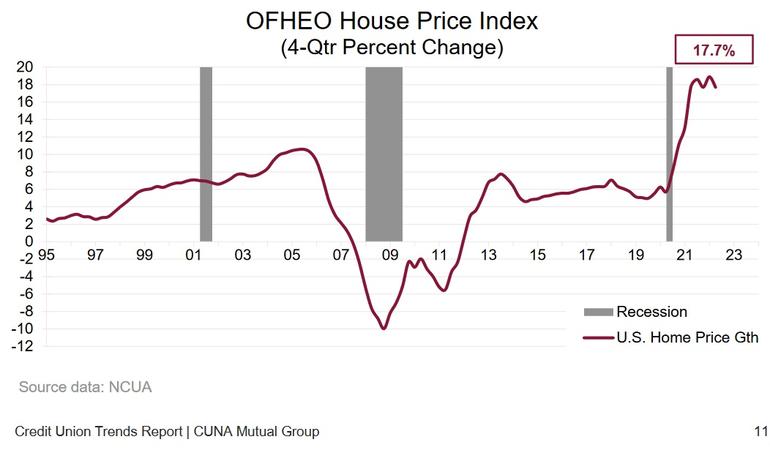
The Trends Report notes the OFHEO House Price Index rose 17.7% over the last year ending in the second quarter.
“Some people are concerned that home prices are overvalued again and creating another home price bubble,” the analysis states. “One way to measure overvaluation is to compare today’s home price-to- income ratio and home price-to-rent ratio to their historical averages. Historically, a house in the U.S. cost around 3 to 3.5 times the median annual income. During the housing bubble of 2004-2005, the median price for a single-family home cost more than 5.1 times the median annual household income in November 2005. Today, that ratio stands at 4.6.”
Savings & Assets
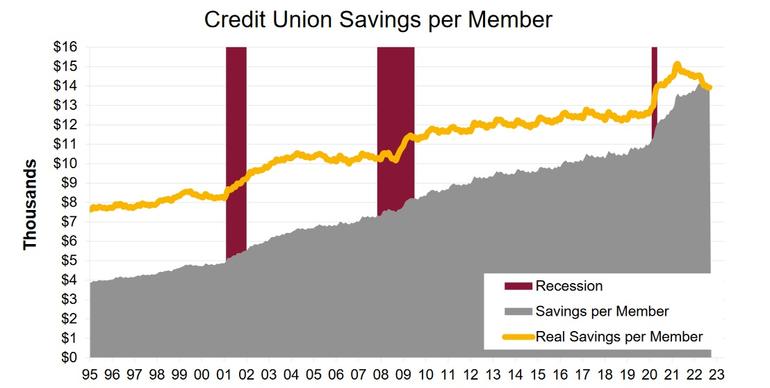
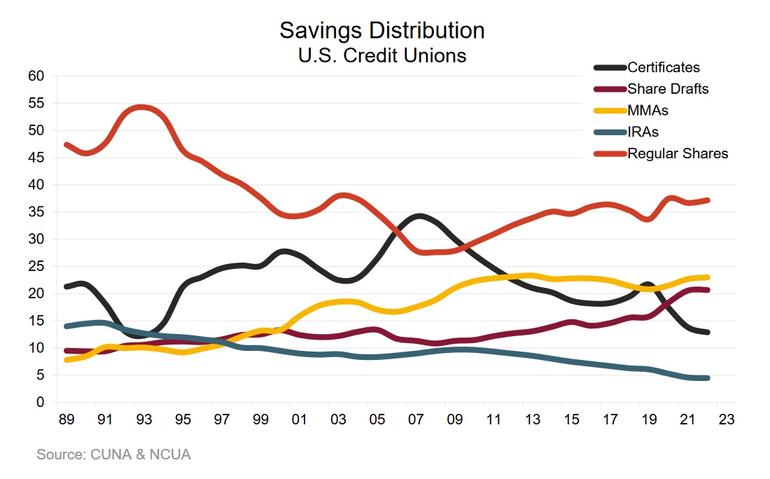
Credit union cost of funds fell to a record low of 0.35% in the first quarter of 2022 due to record low market interest rates and a favorable mix of savings products, according to the Report.
“During the last three years, credit union members’ moved deposits from higher-cost share certificates to low-cost share drafts and regular shares. This is known as the ‘mix effect’,” the Trends Report explains. “ But with the Federal Reserve expected to raise short-term interest rates over 5% by February of 2023, expect credit union cost-of-funds ratios to rise 100 basis points during the next year as credit unions raise their certificate and money market account interest rates and members move funds back into higher these higher-yielding accounts.
The report further notes that savings balances per member have already declined $200 to $13,930 in September from April’s record high of $14,130.
Capital & Key Measures
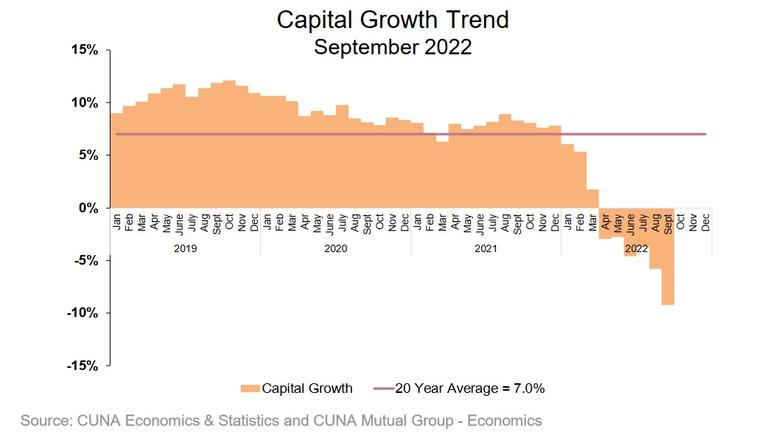
The credit union system’s capital-to-asset ratio fell to 8.5% in September, down from 10.1% in September 2021 due to rising interest rates reducing the market value of investments available for sale, according to the Trends Report.
This past June credit unions classified 75% of their investments as available for sale and therefore were reported at fair value, the report notes, adding that since March of this year the Federal Resave has increased short-term interest rates by 3.75 percentage points reducing investment valuations.
“With the Federal Reserve expected to raise interest rates another 100 basis points over the next three months, expect investment values to continue to fall as well as equity and capital levels,” the report states. “The capital growth rate is also known as the return-on-equity ratio and is one of the most important credit union financial ratios. For most of the last three years, the return-on-equity ratio has been running above the 7% average recorded over the last 20 years. But capital growth began its downward trajectory when interest rates began heading up this past March.”
Credit Unions
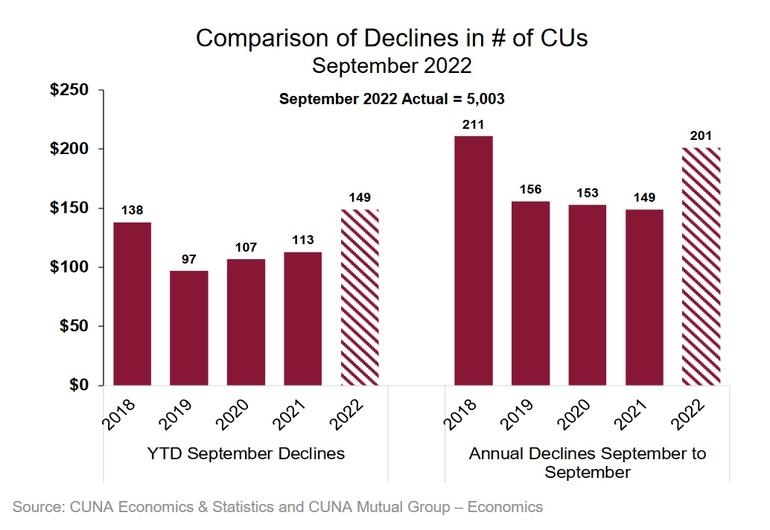
As of September 2022, CUNA estimates 5,003 credit unions were in operation, down 201 from September 2021. Year-to-date, the number of credit unions fell by 149, slightly faster than the 113 decrease reported in the first nine months of 2021.
The Report cites data from NCUA’s Insurance Report of Activity that show 59 mergers were approved in the third quarter (up from 43 in the third quarter of 2020), with an average asset size of $59 million. The average asset size of the continuing credit union was $800 million.
Forty-eight of the mergers were due to credit unions wanting expanded services, four were due to an inability to find officials, three were due to poor financial condition, two were because of a lack of growth, one because of poor management and one for a lack of sponsor support, the Report states.
“Expect mergers to accelerate into 2023 as smaller credit unions wish to expand the services offered to their members by merging with larger institutions,” the Trends Report forecasts.
Credit Union Membership
Credit unions added more than four-million memberships in the first nine months of 2022, slightly below the 4.3 million added in the similar time period of 2021.
“Rising demand for credit was the major driver for the pickup in memberships,” the Report says. “Also driving the increase in memberships was the 3.8 million new jobs added in the U.S. during the last nine months, which was slightly below the 4.8 million added during the same period in 2021.”