

MADISON, Wis.–The credit union loan-to-asset ratio in January hit its highest mark since 2019, but fixed-rate first mortgage loan balances fell 0.9% at a seasonally-adjusted annual rate that same month, the first time in credit union history that the seasonally-adjusted annual rate figure has been in negative territory, according to TruStage’s newest Trends Report.
In addition, the new numbers show credit unions added 127,000 memberships in January 2024, significantly below the 367,000-gain recorded in January 2023, while the forecast calls for a rising cost of funds, according to the same report.
Here’s how credit unions performed by category through January, according to the March Trends Report:
Total Credit Union Lending
Credit union loan balances rose only 6.1% during the last 12 months, more than one percentage point below the 7.2% long-run average, according to the report.
“Driving the weak performance was anemic growth in the consumer credit loan categories of new and used auto, and very slow fixed-rate first mortgage growth rates,” stated Steve Rick, TruStage’s chief economist, in his analysis in the report, which notes used-auto loans make up around 20% of all credit union loan balances and rose only 3% in 2023.
Meanwhile, new-auto loans make up 10.8% of all credit union loan balances and reported no growth during the past 12 months.
“So, these two “bread and butter” credit union loan categories contributed 0.6 and 0.0 percentage points, respectively, to the overall 6.1% loan growth,” the analysis states.
Highest Mark Since 2019
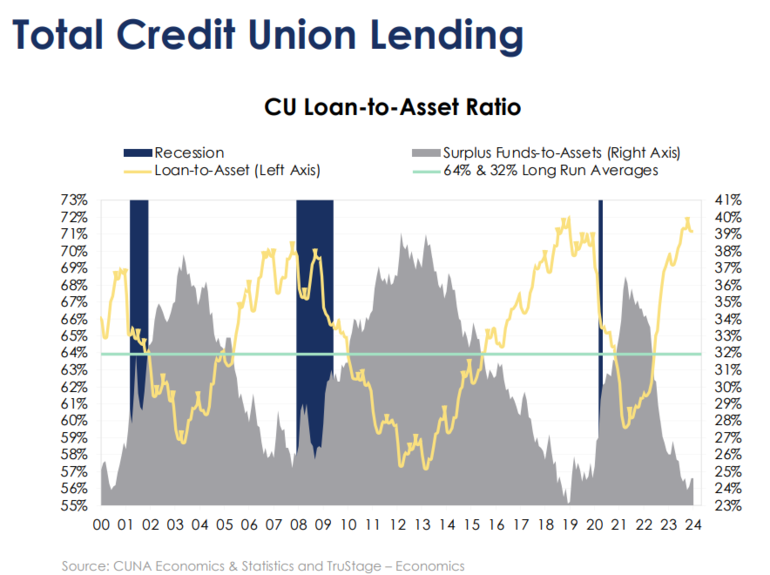
With loans growing faster than assets during the last 12 months, credit unions’ loan-to-asset ratio rose to 71.2% in January 2024, up from 69.9% one year ago and the highest January reading since 2019, according to the Trends Report.
The Trends Report further points out that the long run average for the loan-to-asset ratio is 64%, and that higher loans as a percent of assets and rising interest rates led to a rising credit union yield-on-asset ratios during the fourth quarter of 2023.
“Credit unions earned a 4.74% yield-on-assets ratio in the fourth quarter of 2023, up 87 basis points from the 3.87% reported in the fourth quarter of 2022,” the report states. “Higher loan-to-asset ratios imply lower surplus funds-to-assets ratios, which fell to 24.6% in January, down from 26% one year earlier, indicating a very tight liquidity position at many credit unions. Credit unions are responding to this tighter liquidity by raising the interest rates on their deposit accounts, which will increase their overall cost of funds this year.”
Consumer Installment Credit
Credit union consumer installment credit balances (auto, credit card and other unsecured loans) fell 0.3% in January, below the 0.4% gain set in January 2023, due to the paying down of credit card balances by many credit union members and auto loan repayments exceeding originations, the Trends Report states.
In addition, credit card loan balances fell 0.7% in January, less than the 1% drop in credit card balances reported on average over the last 10 years “as members use excess savings to pay down high-rate credit card debt.”
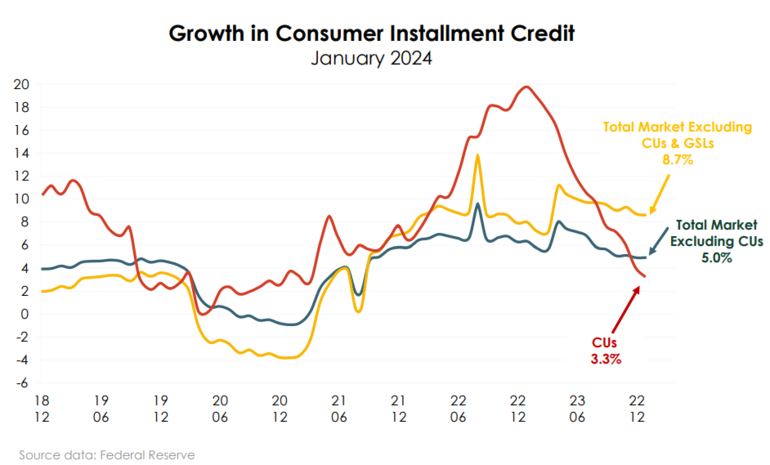
“During the last 12 months, credit union consumer installment credit grew only 3.3%, less than the total market excluding credit unions at 5.0%, and below the total market excluding credit unions and government student loans at 8.7%. Tight liquidity conditions at many credit unions have reduced their willingness to take on new credit. This has reduced credit unions’ consumer loan market share from 15.6% in August 2023 to 15.2% today.”
What Loan Officers are Saying
The Report cited the most recent Senior Loan Officer Survey, which found more than 25% of banks plan to continue to tighten lending standards for credit cards in the first quarter.
“This will slow revolving credit growth this year. Moreover, government student loan balances fell 1.5% ($22.4 billion) over the last year due to various student loan forgiveness programs,” the report states. “For 2024, the growth in the stock of consumer credit is firmly on a downward trend as higher interest rates and tighter lending standards slow borrowing and lending.”
Vehicle Loans
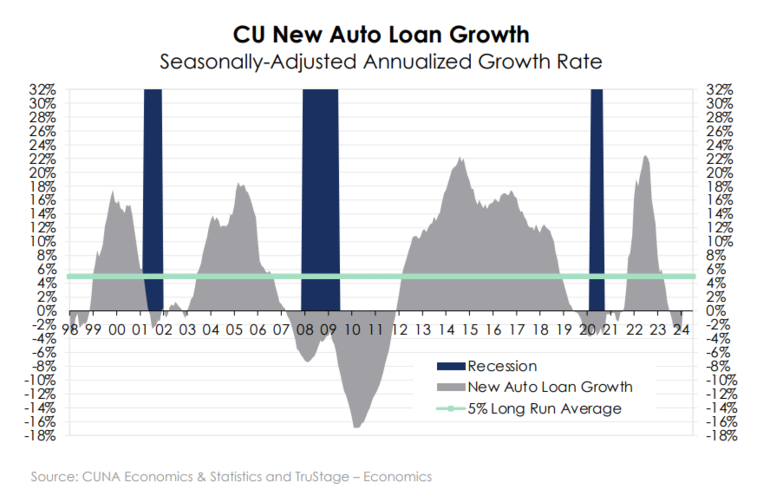
Credit union new-auto loan balances fell 0.9% in January, lower than the 0.3% rise set in January 2023, and loan balances experienced no growth over the last year, the Trends Report analysis shows.
On a seasonally-adjusted annualized basis, new-auto loan balances fell at a 3.1% pace in January, which the Report said is the worst pace since September 2020.
“January’s seasonal factors usually subtract 0.38 percentage points from the underlying trend growth rate, the second worst month of the year after February’s 0.68 percentage point decline,” the report states. “The first quarter of the year is typically the weakest quarter for credit union new-auto loan growth.”
New vehicle sales were 14.9 million in January, according to the Bureau of Economic Analysis, which at a seasonally-adjusted annualized sales rate is 0.7% below the 15.1 million pace set one year earlier.
Some Positives
“When the U.S. new-vehicle market is in balance we should be selling around 17 million vehicles each year,” Rick wrote. “But higher lending interest rates continue to moderate consumer demand for new vehicles. On a positive note, improved supply chains are increasing vehicle production rates and inventory levels and therefore vehicle sales.
“For 2024, expect new vehicle sales to approach 16.2 million, up 4.5% from the 15.5 million vehicle sales in 2023,” the forecast states. “Driving this improvement will be steady growth in vehicle inventory levels, a healthy labor market, a fall in average transaction prices and the prospect of declining interest rates in the second half of the year.”
Real Estate Information
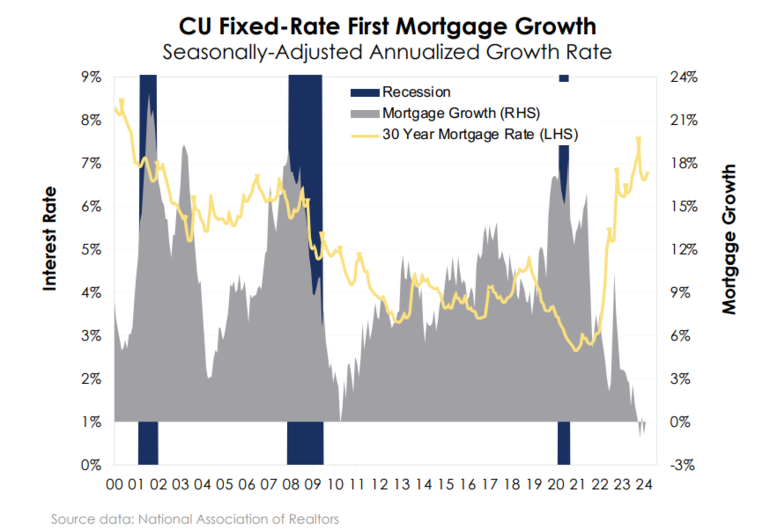
Credit union fixed-rate first mortgage loan balances fell 0.8% in January, which is better than the 2.3% decrease reported in January 2023, the fourth consecutive month of declines, according to the Trends Report.
Credit union fixed-rate first mortgage loan balances fell 0.9% at a seasonally-adjusted annual rate in January.
“This is the first time in credit union history that the seasonally-adjusted annual rate figure has been in negative territory,” according to the Trends Report.
The report further notes the contract interest rate on a 30-year, fixed-rate conventional home mortgage fell to 6.64% in January, down from 6.82% in December but above the 6.27% reported in January 2023. The mortgage credit-risk premium (the difference between the 30-year mortgage interest rate and the 10-year Treasury interest rate) fell to 2.58% in January below the average of 2.84% during 2023, the report added.
“Expect mortgage interest rates to average 6.0-6.75% for the remainder of the year,” Rick forecast before adding, “…Expect real home prices to decline over the next few years given the imbalance between median house prices and median incomes.”
Savings & Assets
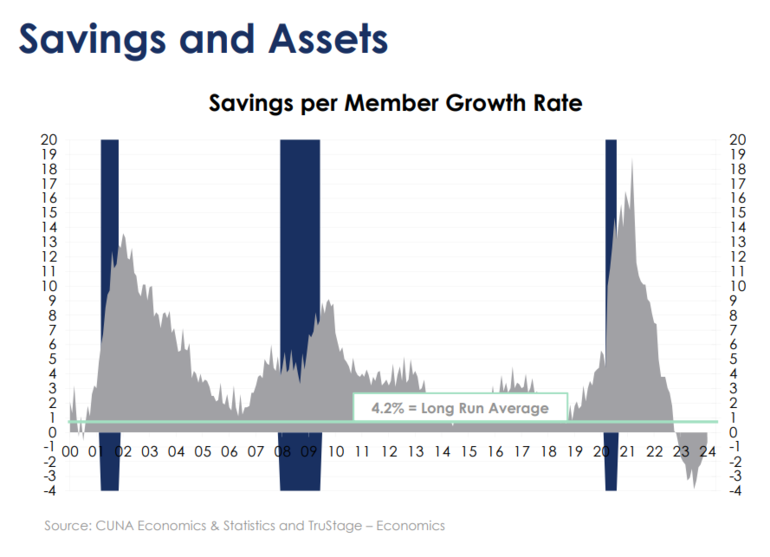
Credit union savings balances fell 0.3% in January due to members paying down credit card balances (which declined 0.7%) that were built up during the fourth quarter of 2023.
The report notes the January savings growth rate was better than the 0.8% decrease reported in January 2023. January savings balances have historically declined 0.2% due to recurring seasonal factors.
“The savings-per-member ratio fell 0.7% during the last year ending in January 2024, the 15th consecutive month of year-over-year declines, due to the denominator of the ratio growing faster than the numerator,” according to the analysis. “Savings balances, the numerator of the ratio, rose only 2.2% during the last 12 months, the slowest pace since the summer of 2006, when stock and home prices were rising rapidly, creating a large wealth effect and discouraging savings accumulation by members. Today, weak savings growth is due to some members spending some of their ‘excess savings’ accumulated over the last few years from stimulus checks and reduced consumption spending.
“Other members can’t save due to high inflation reducing their real wage and some members were moving funds to higher-yielding money market mutual funds,” the analysis continued. “The denominator of the ratio, members, grew 2.9% as American’s joined credit unions to take out new loans at competitive loan rates.”
An End to the Decline
According to the Trends Report, currently, the average credit union member has a total of $13,415 on deposit at their credit union,
down from the $13,505 in January 2023.
“We expect credit union deposits to increase only 3% this year, below the long-run average of 7%, as some interest-rate sensitive deposits move to higher yielding alternatives,” Rick wrote. “But with membership growth also expected to be 3% this year, the savings-per-member ratio should end its decline.”
Equity and Other Key Measures
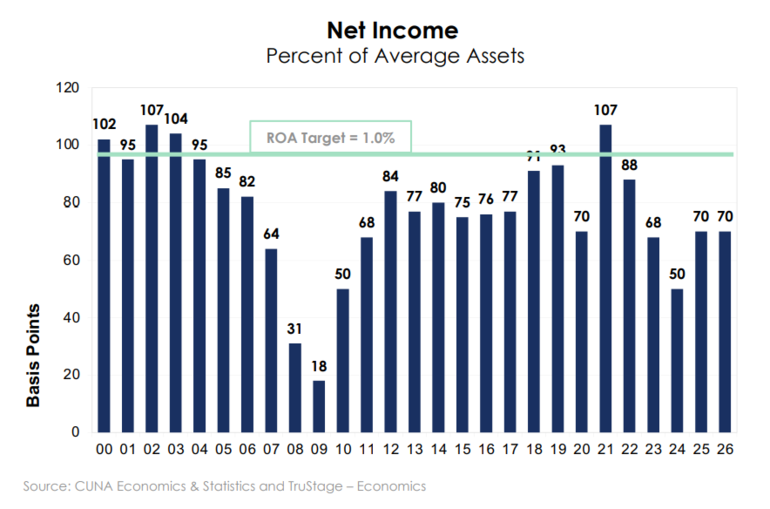
The credit union industry’s net income to average asset ratio, return on assets, fell to 0.68% in 2023, down from 0.88% in 2022, which was the lowest since 2011.
Among the findings in the analysis:
- A 15-basis point increase in net interest margins was more than offset by a 26-basis point increase in provision for loan losses and a 10-basis point increase in operating expense-to-average asset ratios.
- Credit union operating expenses rose 7.1% in 2023 due to high inflation (3.4%), rising wages (4.5%) and 2.2% more employees.
- At the end of 2023, U.S. credit unions employed 369,258 full and part time Americans, up 7,900 from the end of 2022. Part time employees typically make up 5.6% of a credit union's total employee base, the report states.
An ‘Important’ Metric
“Expect return on asset ratios to fall to 0.5% in 2024, due to an increase in provision expense as credit quality deteriorates, continued pressure on net interest income caused by the inverted yield curve, and the scarcity of the income that flows from mortgage refinances,” the Trends Report forecasts. “Credit union average return on equity (ROE) rose to 8.0% in 2023, from -7.6% in 2022 when rising
interest rates reduced the value of available-for-sale investments. Credit union equity (Other Reserves + Undivided Earnings + Unrealized Gains/Losses on Available for Sale Securities) rose $15.5 billion in 2023, due to gains on securities ($0.180 billion) boosting net income ($15.32 billion).
“The ROE ratio is one of the more important credit union metrics because it determines the long-run sustainable asset growth rate. For example, credit unions’ long run average ROE ratio is around 7%, which is the growth rate of their equity. This indicates their assets can grow 7% while maintaining a constant equity-to-asset ratio.”
Credit Unions & Members
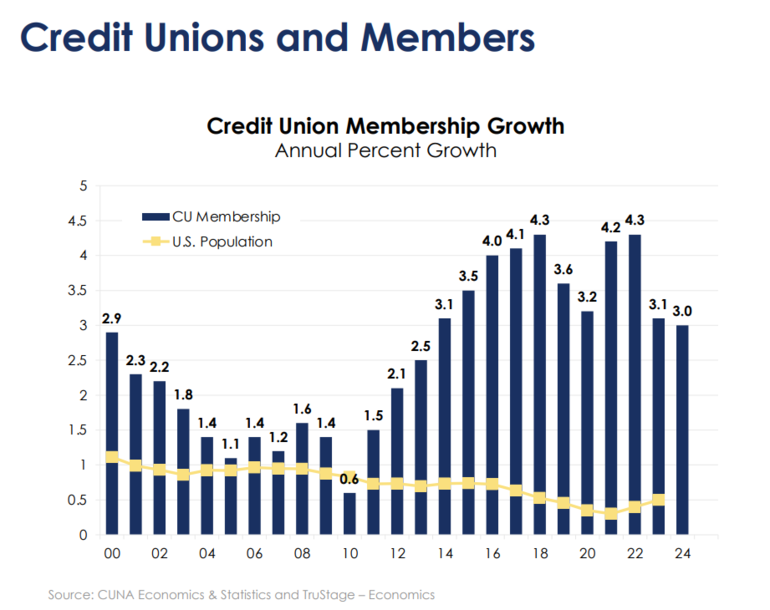
The new Trends Report numbers show credit unions added 127,000 memberships in January 2024, significantly below the 367,000-gain recorded in January 2023.
“One factor driving membership growth is job creation. In January, the economy added 229,000 jobs, and averaged 234,000 jobs during the last 3 months, according to the Bureau of Labor Statistics, which is less than the 292,000 3-month average job creation ending in January 2023,” the Trends Report states. “Expect monthly job growth to slow over the next few months as the demand for labor slowly ebbs as the economy cools down from the above trend growth of 2023.”
The report notes total credit union memberships reached 142.1 million in January 2024, which, in percentage terms,
rose 0.13% in January and 2.9% during the last 12 months.
The Forecast
“Credit union membership growth slowed in 2023 due to a slowdown in auto lending as competition from other lenders increased,” the Trends Report states. “We expect membership growth to slow to around 3% in 2024, which is above the current 0.5% U.S. population growth. After a historically low growth rate of 0.3% in 2021, the U.S. resident population increased 0.4% in 2022 and then 0.5% in 2023, according to the U.S. Census Bureau. Today the U.S. population is over 336 million, 1.8 million more than one year ago.”
Daily News Headlines. To Your Inbox. Every Day. And It’s Free
The biggest, best and freshest news reporting in credit unions remains free, and now has an added bonus---free shipping to your email address! That’s right. Each morning CUToday.info delivers its daily Fresh Today news update offering the latest headlines and breaking news right to your email, with the easy-to-read headlines format allowing you to click on the stories that interest you most in order to learn more. So stop paying those bank-fee-like subscription prices from other so-called “news” publications!
If you haven’t yet signed up for the new email solution on which CUToday.info has partnered with ResponseGenius, you can do so here. Signing up requires less than one minute of your time—and it’s free!
Please note that after signing up you may need to go to your Spam/Junk folder and mark the morning headlines email as safe. CUToday.info does not provide its list of readers and emails to outside parties, and we will not be contacting you to sell you an extended warranty or sending you any links so you may cash in on an inheritance.