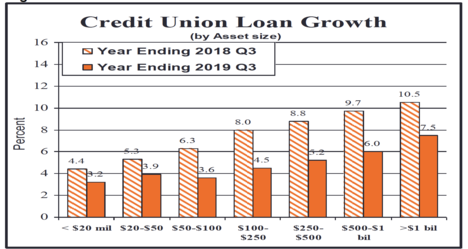
MADISON, Wis.–Credit union loan balances were up just 6.2% over the 12 months ending in November 2019, below the 7.2% long-run average, are volume is expected to slow to 5.5% in 2020, according to CUNA Mutual’s latest Trends Report.
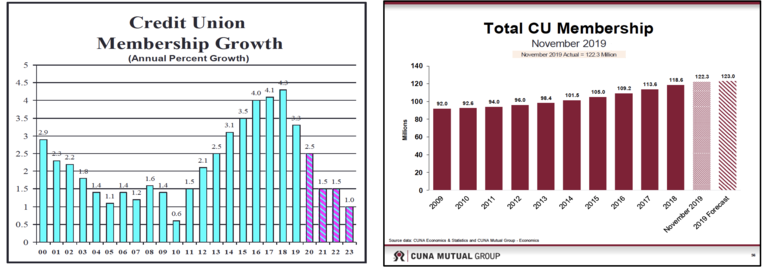
CU membership, meanwhile, was up just 173,000 in November, significantly below the 256,000 new members added in November 2018, with the 12-month membership growth figure at its slowest pace since 2014, added the January Trends Report, which includes data through November of 2019.
One big positive: industry ROA through the first three quarters of 2019 saw its highest average since 2003.
Here is a look at how credit unions performed across multiple categories, according to CUNA Mutual’s Trends Report.
Total Credit Union Lending
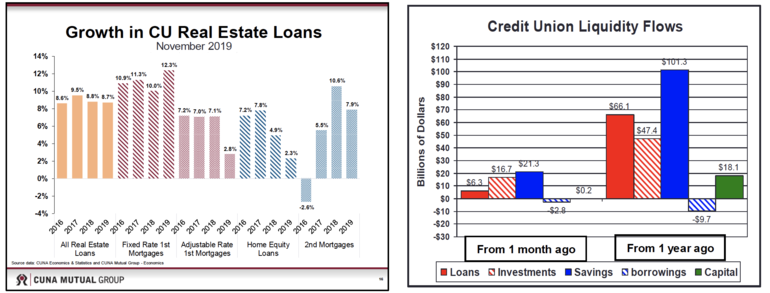
Credit union loan balances rose 0.56% in November, basically the same as the 0.54% pace reported in November 2018, CUNA Mutual said. Driving overall loan growth was strong growth in fixed-rate mortgages (1.5%), adjustable-rates mortgages (0.7%) and unsecured personal loans (0.6%).
“Over the last 12 months, total credit union loan balances rose only 6.2%, below the 7.9% long-run average,” the Trends Report analysis states. “However, industry growth rates mask big disparities between large and small credit unions. In the year ending in the third quarter of 2019, credit unions with assets greater than $1 billion reported a 7.5% increase in loan balances, which was down from the similar time period one year earlier, while credit unions with assets less than $20 million reported loan growth of only 3.2%, below the 4.4% pace set one year earlier. We expect overall credit union loan growth to slow to 5.5% in 2020.
Credit Union Consumer Installment Credit
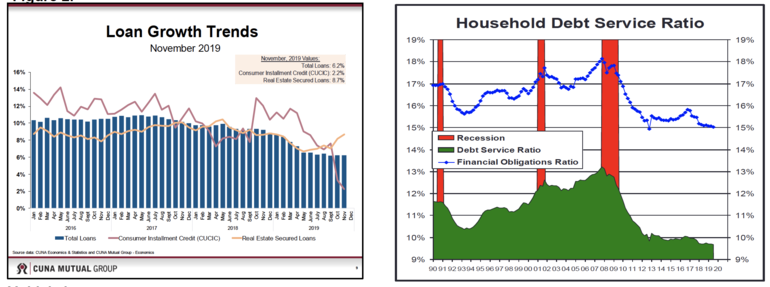
Credit union consumer installment credit balances (auto, credit card and other unsecured loans) fell 0.4% in November, below the 0.7% increase set in November 2017, CUNA Mutual said. Consumer installment credit grew only 2.2% over the last year, slower than the 8.7% rise in real estate loans.
CUNA Mutual pointed to Fed data showing household debt service ratio (mortgage and consumer debt payments required to remain current on that debt as a percent of disposable income) fell to 9.69% in the third quarter, the lowest on record and slightly below the 9.7% set in the third quarter of 2018. The composition of the debt service ratio changed over the last year as the consumer debt service ratio rose to 5.57% in the third quarter of 2019, up from 5.53% in the third quarter of 2018, while the mortgage service ratio fell to 4.12% from 4.16%, the Fed data show.
Vehicle Loans
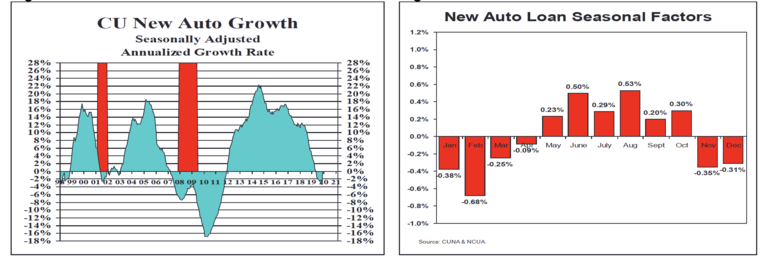
Credit union new-auto loan balances fell at a -3.4% seasonally adjusted annual rate in November, significantly below the double digit pace set during 2012-2018, according to the Trends report. CUNA Mutual said five factors drove the decline:
- CUs raised new auto loan interest rates 2 percentage points over the last year, from 3.7% to 5.7%.
- Rapid loan originations 2-3 years ago precipitate larger loan balance amortization today.
- New auto sales declined 2% over the last year.
- Members used “cash out” funds from mortgage refinances to pay off auto loans.
- Rapid growth into indirect auto lending has leveled off, leading to a drop in the growth rate.
CUNA Mutual’s economists said its economists expect auto sales to slow another 2% in 2020 to a 16.7 million pace, down from 17 million in 2019.
Real Estate Secured Lending – First Mortgages and Other Real Estate
Credit union fixed-rate first mortgage loan balances grew 1.5% in November, above the 1.1% pace set in November 2018, as existing-home sales fell 1.7% in November from October but marked at 2.7% rise over the last year.
“Home sales are limited due to a lack of homes for sale,” stated CUNA Mutual. “The supply of existing homes available for sale is becoming increasingly scarce with the inventory-to-sale ratio running at a record low 3.7 months, and below the 5.5 months considered to indicate a balanced housing market. This signals a very tight housing market as rising housing demand runs up against limited supply, which is maintaining upward pressure on home prices.”
CUNA Mutual added that with the Federal Reserve expected to keep short-term interest rates unchanged in 2020, the 10-year Treasury interest rate is expected to drift up 20-40 basis points in 2020, while the 30-year mortgage interest rate is also expected to move higher in 2020 to around a 3.9% - 4.1% range.
Surplus Funds (Cash + Investments)
Credit union surplus funds rose $16.7 billion, or 4.3%, in November due to a surge in savings balances caused by the month ending near a payroll Friday, the Trends Report notes. Deposit inflows ($21.36 billion) were also used to pay down borrowings (-$2.8 billion) and fund the $6.3 billion loan growth.
Credit union surplus funds as a percent of assets rose to 25.2% in November, up from 24% in November 2018, as credit union assets rose 7.7% and surplus funds rose 13.3%.
“The obverse of the rising surplus funds ratio is the falling loan-to-asset ratio, which fell to 70.5% in November, down from 71.5% set in November 2018,” CUNA Mutual said.
According to third quarter NCUA call report data, average annualized loan yields rose to 4.92% during the first nine months of 2019, up from 4.66% for the similar period in 2018, as old lower-rate loans repriced into today’s higher interest rates, CUNA Mutual said.
“Credit union yield-on-asset ratios rose 30 basis points to 4.04% during the first nine months of 2019 due to higher interest rates, or the ‘rate effect’,” the Trends Report said. “Slightly offsetting the rate effect was the ‘mix effect’ as the percent of assets in the loan category fell one percentage point over the last year. Credit union costs of funds rose 23 basis points during the last year, coming in at 0.87% in the first nine months of 2019. Therefore, net interest margins rose seven basis points to 3.17% in 2019, the sixth consecutive year of rising margins after hitting a record low of 2.77% in 2013.”
Savings and Assets
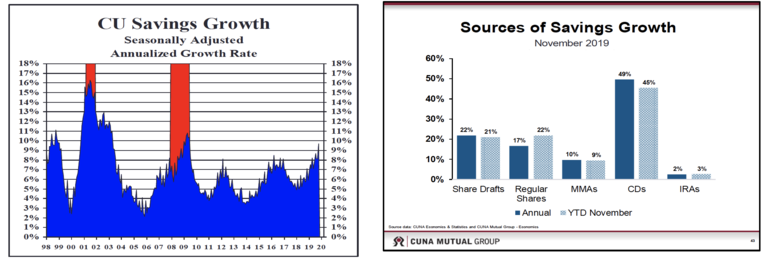
Credit union savings balances rose 1.6% in November, better than the 1.4% gain reported in November 2018, due to the month ending on a payroll Friday.
According to the Trends Report analysis, credit unions reported a savings inflow of $101 billion during the last 12 months, an 8.1% increase. Almost half of this inflow (49% percent or $50 billion) was deposited into share certificate accounts.
“Share certificate account growth was due to credit unions paying relatively high rates to attract funds to lessen concerns over tight liquidity, to lock down longer-term deposits and also due to members wanting to lock in interest rates before they declined this fall,” CUNA Mutual said.
Capital and Other Key Measures
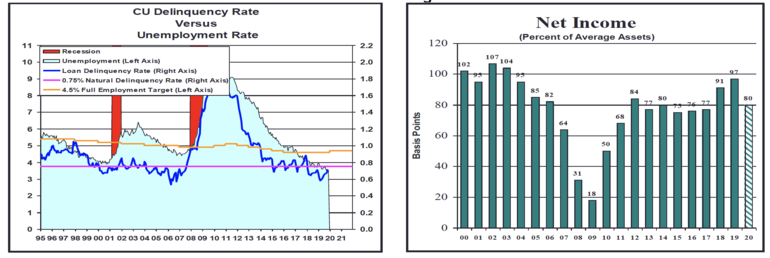
The loan delinquency rate (loans two or more months delinquent as a percent of total loans outstanding) rose to 0.71% in November from 0.68% in October, 2019, the Trends Report shows, a figure is said is in line with the traditional seasonal pattern.
On a year-over-year basis, the loan delinquency rate is one basis point higher than the 0.7% reported in November 2018.
“Expect loan quality measures to deteriorate slightly over the next year as loan growth slows and the delinquency rate rises to the 0.75% long-run natural delinquency rate in 2020,” CUNA Mutual’s economists said. “We also expect the unemployment rate to rise slightly in 2020 to around 3.8% by year end, still remaining below the 4.5% full employment rate.”
The Trends Report analysis found return-on-asset ratios came in at 0.97% (annualized) for the first nine months of 2019, the highest since 2003, due to stronger net interest margins.
“Expect credit union return-on-asset ratios to come in at 80 basis points in 2020 as net interest margins decrease,” CUNA Mutual forecast.
Credit union capital balances grew 11.3% in the year ending in November, significantly above the 7% average set over the last 20 years, the Report added.
The Number of Credit Unions
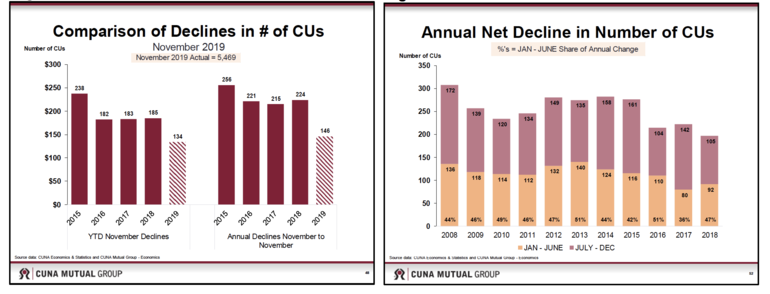
As of November 2019, CUNA estimates 5,469 credit unions were in operation, down 146 from November 2018, according to the Trends Report. Year-to-date the number of credit unions fell by 134, slightly lower than the 185 reported in the first 11 months of 2018. “The annual contraction rate of the credit union industry fell to -2.6% in 2019, below the -3.5% average pace set over the last 25 years,” states the Trends Report analysis. “This slowdown in the rate of contraction can be explained by the fact that 89% of credit unions reported positive earnings in 2019, up from 78% in 2014.”
Credit Union Membership
Credit union memberships grew 173,000 in November, or 0.14%, which is significantly below the 256,000 new members, or 0.22%, that were added in November 2018, CUNA Mutual reported.
Through November, credit unions added 3.754 million new members, faster than the 4.595 million members added during a similar period in 2018. During the last 12 months, credit unions memberships rose 3.5%, the slowest pace since 2014.
According to the Trends Report, the data show total credit union memberships reached 122.3 million in November, 4.081 million more than November 2018.
“Strong U.S. job growth and strong mortgage lending are two major factors driving the surge in credit union memberships,” the report states. “For 2020, expect that another 1.7 million new jobs will be created and that credit union membership growth will be at 2.5%, slightly below the 3.3% pace in 2019.”