

MADISON, Wis.–Credit unions should expect loan growth to slow in 2023, while net capital growth will also be “subdued,” according to the new Trends Report from CUNA Mutual, which further projects membership growth over the next two years to be below the recent five-year average.
The CUNA Mutual data is being released at the same time NCUA has published new numbers that show membership growth is flat or negative in many credit unions even while it’s up overall, and that 24 states finished 2022 with fewer members than when the year began (see related reporting).
The February Trends Report from CUNA Mutual is based on December data. Here’s a look at how credit unions performed by category:
Total Credit Union Lending
Credit union loan balances rose 1.1% in December, the exact same pace reported in December 2021, according to the Trends Report.
Driving overall loan growth was strong growth in second mortgages (3.7%), credit card loans (2.9%), adjustable-rate mortgages (2.6%) and home equity loans (2.1%), the Trends Report states, noting December credit card seasonal factors—such as holiday shopping—typically add 3.1 percentage points to the underlying credit card trend loan growth.
Among the metrics:
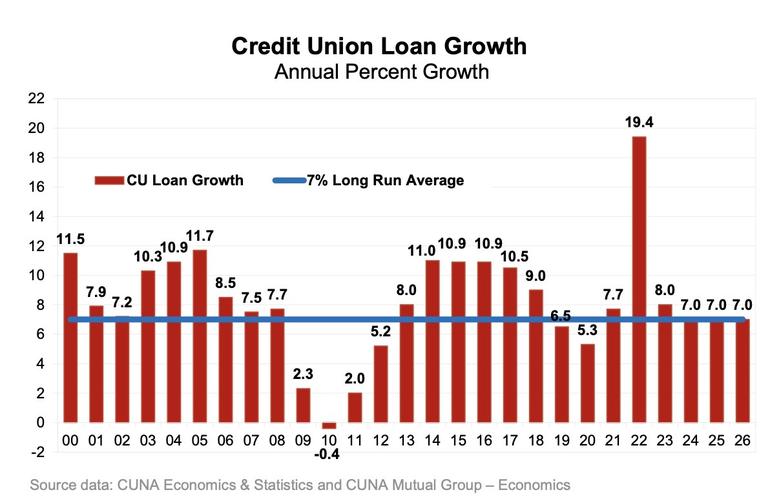
- Credit union loan balances rose 19.4% in 2022, up from the 7.7% reported in 2021 and above the 7% long run average for two reasons. “First, credit unions’ loan pricing advantage over other lenders has increased the quantity of loans originated and allowed credit unions to increase their market share.”
- Credit unions now hold 15% of the consumer loan market, up from 11.3% one year ago. “Second, 8% inflation in 2022 pushed up the prices of the goods and services credit unions make loans for, which increased the dollar amount of each loan,” the Trends Report forecasts.
According to the CUNA Mutual analysis, credit unions should expect loan growth to slow to 8% in 2023 as higher interest rates reduce the demand for loans and rising economic uncertainty reduces consumers’ willingness to purchase durable goods on credit.
Consumer Installment Credit
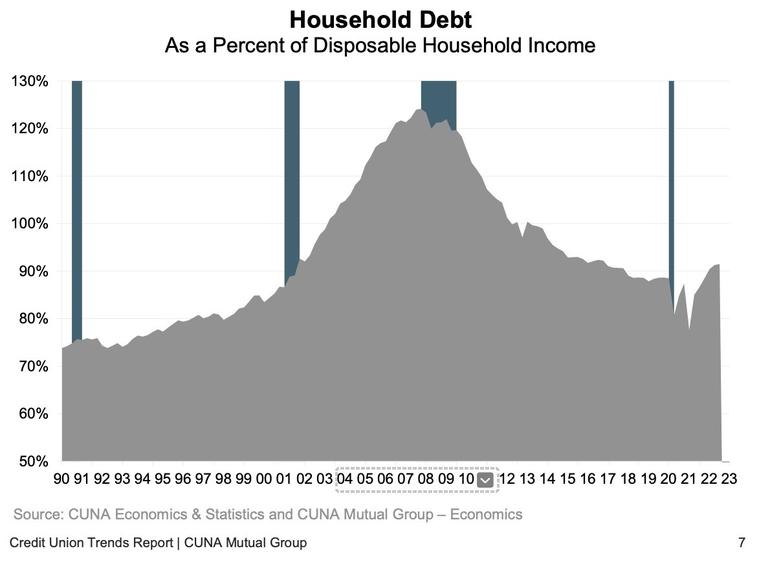
“The great deleveraging of the U.S. consumer balance sheet ended in 2022 as household debt grew faster than disposable income,” the Trends Report explains.
Household debt burdens, as measured by residential mortgages and consumer credit as a percentage of disposable personal income, rose to 91.5% in the third quarter of 2022, up from 86.5% in the third quarter of 2021, according to the Federal Reserve’s Flow of Funds report.
“Debt-to-income ratios are back to the level seen back in 2002, before the housing and debt boom of 2003-2007,” the report states. “Falling debt burdens during the last 12 years have improved household balance sheets. Household net worth has also surged since 2009 due to rapidly rising stock and home prices.
“Expect household debt-to-income ratios to rise slowly for the next few years as debt growth barely exceeds income growth,” the forecast continues. “We expect the supply and demand for credit to decrease this year as lending institutions tighten their lending standards reducing the supply and higher market interest rates reduce the demand. Tighter lending standards will reduce credit card and other forms of short-term debt the most.”
Vehicle Loans
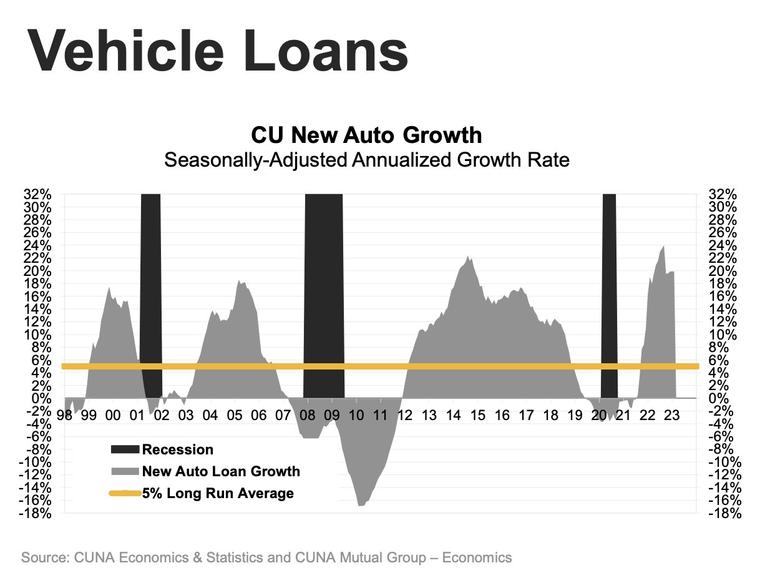
According to the new report, credit union new-auto loan balances rose 0.9% in December, double the 0.45% pace set in December 2021, and rose a remarkable 21.4% for the full year, which is the fastest pace since 2015.
“On a seasonally-adjusted annualized basis, new-auto loan balances rose 19.9% in December,” the Trends Report states. “Credit union new-auto loan balances have been surging since the Federal Reserve began raising interest rates in March 2022 and credit unions have been slower than other lenders to raise auto loan interest rates giving them a competitive advantage.”
The report further notes that new vehicle sales declined 6.3% in December from November to a 13.3 million seasonally-adjusted annualized sales rate, but sales are up 4.7% from the pace set one year earlier. “Higher production levels are allowing deliveries of more vehicles to dealerships and is having a positive impact on inventories. Higher inventories will play a key role in ensuring a better equilibrium between the supply and demand of new vehicles,” the report predicts.
Real Estate Information
The housing market closed 2022 on a weaker note as existing home sales fell 2% in December from November and fell 34% from December 2021, the Trends Report points out, adding that rising mortgage interest rates appeared to weigh on sales along with limited homes available for sale. “Currently the months supply of homes on the market has plummeted to 2.8 months, below the six months considered a balanced housing market,” the Trends Report says. “Meanwhile home prices are beginning to fall despite a tight housing market. Median single-family home prices fell 2% in December but rose 2% during the last year, which is below the 4% long run average. Housing demand is expected to remain below its long-term trend of five million annual home sales during the next year due to unaffordability issues related to high home prices and high interest rates. This will help reduce credit union purchase mortgage originations 10-15% in 2023 compared to 2022.”
Savings & Assets
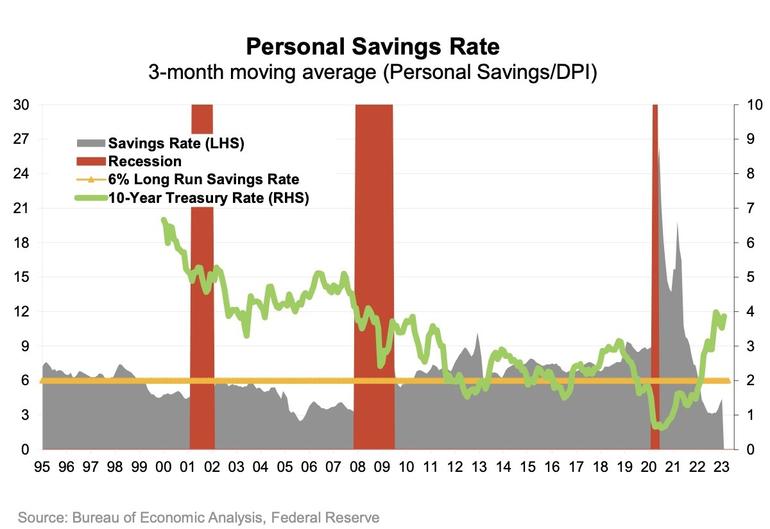
The personal savings rate (personal savings divided by disposable personal income) averaged 3.7% in 2022, below the 6% long run average, which has created a headwind for credit union deposit growth, according to the Trends Report.
The report adds that during December 2022, consumers saved 4.5% of their disposable income, down from the 7.5% reported in December 2021.
“Expect the personal savings rate to rise to 6% later in 2023, due to possible recession in the second half of the year,” the report predicts. “The drop in the personal savings rate is one factor pushing up long-term interest rates recently. The figure (shown in chart) shows how the jump in the savings rate over the last few years helped lower the 10-year Treasury note interest rate. Financial institutions used the surge in savings deposits to purchase additional government debt. This increased the price of bonds and reduced the interest rates on those bonds. The recent drop in the savings rate slowed the growth in credit union deposits and therefore the funds available to purchase additional government debt which raises interest rates.”
Capital & Other Key Measures
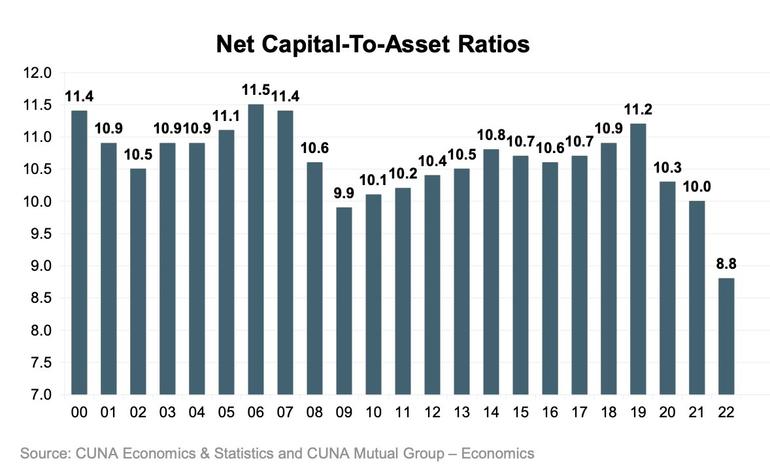
According to the Trends Report, the credit union movement’s net capital-to-asset ratio ended 2022 at 8.8%, down from the 10% reported at year-end 2021, as rising interest rates reduced the value of available- for-sale investments.
“This is the lowest net capital ratio since August 1993. Credit union net capital (Other Reserves + Undivided Earnings + Unrealized Gains/Losses on Available for Sale Securities) fell -$14.6 billion in 2022 due to losses on securities (-$32.2 billion) outweighing net income ($17.6 billion), the Trends Report explains. “The numerator or this ratio (net capital) declined 7% in 2022, while the denominator (assets) rose 5.2%. The net effect was a 12% decline in the ratio from 10% to 8.8%.”
The new analysis further notes credit union earnings as measured by return-on-asset ratios came in at 0.82% in 2022, below the 1% long run average. Credit unions reported a return-on-equity number of 8.2% in 2022.
“The return on equity ratio is an important measure of credit union financial performance and is considered the speed limit for asset growth in the long run,” the report states. “Credit union net capital growth will be subdued in 2023 due to further increases in interest rates and return-on-asset ratios falling to 0.6%. We expect rising net interest margins will be more than offset by rising loan loss provision expense and rising operating expenses due to high inflation and rising labor costs.”
Credit Unions & Members
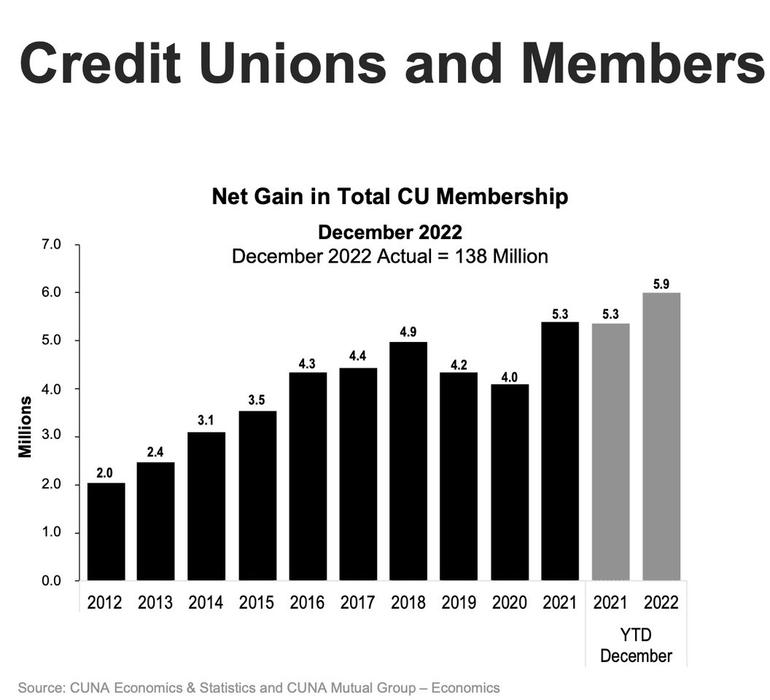
Credit unions added 301,000 memberships in December, less than the 384,000 reported during December 2021. Credit unions added 5.9 million memberships for all of 2022, the fastest pace in credit union history.
“This membership surge is due in large part to the credit lending boom reported in 2022 as consumers took advantage of credit unions’ low loan rates,” the Trends Report says. “Membership growth is also driven by job growth. In 2022, the economy gained 4.8 million jobs, according to the Bureau of Labor Statistics, which is more than double the 2.2 million jobs the economy typically added annually during 2010-2019. For 2023, expect a weaker labor market with an expected 1.2 million additional jobs being added to the workplace.”
The Trends Report further forecasts that credit union membership growth is expected to be 3% in 2023 and 2024, below the recent five-year average of 4.8%, due to a decrease in the demand for credit by the American consumer.
It’s Called Fresh for a Reason. And We Offer Home Delivery. For Free!
The biggest, best and freshest news reporting in credit unions remains free in ’23! Each morning CUToday.info delivers its daily Fresh Today news update offering the latest headlines and breaking news right to your email, with the easy-to-read headlines format allowing you to click on the stories that interest you most in order to learn more.
If you haven’t yet signed up for the new email solution on which CUToday.info has partnered with ResponseGenius, you can do so here. Signing up requires less than one minute of your time—and it’s free!
Please note that after signing up you may need to go to your Spam/Junk folder and mark the morning headlines email as safe. CUToday.info does not provide its list of readers and emails to outside parties, and we will not be contacting you to sell you an extended warranty or sending you any links so you may cash in on an inheritance you didn’t know was coming.
And did we mention it’s free?
Please note and/or make your IT department or email administrator aware the emails will be coming from the domains CUTodayinfo.com and CUTodayinfoReply.com