

MADISON, Wis.– Credit union loan growth this year is likely to slow to 4-5%, CU employee productivity took a “step back” in 2023, there is likely to be a surge in mergers this year, and credit unions are poised to become a near $9 trillion industry over the next two decades, according to TruStage’s newest Trends Report.
The Trends Report, which is based on CU performance through October 2023, also includes numerous other insights and predictions.
Here’s a look at how credit unions performed by category:
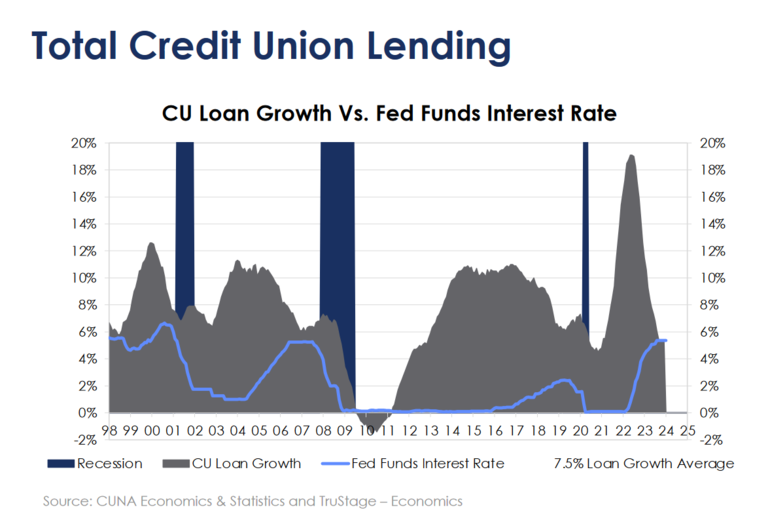
Total Credit Union Lending
The TruStage Trends Report shows credit union loan balances rose 0.4% in October, below the 1.2% increase reported in October 2022. Loan categories that increased the fastest were home equity (3.9%), credit card (1.3%) and adjustable-rate first mortgage (1.2%). New-auto loan balances declined 0.1% and fixed-rate first mortgages fell 0.2%, according to the Trends Report.
“Economists recognize there are at least 10 channels through which higher interest rates impact the real economy,” wrote TruStage Chief Economist Steve Rick.
Rick noted a three percentage point increase in the Fed Funds rate historically depresses credit union loan growth by five percentage points, albeit with a two-year lag.
The Forecast
“This is, of course, the goal of tighter monetary policy, which is to decelerate the rate of credit creation from above-trend growth to something closer to normal in an attempt to reduce inflationary pressure,” Rick stated. “Credit union loan balances grow on average 7.5% per year over the long run, but today credit union loan balances are only rising at a 5.4% seasonally-adjusted annual rate. We are forecasting below trend credit union loan growth of 4-5% for 2024 due to elevated short-term interest rates.”
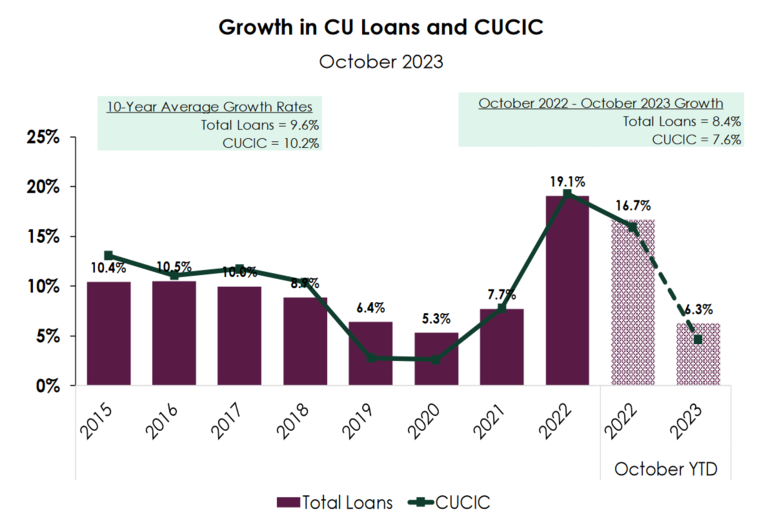
Consumer Installment Credit
Credit union consumer installment credit balances (auto, credit card and other unsecured loans) reported a 0.3% rise in October, below the 0.5% increase set in October 2022, due to a deceleration in the “total auto loan” category of 0.9% last October to 0.1% this October, according to the Trends Report.
The report shows credit card balances rose 1.4% in October, above the 1.2% growth reported in October 2023. Year–to–date, credit union consumer installment credit grew only 4.6%, more than three times slower than the 16% reported during the same period in 2022, the Trends Report states.
Pulling Down Growth
“This has pulled down overall loan growth to 6.3% so far this year, from 16.7% year-to-date growth in 2002,” Rick stated.
The analysis shows that for all lenders, outstanding consumer credit rose by $5.1 billion in October, according to the Federal Reserve, which is lower than the $12 billion reported in September, and almost one-third the average pace of $15 billion growth reported during the years 2015 – 2019.
“The slowdown in the rise of consumer credit outstanding demonstrates one of the channels of restrictive monetary policy, i.e., higher interest rates,” Rick explained. “Expect growth in consumer credit to moderate further in 2024 due to higher loan delinquency rates and tighter lending standards and still high interest rates.”
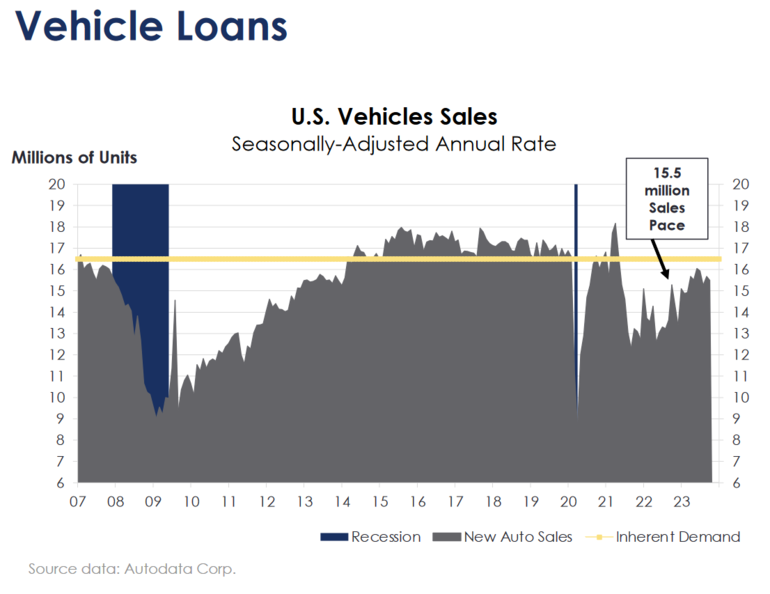
Vehicle Loans
Credit union new-auto loan balances fell 0.1% in October, less than the 0.5% decline set in October 2022, but increased 5.1% during the last year, the Trends Report shows.
The data further reveal that on a seasonally–adjusted annualized basis, new-auto loan balances fell 2.4% in October, significantly below the 16.1% gain reported in October 2022. October seasonal factors typically add 0.3 percentage points to the underlying annualized growth trend, according to the Trends Report.
“Two factors are driving the slowdown in new-auto loan growth: First credit union liquidity pressures have pushed loan-to-savings ratios to 86.1%, the highest since May 1980, which cause some credit unions to pull back in lending,” Rick stated. “Second, manufactures have increased vehicle incentives and offer low-rate captive financing to entice auto buyers.”
According to Rick, the effect of this lending slowdown is the number of new-auto loans as a percent of members in offering credit unions – the penetration rate – fell to 7.5% in the third quarter, down from 7.9% last year.
“But on the bright side, the penetration rate is up from the 6.3% in pre–COVID 2019,” Rick added.

Real Estate Information
Credit union fixed–rate mortgage lending has slowed considerably during the last 12 months due to mortgage interest rates averaging 6.80% in 2023, up from the 5.33% average in 2022, according to the new Trends Report.
“Fixed–rate first mortgage loan balances grew a weak 2.8% over the last year, below the 4.1% pace set in the year ending October 2022,” the Trends Report states. “But total first mortgage loan balances are up 5.4% during the last year because adjustable-rate mortgages rose a strong 20.9% as members opted for lower rate adjustable-rate mortgage products.”
What to Expect
Rick said credit unions should expect mortgage originations to increase 15% in 2024 due to mortgage interest rates falling one percentage point during the next 12 months.
“With long term bond yields already falling and the Federal Reserve expected to push down short–term interest rates this summer, we forecast 30–year mortgage interest rates to fall from 7.0% today to 6.0% by year-end 2024,” Rick added.
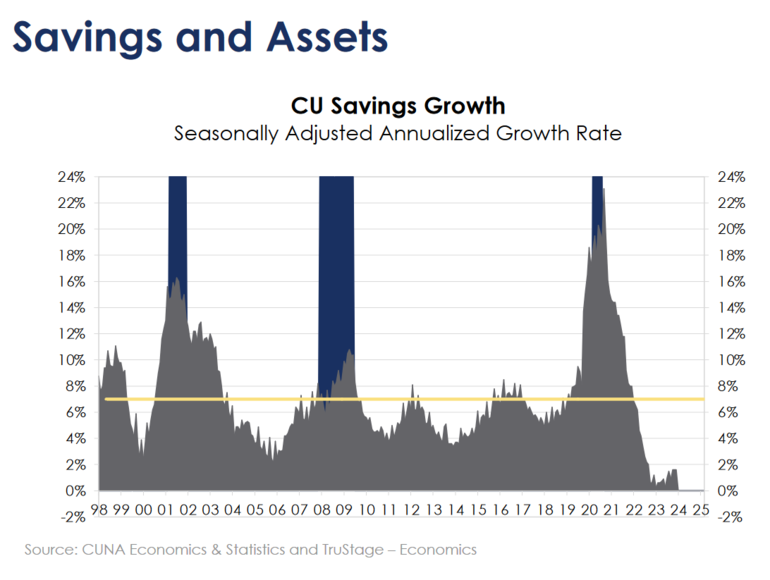
Savings & Assets
Credit union savings balances fell in October by 0.6%, which the Trends Report notes is better than the 0.7% decline in October 2022.
“Historically, October’s seasonal factors reduce the underlying savings trend growth by 0.10 percentage points,” Rick stated in the Trends Report. “So, this year members were dipping into savings deposits to maintain their current level of consumption spending in this era of high and rising prices. For many consumers, their real disposable income declined during the last year thus requiring the drawdown in precautionary savings balances.”
The report shows savings balances grew at a 1.6% seasonally–adjusted annualized growth rate in October, above the 0.5% reported one year earlier, and below the 7% long–run average.
‘Positive Growth’
“Credit unions are experiencing low but positive deposit growth due to some members moving funds to higher yielding money market mutual funds, strong new membership growth, and falling real incomes,” the Trends Report states. “We expect credit union deposit growth to rise only 3% in 2024, still below the 7% long–run average, but above the 1.5% expected in 2023. Much of the deposit growth in 2024 will be self-funded by the credit union as they pay higher deposit interest rates on these accounts.”
Equity and Other Key Measures
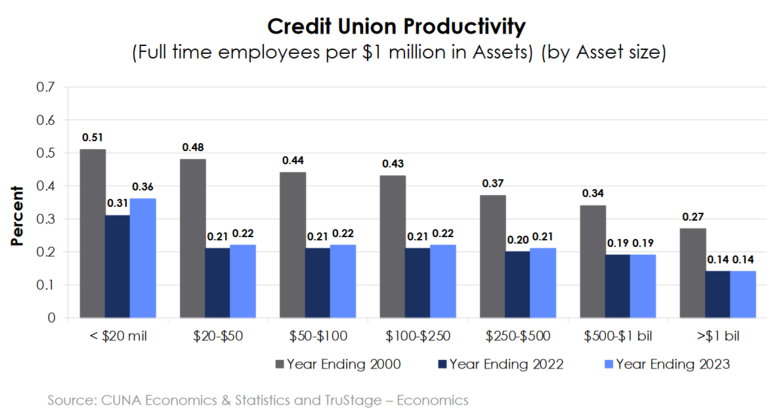
According to the Trends Report analysis, credit union productivity took a step back in 2023 as asset growth slowed or even declined for most credit unions.
“One way to measure a credit union’s productivity is look at the number of employee per $1 million in assets. The lower the ratio, the higher the credit union’s productivity,” Rick explained. “The recent liquidity crunch led to falling deposits and assets at many credit unions. But credit unions have not cut staff in proportion to the drop in assets. This has resulted in an increase in the employee to asset ratio for many small to medium sized credit unions over the last year.”
What Larger CUs are Seeing
“Larger credit union, those with assets greater than $500 million in assets, reported no change in the employee-to-asset ratio over the last year due to average asset growth over 3%,” the Trends Report analysis continues. “Despite this temporary setback, the credit union system has become significantly more productive over the last 23 years. Back in the year 2000, it took on average 0.38 full–time credit union employees to manage every $1 million in assets. Today that ratio stands at 0.16, a 58% improvement in productivity overall or 2.9% increase in productivity per year. Or to think of the inverse of the productivity ratio, 23 years ago each credit union employee managed $2.6 million, today each employee manages $6.2 million.”
Doing the Math
As Rick further explained, today 360,160 full – time employees are working at credit unions managing $2.251 trillion in assets. The number of employees working at credit unions today would have been 855,380 (0.38 x 2,251,000) if credit union employees had the same level of productivity that they did back in 2000.
“The net result is that 495,220 (855,380 – 360,016) employees were not needed due to improvements in human and physical capital,” Rick stated. “Smaller asset size credit unions reported bigger improvements in productivity ratios over the last 23 years; however, larger credit unions are still more productive due to their economies of scale.”
Credit Unions & Members
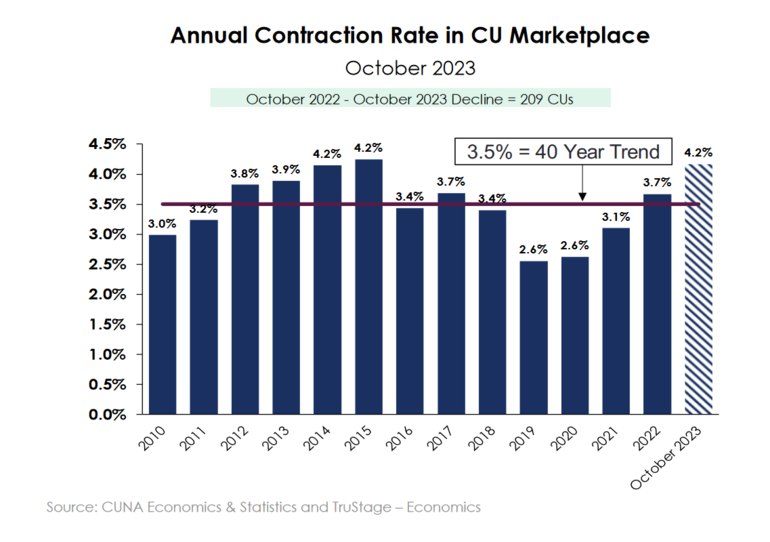
As of October 2023, the Trends Report cites CUNA estimates that 4,814 credit unions were in operation, down 209 from October 2022. Year–to–date the number of credit unions fell by 149, significantly more than the 129–decline reported in the first 10 months of 2022, the report adds.
“We expect a surge in credit union mergers in the 2024 – 2025 period, like what we experienced the years following the Great Recession as many credit unions look to offer more financial services to their members through mergers,” Rick forecast. “Credit union consolidation and concentration are expected to continue above their long – run pace over the next few years. Since 1980, the number of credit unions has declined by roughly 3.5% each year, but this year they were contracting at a 4.2% pace. If we apply the historical 3.5% exponential “decay” rate to the current number of credit unions, 4,814, we should expect another 168 credit unions to exit the financial system in 2024. If we forecast out a little further, according to the laws of exponential decay, there will only be 2,361 credit unions in 20 years, half as many as there are today.”
The ‘Fortunate’ News
Rick added that “fortunately,” credit union assets follow an average annual exponential growth rate of 7%.
“This means the time that it takes for credit union assets to double (currently $2.251 trillion) is only 10 years. So, 20 years from now in the year 2043 credit union assets could be 3.9 times bigger than today, or $8.7 trillion,” the forecast states.
The Best Way to Start a New Year. With Something Free.
The biggest, best and freshest news reporting in credit unions remains free! Each morning CUToday.info delivers its daily Fresh Today news update offering the latest headlines and breaking news right to your email, with the easy-to-read headlines format allowing you to click on the stories that interest you most in order to learn more. So stop paying those bank-fee-like subscription prices from other so-called “news” publications!
If you haven’t yet signed up for the new email solution on which CUToday.info has partnered with ResponseGenius, you can do so here. Signing up requires less than one minute of your time—and it’s free!
Please note that after signing up you may need to go to your Spam/Junk folder and mark the morning headlines email as safe. CUToday.info does not provide its list of readers and emails to outside parties, and we will not be contacting you to sell you an extended warranty or sending you any links so you may cash in on an inheritance you didn’t know was coming.
And did we mention it’s free?