

MADISON, Wis.–Overall credit union loan balances rose 0.8% in May, down from the 1.1% of a year earlier and 4.5% over the past year, but the growth in fixed-rate first mortgages raises “concerns” over interest rate risk when rates begin rising again, according to the newest Credit Union Trends Report released by CUNA Mutual.
Among the other findings in the July report, which is based on data through May:
- Every loan category reported positive growth rates in May except adjustable-rate first mortgage loan balances which fell -0.5% and second mortgage loans, which fell -0.4%.
- Many credit unions are parking excess funds in their Fed reserve account to maintain liquidity in anticipation of future deposit withdrawals.
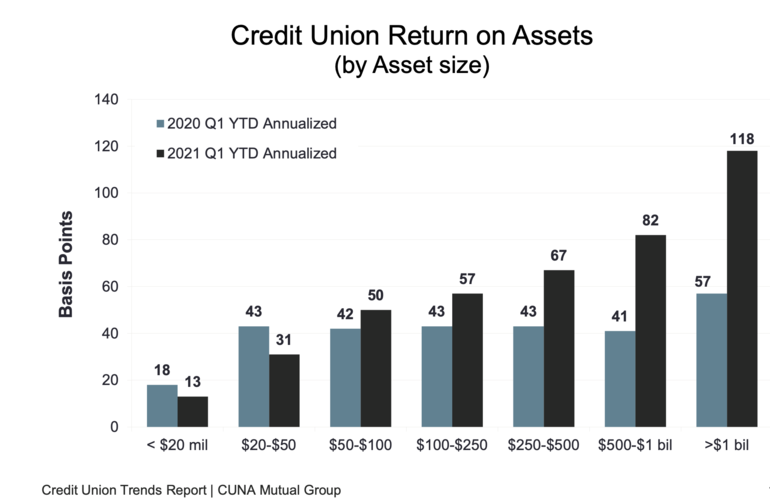
- The disparity between small and large credit unions’ return-on-asset ratios increased significantly over the last year.
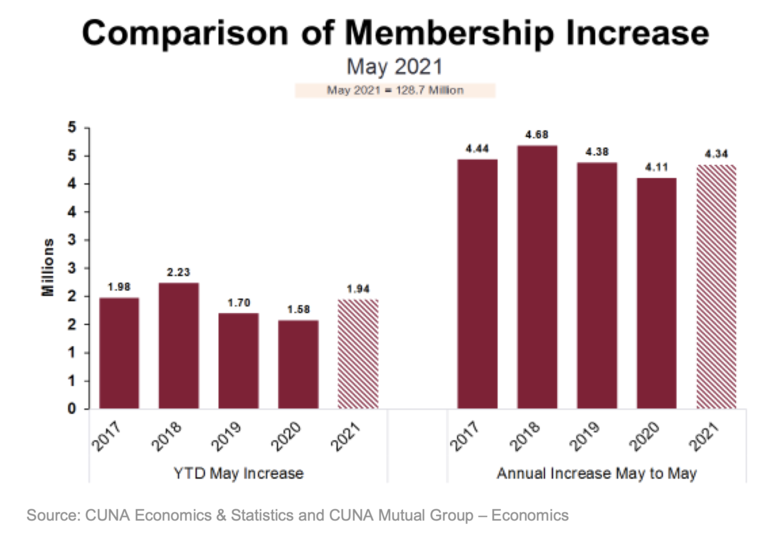
- Credit union memberships grew 254,000 in May, or 0.2%, down from May 2020 when the movement added 399,000 memberships at an increase of 0.32%. But faster loan growth, reopening of credit union branches and surging job creation are three factors boosting credit union membership growth.
The Economy
Looking to the broader economy, the analysis notes falling long-term interest rates have pushed down the 30-year fixed-rate mortgage interest rate from the recent high-water mark of 3.18% in early April to 2.88% today.
“Falling interest rates will extend the mortgage refinance boom many credit unions have benefited from over the last year,” the Trends Report forecasts.
CUNA Mutual’s analysis stated the real interest rate ought to rise as the economy recovers and the demand for loanable funds begins to rise, but concerns over the Delta variant and ongoing COVID-19 pandemic, along with worries about a return to secular stagnation (low growth, low inflation) have pushed the real interest rate further into negative territory in the last few weeks.
“Don’t be surprised if the 10-year Treasury interest rates remain below 2% for the rest of the year and mortgage interest rates remain below 3.25%,” the report states.
CU Performance by Category
Here’s a look at how credit unions performed by category through May:
Lending
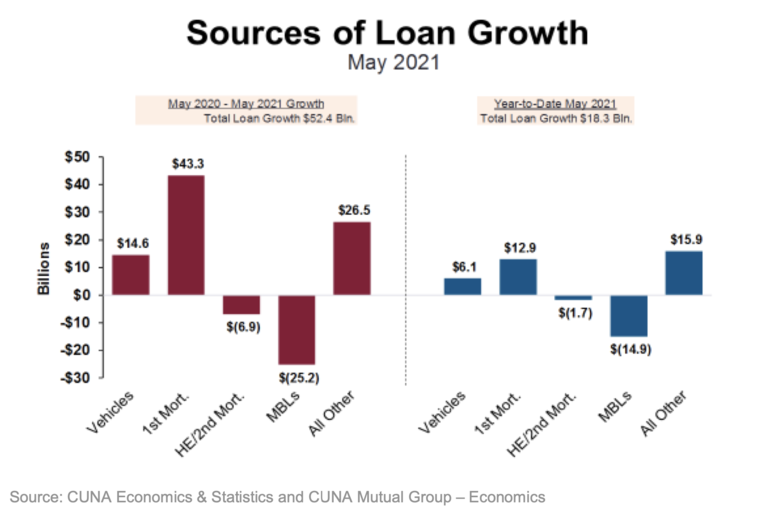
Credit union loan balances rose 0.8% in May, slower than the 1.1% pace reported in May 2020 and 4.5% during the last 12 months due to record-setting first mortgage loan originations, according to the Trends Report. Every loan category reported positive growth rates in May except adjustable-rate first mortgage loan balances which fell -0.5% and second mortgage loans which fell -0.4%.
First mortgage lending has made up the lion’s share of loan growth over the last 5 months. Since the end of 2020, credit union first mortgage loan balances increased $12.9 billion, while vehicle loan balances only rose $6.1 billion, the report states.
“Higher yielding unsecured and credit card loan balances made up 9.4% of all loan balances in May, the lowest in credit union history,” according to the analysis. “This is one of the factors pushing credit union yield on asset ratios to record lows this year.”
Consumer Installment Credit
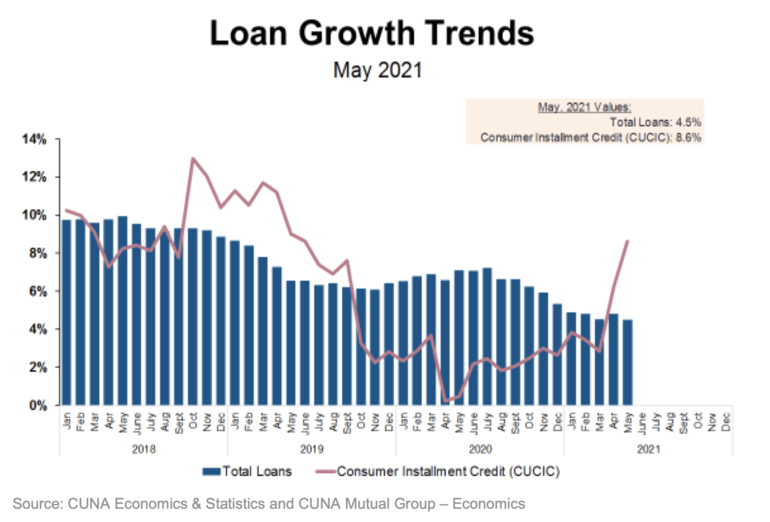
Credit union consumer installment credit balances (auto, credit card and other unsecured loans) reported 2.2% in May, more than the 0.1% decrease set in May 2020, due to an acceleration in credit card loans, the Trends Report states.
During the last 12 months, credit union consumer installment credit grew only 8.6%, which is above the total credit union loan growth of 4.5%, the report added, noting credit union consumer installment credit also grew faster than the rest of the market excluding credit unions, which increased only 3.4% over the last year.
Vehicle Loans
Credit union new-auto loan balances rose 0.5% in May, a big change compared to the 1.2% decline reported in May 2020, the report observed.
“On a seasonally adjusted annual rate, however, new auto loan balances fell 1.5% in May the 23rd monthly decline. The month of May is historically the beginning of the new auto lending season, so we expected a credit union lending turnaround,” the report states. “New auto loan balances are down 1.2% year to date, better than the 3.4% drop reported during the first 5 months of 2020.”
CUNA Mutual said credit unions should expect new auto sales to remain below the long-run average of 16.5 million sales pace for the next two quarters due to a global shortage of semiconductor microchips.
Real Estate
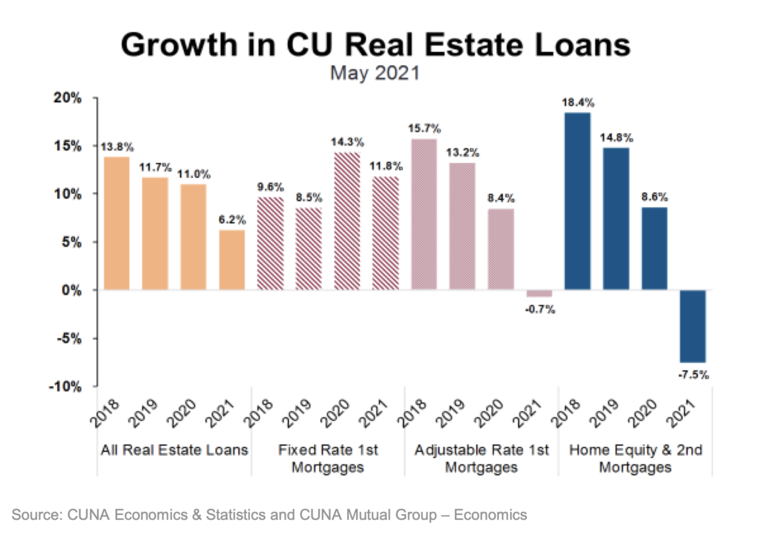
Credit union fixed-rate first mortgage loan balances rose 0.7% in May, below the 2.1% increase reported in May 2020, as the mortgage refinance boom begins to taper off, according to the Trends Report.
Credit union fixed-rate first mortgage loan balances rose 12% at a seasonally adjusted annual rate in May, the slowest pace in a year and a half, the report states, pointing out adjustable-rate first mortgage balances fell 0.5% in May, better than the 1.8% decline reported in May 2020, and have declined 0.7% over the last year.
Fixed-rate first mortgages now make up 34.6% of all credit union loan balances, up from 32.3% last May and the highest in credit union history, according to the report.
“This raises concerns for interest rate risk when market interest rates rise,” CUNA Mutual’s economists cautioned.
Surplus Funds
Credit union surplus funds fell in May by $2.4 billion due in part to an $8.7 billion decline in deposits and a $10.1 billion increase in loans, according to the analysis. Borrowing rose $20.2 billion due to credit unions reporting a drop in excess liquidity.
Credit union surplus funds as a percent of assets fell to 36.2% in May, from 36.5% in April but up from 30.1% set in May 2020, the Trends Report stated.
“Expect credit union liquidity to decrease further in 2021 as loan growth continues to outpace deposit growth,” the Report forecasts. “…Inverted to flat yield curves historically induce credit unions to reduce the percent of surplus funds invested with maturities greater than one year. With the effective Fed Funds interest rate at 0.08% and the Federal Reserve now paying 0.10% on required and excess reserve balances held at the Fed and the 3-year Treasury rate trading at only 0.39%, many credit unions are parking excess funds in their Fed reserve account to maintain liquidity in anticipation of future deposit withdrawals.”
Savings & Assets
According to the Trends Report, credit union savings balances grew at a 17.2% seasonally-adjusted, annualized growth rate in May, like the pace set in May 2020 when the COVID-19 pandemic was impacting the U.S.
“The deposit surge was caused by reduced member spending, $1,400 stimulus checks and the tax deadline extension,” the report noted. “The growth in savings per member over the last year rose to 12.3% in May, above the 11.2% reported in May 2020 and significantly above the 30-year average of 4.3%.”
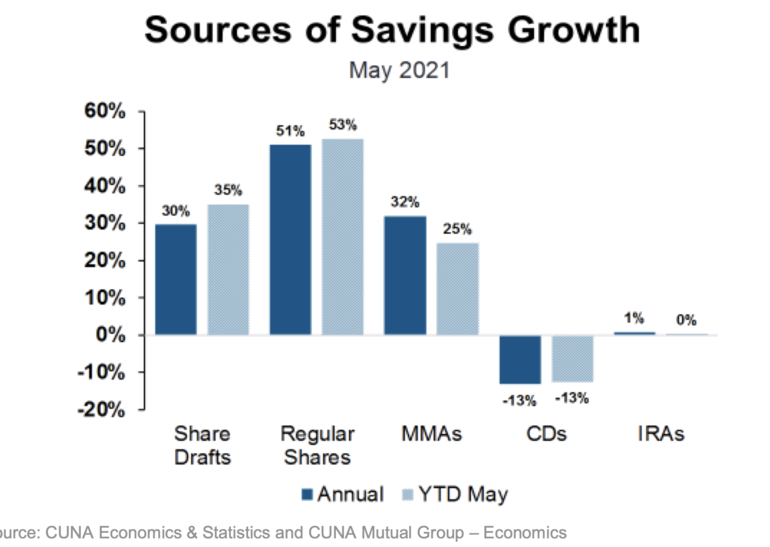
Regular share accounts obtained 53% of all new savings flowing into credit unions during the first five months of 2021, up from 51% during the last 12 months.
The Report forecast that credit unions should expect to see deposits to rise 15% in 2021 and only 5% in 2022, down from 20.6% in 2020.
Capital & Other Key Measures
The credit union loan delinquency rate (loans two or more months delinquent as a percent of total loans outstanding) fell to 0.46% in May, down from 0.47% in April and from 0.66% in May 2020, according to the Trends Report.
Delinquency rates are still below the 0.75% long-run natural delinquency rate, even though the unemployment rate was 5.8% in May.
“Credit union asset quality remains very healthy and this trend is being driven by deleveraging (which is magnified by refinancing activity), continued forbearance activity, significant government stimulus and a recovering economy,” the Report states. “However, several of these factors will recede in the coming months: households are unlikely to receive further direct stimulus payments related to COVID-19 and extended unemployment benefits are set to expire in September. Therefore, credit unions should expect a slight deterioration in portfolio quality figures, but not to any great extent.”
Credit union return-on-assets ratios rose to 1.04% in the first quarter of 2021, up from 0.53% in Q1 2020, due mainly to falling provision for loan loss ratios (15 basis points in Q1 2021 versus 53 basis points in Q1 2020) and falling operating expense ratios (2.76% in Q1 2021 versus 3.16% in Q1 2020), the Trends Report observed.
“The disparity between small and large credit unions’ return-on-asset ratios increased significantly over the last year,” the analysis notes.
Credit Unions & Members
Credit union memberships grew 254,000 in May, or 0.2%, down from May 2020 when the movement added 399,000 memberships at an increase of 0.32%.
According to the Trends Report, the membership gain year-to-date slowed to 1.94 million, up from 1.58 million for a similar period in 2020. Credit union memberships grew 4.34 million during the year ending in May 2021. Total credit union memberships have surpassed 128.7 million and are expected to reach over 130 million by the 4th quarter of 2021.
Faster loan growth, reopening of credit union branches and surging job creation are three factors boosting credit union membership growth, the Report observed.
“Credit union memberships grew at a 3.1% seasonally-adjusted, annualized growth rate in May, slower than the record-setting pace of the last few years,” the analysis states. “The current pace is however above the strong pace that began after Bank Transfer Day on November 5, 2011. Expect credit union memberships to grow 3% in 2021 and then increase to 3.5% during 2022 and 2023.”
The full report can be found here.