

MADISON, Wis.—Loan balances were up again in October, according to the latest CUNA Mutual Group Trends Report, which offers a forecast for what 2023 may hold for lending that is both favorable and not so favorable.
The November report, which includes CU performance data through October, shows CU loan balances rose 1.4% in October, above the 1.0% increase reported in October 2021. In the same period, vehicle sales rose 11% to 15.1 million units in October on a seasonally-adjusted annualized sales rate, up from the 13.6 million reported in September.
As for next year, expect car sales to climb back to the 16.5 million inherent demand, while CU mortgage originations are forecast to decrease by 5%. The Trends Report also predicts a surge in credit union mergers.
Here's a look at how credit unions performed by category:
Total Credit Union Lending
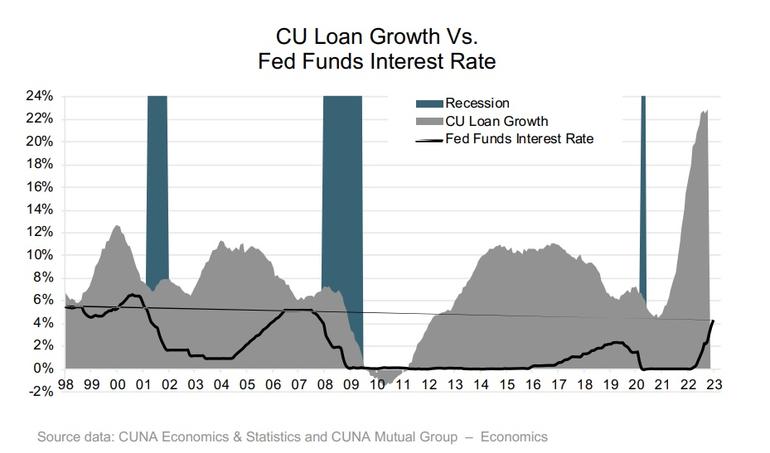
With CU loan balances up, the Trends Report reveals the categories that increased the fastest were home equity (6.0%), adjustable-rate first mortgage (3.4%), unsecured personal (2.6%) and used-auto lending (1.3%). New auto loan balances slowed to only 1.0%, after averaging monthly increases of 2% this year. Short-term interest rates (specifically the fed funds interest rate) increased by over 4.25% this year, the Trends Report reminds.
CUNA Mutual noted that rising short-term interest rates are affecting credit union loan growth.
“A three-percentage-point increase in the Fed Funds rate historically depresses credit union loan growth by five percentage points, albeit with a two-year lag. This is, of course, the goal of tighter monetary policy, which is to decelerate the rate of credit creation from above-trend growth to something closer to normal,” the report states. “Credit union loan balances grow on average 7% per year over the long run, but credit union loan balances are rising at an outstanding 22% seasonally-adjusted annual rate today. The Federal Reserve is expected to raise the Fed Funds interest rate to 5% in the first quarter of 2023, to slow credit creation, aggregate demand and inflationary pressures.”
Consumer Installment Credit
Credit union consumer installment credit balances (auto, credit card and other unsecured loans) reported a 0.5% rise in October, above the 0.4% increase set in October 2021, due to an acceleration of 2.6% in the “unsecured personal loan” category, according to the analysis.
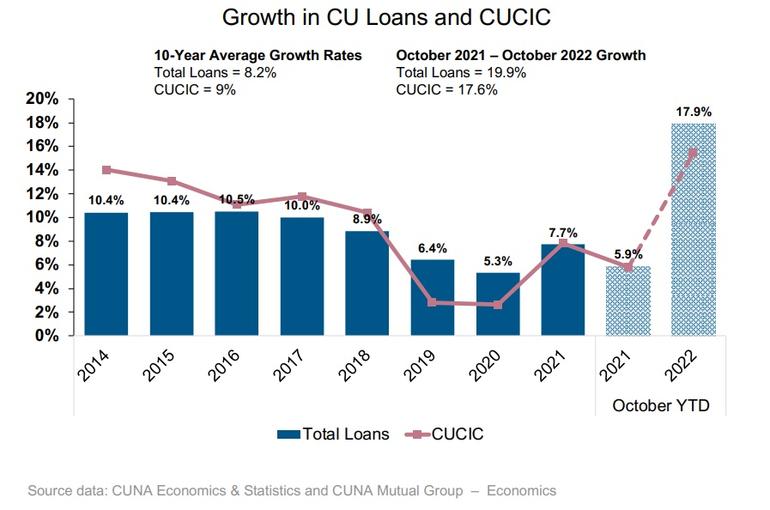
Credit card balances rose 1.4% in October, above the 0.9% growth reported last October. Year-to-date, credit union consumer installment credit grew 15.4%, almost three times faster than the 5.8% reported during the same period in 2021, the Trends report stated.
That trendline has pulled overall loan growth to 17.9% so far this year. For all lenders, outstanding consumer credit rose by $27 billion in October, according to the Federal Reserve, which is higher than the $26 billion reported in September, and almost twice the average pace of $15 billion growth reported during the years 2015-2019, according to the Trends Report.
“The continued growth in the stock of consumer credit demonstrates a willingness by consumers to spend despite the ups and downs of the stock market and predictions of a 2023 recession. Expect growth in consumer credit to moderate in 2023 due to tighter lending standards and rising interest rates,” CUNA Mutual said.
Vehicle Loans
Credit union new auto loan balances fell 1.0% in October, faster than the 0.3% decline set in October 2021, but nevertheless increased 20.8% in the year ending in October. On a seasonally-adjusted annualized basis, new auto loan balances rose 22.3% in October, significantly above the 7.7% pace reported in October 2021.
According to the Trends Report, multiple factors are driving the increase in new auto loan growth: rising inventories of new cars and less aggressive interest rate offers from banks. The number of new-auto loans as a percent of members in offering credit unions—the penetration rate—rose to 7.8% in the third quarter, up from 6.9% last year and 6.3% in pre-COVID 2019, the Trends Report notes.
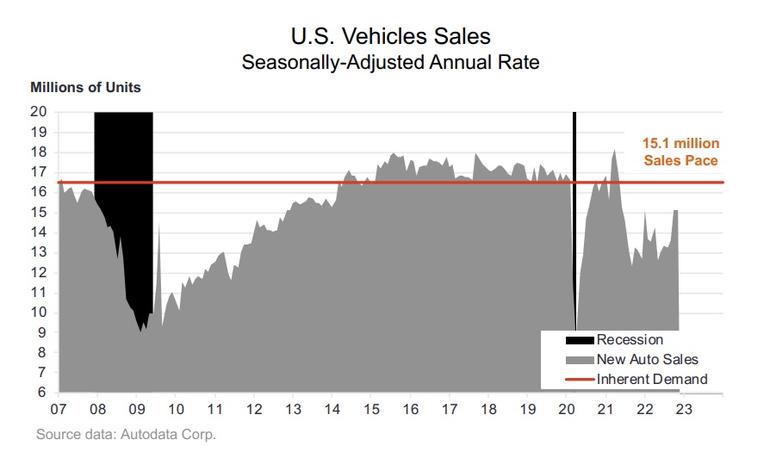
Vehicle sales rose 11% to 15.1 million units in October on a seasonally-adjusted annualized sales rate, up from the 13.6 million reported in September. October sales were 14% above the October 2021 rate but still well below the 16.5 million average long-run average, the report explained.
“Rising new vehicle production and inventory levels are helping to slow price appreciation to 3.8% year-over-year,” the Report states. “In October U.S. production of autos and light trucks rose to 10.7 million, the highest since September 2020. But U.S. consumers are beginning to hesitate when purchasing a new vehicle due to rising new-vehicle and financing costs. However, despite record-high monthly payments consumers still need cars, so expect car sales to climb back to the 16.5 million inherent demand by the end of 2023.”
Real Estate Information
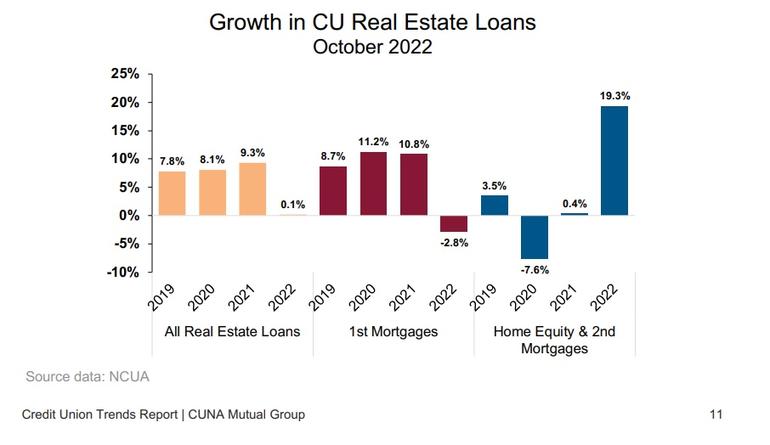
Not surprisingly, credit union fixed-rate mortgage lending has slowed considerably during the last 12 months, with the Trends Report noting mortgage interest rates have averaged 5.24% in 2022, up from the 2.96% average in 2021.
Fixed-rate first mortgage loan balances grew a weak 4.3% over the last year, below the 15.9% pace set in 2021. Total first mortgage loan balances are down 2.8% during the last year, according to the Trends Report.
Second mortgage loan balances fell 31% over the last year but rose 3% during October.
“Expect mortgage originations to decrease by 5% in 2023 due to relatively high interest rates, a near-recession economy and fewer opportunities for mortgage refinances,” the Report forecasts. “With the Federal Reserve expected to push short-term interest rates above 5% in February 2023, we expect 30-year mortgage interest rates to remain around 6.5% in the first half of 2023,” CUNA Mutual.
Savings and Assets
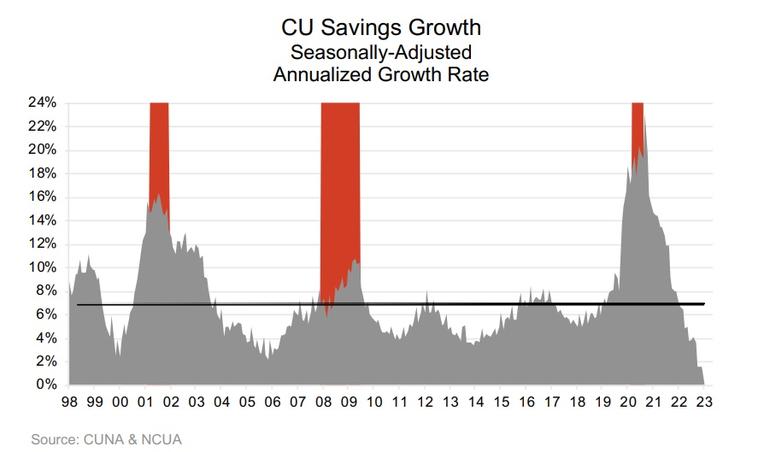
Credit union savings balances fell in October by 0.7%, less than the 0.9% rise in October 2021.
“Members are dipping into savings deposits to maintain their current level of consumer spending in this era of rising prices,” the report states. “Consumer real disposable income declined 3% during the last year thus requiring the drawdown in precautionary savings balances Savings balances grew at a 1.6% seasonally-adjusted annualized growth rate in October, below the 8.2% reported one year earlier and below the 7% long-run average. Credit unions are experiencing small but positive deposit growth due to strong new membership growth.”
The report further notes the personal savings rate (personal savings as a percent of disposable personal income) fell to 2.3% in October, one of the lowest on record, and below 7.3% in October 2021, CUNA Mutual said.
“A tight labor market will drive up wages and therefore prevent inflation from running too far ahead of personal income growth. We expect credit union deposit growth to rise in 2023 to 6%, still below the 7% long-run average, but above the 4% expected in 2022,” the report continued. “Consumer spending will slow (and thus savings will rise) as uncertainty over the expected 2023 recession raises uncertainty levels.”
Number of Credit Unions
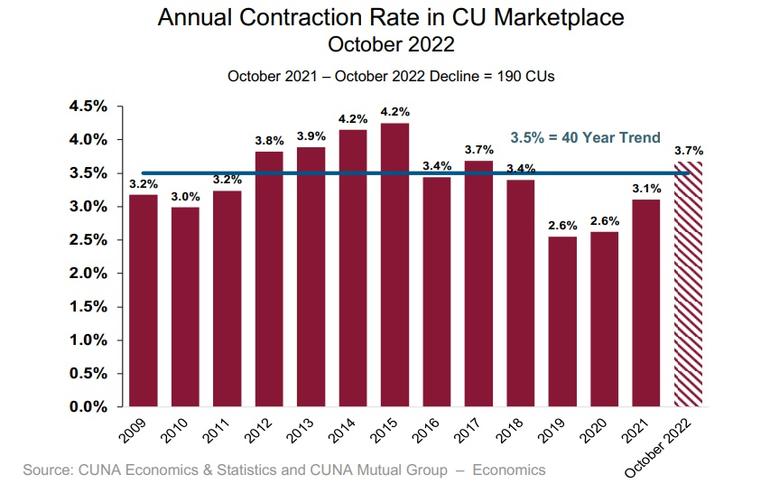
As of October 2022, CUNA Mutual cited CUNA data estimating 4,989 credit unions were in operation, down 190 from October 2021. Year-to-date the number of credit unions fell by 163, “significantly more than the 138-decline reported in the first 10 months of 2021,” the report states.
“We expect a surge in credit union mergers in the 2023-2024 period, like what we experienced in the years following the Great Recession as many credit unions look to offer more financial services to their members through mergers,” CUNA Mutual forecast.
The report further predicts credit union consolidation and concentration will continue above their long-run pace over the next few years. Since 1980, the number of credit unions has declined by roughly 3.5% each year.
“If we apply this exponential ‘decay’ rate to the current number of credit unions, 4,989, we should expect another 175 credit unions to exit the financial system in 2023,” the Trends Report states. “If we forecast a little further, according to the laws of exponential decay, there will only be 2,447 credit unions in 20 years, half as many as there are today. Fortunately, credit union assets follow an average annual exponential growth of 7%. This means the time that it takes for credit union assets to double (currently $2.2 trillion) is only 10 years.”
Just in Time for the New Year, CUToday’s Free Morning Headline Email is Now Double-Free!
Don’t forget to check your Spam/Junk email folder if you haven’t been receiving your free, popular and daily CUToday.info news headlines.
And if you haven’t yet signed up for the new email solution on which CUToday.info has partnered with ResponseGenius, you can do so here. Signing up requires less than one minute of your time.
CUToday.info has received very positive response from readers following the move to an improved provider of the daily headlines, but many also noted they did need to go to their Spam/Junk folder and mark it as safe.
The new email solution has not only improved every reader’s delivery experience, but it also features a fresh, new format that is easy to read, especially on mobile devices.
Please note and/or make your IT department or email administrator aware the emails will be coming from the domains CUTodayinfo.com and CUTodayinfoReply.com.