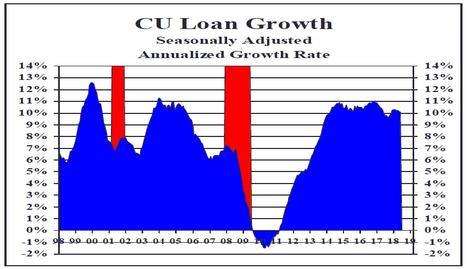
MADISON, Wis.—Credit union loan balances rose 1.3% in June, faster than the 1.1% pace reported in June 2017, due to faster growth in new-auto loans (2.3% vs 1.2%) and fixed-rate first mortgages (1.5% vs 0.9%), according to CUNA Mutual Group’s August Trends Report.
The report indicates that new car sales are not declining from last year’s levels.
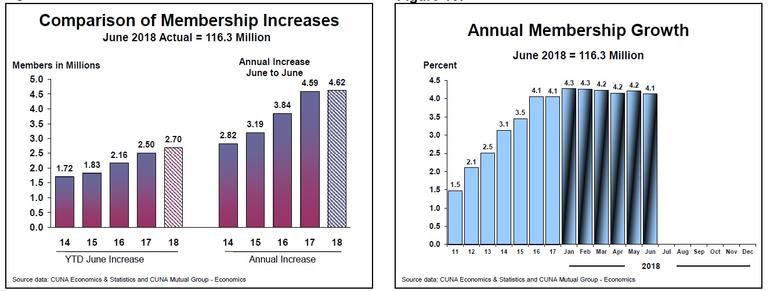
Meanwhile, credit union memberships grew a strong 460,000 in June and have now reached more than 35% of the total U.S. population.
June typically records the fastest loan growth of the year, with seasonal factors adding 0.42 percentage points to the underlying trend growth.
Credit union loan balances grew at a 10.1% seasonally-adjusted, annualized growth rate in June, slightly below the pace set over the last four years, the report shared.
“There are numerous factors that will drive double-digit loan growth through 2018. The most important one is job growth. The economy is expected to add close to 2.3 million jobs in 2018 and 2.1 million in 2019. As the labor market moves beyond full employment in the second half of 2018, wage growth will accelerate, giving members increased ability to borrow. Additionally, this will also raise consumer confidence, increasing members’ willingness to borrow,” the report forecast.
Credit Union Consumer Installment Credit (CUCIC)
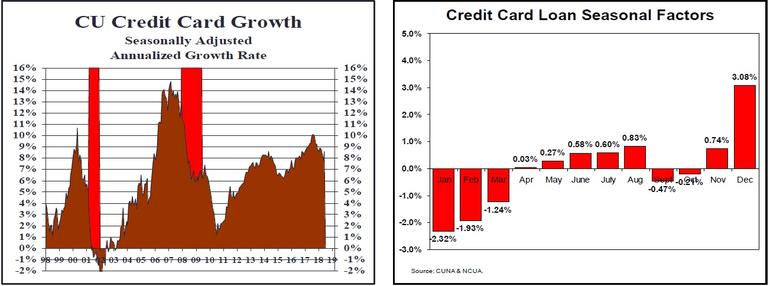
Credit union consumer-installment-credit loan balances (auto, credit card and other unsecured loans) rose 9.3% during the 12 months ending in June, more than twice the 4.1% reported by all other lenders. Credit card growth has been declining lately, growing at a 8.5% seasonally-adjusted annualized growth rate. June’s credit card seasonal factors usually add 0.58 percentage points to the underlying trend growth rate.
“Rising interest rates had been weighing on credit card growth more than auto loan growth because credit cards often carry variable rates while borrowers can lock in a fixed rate with many other types of loans,” CUNA Mutual Group said.
Vehicle Loans
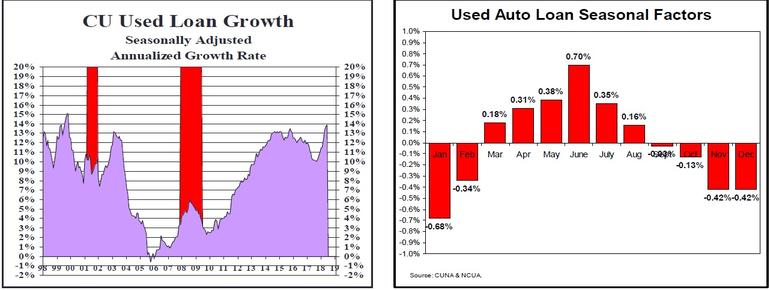
Credit union used-auto loan balances grew at a 13.9% seasonally-adjusted, annualized growth rate in June, an acceleration from the pace set during the last couple of years. On a month-over-month basis, used-auto loan balances increased 1.3% in June, faster than the 1% reported in June 2017. June’s seasonal factors usually add 0.7 percentage points to the underlying trend growth rateand are typically the largest of the year.
“March through August is considered the used-auto buying and lending season. Credit union used-auto loan portfolios are generally 62% larger than new-auto loan portfolios, but a typical used-auto loan is originated at roughly half the dollar amount of a new-auto loan. So even though new-auto loan balances increased 13.8% during the last 12 months, and used-auto loan balances grew only 11%, many credit unions have had to increase staffing in the used-auto lending area to keep up with the surge in used-auto loan demand,” the report shared.
Vehicle sales rose in June to a 17.3 million unit seasonally-adjusted, annualized sales rate, which is up from the 16.9 million units reported in May and up 4.6% on a year-ago basis. This pace is above the 16.5 million-level considered a strong auto market. New-auto sales tailwinds include strong job creation, rising nominal personal income, high consumer confidence and proposed tariffs on imported vehicles, which would bring forward sales before implementation of tariffs.
Real Estate Secured Lending – First Mortgages and Other Real Estate
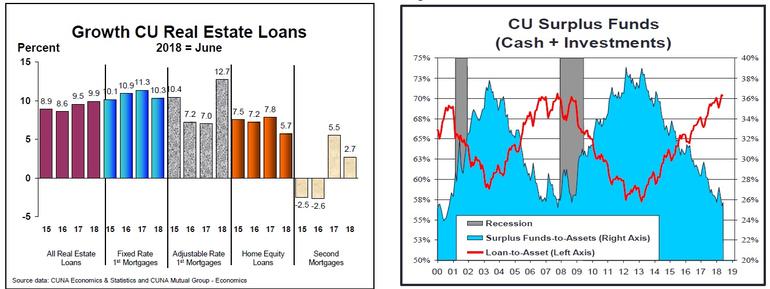
Credit union fixed-rate first mortgage loan balances grew 1.5% in June, faster than the 0.9% reported in June 2017. A year-to-date growth comparison shows a 4.7% growth rate during the first half of 2018 compared to 5.6% during 2017. Adjustable-rate first mortgage loan balances reported 7.9% growth during the first half of 2018, up from 2.5% during the similar period last year. Credit unions now hold $420 billion of first mortgages on their books, which are 4.1% of the entire mortgage market, up from 3.9% in June 2017. All credit union real estate loans grew 9.9% over the last year, faster than the 9.5% pace set in 2017.
The contract interest rate on a 30-year fixed-rate conventional home mortgage fell to 4.57% in June, down from 4.59% in May, but above the 3.9% reported in June 2017.
“We expect the Federal Reserve to raise short-term interest rates in the second half of 2018, which will lift the 30-year mortgage interest rate to the 4.75-5% range by the first half of 2019. This forecasted increase in interest rates will encourage some fence-sitters to purchase a home now before interest rates rise further,” CUNA Mutual Group said.
Home prices rose 0.7% in June from May, according to the Core Logic Home Price Index, and 6.8% year-over-year. The index has now posted more than six years of positive year-over-year growth rates. Home prices are expected to rise another 6% in 2018 and 5% in 2019.
Surplus Funds (Cash + Investments)
Credit union surplus funds as a percent of assets fell to 25.7% in June, down from 28.1% in June 2017, as surplus funds fell 2.8% over the last year while assets grew 6.5%. “This measure of credit union liquidity is the tightest since September 2008. The weak growth in savings over the last year resulted in credit unions relying more on wholesale borrowings, which rose $14.1 billion, or 29%,” the report said. Credit unions’ capital balances increased by $7.4 billion, 5.8%, during the last 12 months. The credit union movement’s capital-to-asset ratio fell to 10.5%, slightly below the 10.6% reported in June 2017, due to assets growing slightly faster that capital.
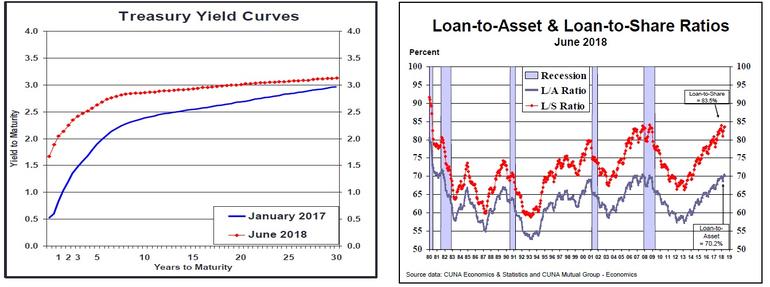
The report noted the obverse of the falling surplus funds ratio is the rising loan-to-asset ratio, which reached 70.2% in June, the highest level since September 2008. Credit unions can expect rising asset yields over the next year as more and more funds are moved from the investment portfolio into new- and used-auto loans and additional mortgage lending,.
During June, credit unions added $13.1 billion in loans and $9.1 billion in investments to their balance sheets. This was funded by $14.8 billion in new savings deposits, $7 billion in new borrowings and accumulating $1 billion in earnings, CUNA Mutual said.
Savings and Assets
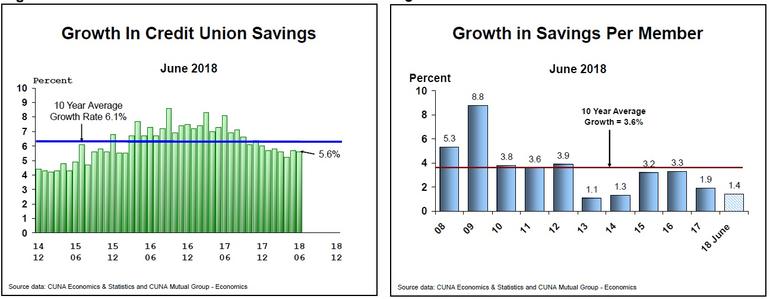
Credit union savings balances grew 5.6% during the 12 months ending in June, slower than the 6.1% average annual growth rate recorded during the last 10 years due to the falling national savings rate (savings as a percent of disposable personal income). This savings growth rate was caused more by fast membership growth, 4.1% during the last 12 months, than by the low savings-per-member growth, 1.4% during the last year.
Capital and Other Key Measures
The yield curve has flattened significantly during the last year and a half, which will put downward pressure on credit unions’ net interest margins during the remainder of 2018, the report said. In June, the Federal Reserve raised the Fed Funds interest rate 0.25 percentage points, raising short-term interest rates, and, with some delay, credit union cost of funds. Continued quantitative easing (printing money to buy assets) by the European Central Bank, low inflation expectations and the global savings glut kept longer-term interest rates from rising. This will keep downward pressure on credit union yield on assets.
Credit union loan-to-share ratios rose to 83.5% in June, up from 80% one year earlier. The recent cyclical high of 84.1% occurred during September 2008, nine months after the start of the Great Recession. Loan-to-asset ratios reached 70.2% in June, the highest since September 2008, which will buoy net interest margins and offset the downward pressure on margins caused by the flattening yield curve, CUNA Mutual is forecasting.
Credit Union Numbers
As of June 2018, CUNA estimates 5,714 credit unions were in operation, 8 fewer than May and 228 fewer than June 2017. During the first half of 2018, approximately 86 credit unions ceased to exist because of mergers, purchase and assumptions or liquidation, the report states.
“During a typical year, 46% of the total decline in the number of credit unions takes place in the first half of the year, which means we can forecast the 2018 full year decline in the number of credit unions to be 187, slightly below the 222 reported in 2017. The average asset size of a credit union now stands at $253.9 million, up 9.7% from a year ago, while the median asset size is $32.5 million, up 7.2% over the last year, indicating larger credit unions growing faster than their smaller counterparts,” CUNA Mutual Group said.
“The trend towards industry consolidation and bigger credit unions is only likely to accelerate due to the benefits of greater economies of scale, higher productivity and larger earnings that are all achieved with a larger asset base,” the Trends Report stated. “Larger, more efficient credit unions will also raise the barrier to entry for new small credit unions.”
Credit Union Membership
Credit union memberships grew a strong 460,000 in June (0.40%) which is slightly below the 528,000 new members (0.48%) added in June 2017. Total credit union memberships have now reached 116.3 million – 35.6% of the total U.S. population of 326.8 million. Last June, 34.3% of the U.S. population belonged to a credit union. The membership gain was driven by strong demand for credit by the American consumer and the 248,000 new jobs added to the U.S. economy in June, according to the Bureau of Labor Statistics. Year-to-date, credit unions added 2.7 million new members, faster than the 2.5 million members added in the similar period in 2017. Year-over-year memberships have increased at a 4.1% pace, faster than the 0.8% population growth.
“We expect the economy to add another 2.3 million jobs in 2018 and 2.1 million jobs in 2019, contributing to credit union membership growth of 3.5% in 2018 and 2.5% in 2019,” the report stated.