MADISON, Wis.—Credit union loan balances grew at a 10.4% seasonally adjusted annualized pace in November, while savings balances grew 8.8%, according to CUNA Mutual Groups latest Trends Report data.
CUNA Mutual is projecting that CU loan growth will exceed 10% this year.
At the same time, total CU membership in the U.S. has now surpassed 109 million, according to the Trends Report.
The U.S. economy is expected to grow 2.5% in 2017, faster than the 1.8% reported in 2016 and faster than the long-term trend of 2%, CUNA Mutual is forecasting
“The election of President Donald J. Trump has changed the outlook for economic growth, inflation and interest rates for the next few years. The Trump administration is looking to implement a fiscal expansion in the form of infrastructure investment along with corporate and personal tax cuts. If implemented, this could boost economic growth to over 3% in 2018. Expect auto sales to reach a record pace of 17.75 million in 2017,” the Report forecasts. “This should keep credit union new-auto lending growing at a double-digit pace. The unemployment rate is expected to fall below 4.5% in 2017, and more than two-million new jobs are forecast to be created. Expect credit union loan growth to exceed 10% in 2017, which will be the 4th consecutive year of double-digit loan growth.
Here’s a look at some of the other credit union performance through November, according to the Trends Report:
Total Credit Union Lending
Credit union loan balances rose 0.9% in November, greater than the 0.7% pace reported in November 2015. Driving overall loan growth was strong growth in new-auto loans (1.5%), unsecured personal loans (1.4%), and credit card loans (1.2%). November seasonal factors typically subtract 0.22 percentage points from the underlying trend loan growth as winter weather slows auto and home purchases, CUNA Mutual explained.
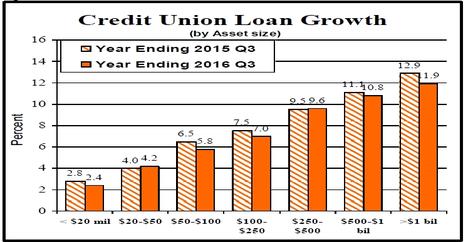
Over the last 12 months, total credit union loan balances rose more than 10.8%, the fastest pace since 2005, but industry growth rates mask big disparities between large and small credit unions. In the year ending in the third quarter of 2016, credit unions with assets greater than $1 billion reported an 11.9% increase in loan balances, which was down slightly from the similar time period one year earlier. Credit unions with assets less than $20 million reported loan growth of only 2.4%, below the pace set one year earlier, according to the Trends Report.
Consumer Installment Lending
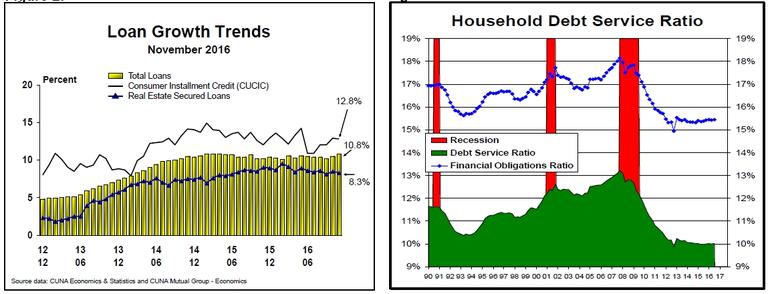
Credit union consumer installment credit balances (auto, credit card and other unsecured loans) rose 0.4% in November, slower than the 0.5% pace set in November 2015, CUNA Mutual said. Consumer installment credit grew 12.8% over the last year, faster than the 8.3% rise in real estate loans.
Vehicle Loans
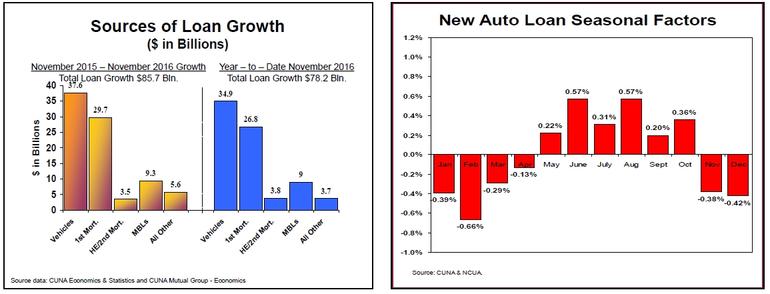
Auto loans remain credit unions’ “bread and butter” loan product with vehicle loan balance growth outpacing the growth in mortgage and business loans, the Trends Report observed. During the last 12 months, vehicle loan balances increased $37.6 billion (14.3%), better than the $29.7 billion increase for first mortgage loans (9.1%). New-auto loan balances rose a robust 1.5% in November, greater than the 0.8% pace set in November 2015, despite November being typically one of the slower months of the year for auto loan originations, CUNA Mutual said.
Expect auto sales to set another record in 2017 due to low gas prices, a recovering construction sector, strong job growth, rising wages, and greater access to auto credit, CUNA Mutual stated.
Real Estate Secured Lending – 1st Mortgages and Other Real Estate
Credit union fixed-rate first mortgage loan balances grew 1.1% in November, the same pace set in November 2015, as existing-home sales rose 0.7% in November from October and are up 15.4% over the last year, according to CUNA Mutual. The Trends Report noted home sales are limited due to a lack of homes for sale. The supply of existing homes available for sale is becoming increasingly scarce with the inventory-to-sale ratio running at four months, the lowest since January 2005, CUNA Mutual reported.
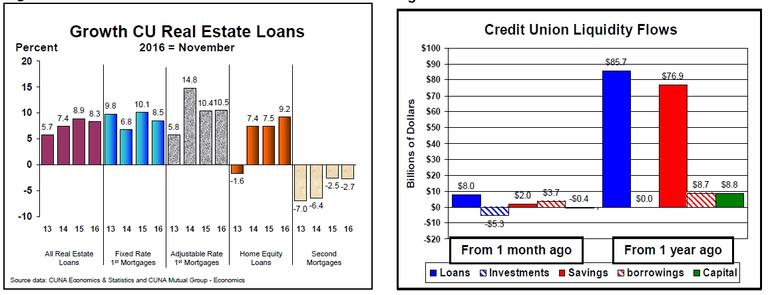
From November 2015 to November 2016, fixed-rate first mortgage loan balances grew 8.5%, slightly below the 10.5% increase in adjustable-rate mortgage balances, and slower than the 9.2% growth of home equity balances. Second mortgage balances continued its multi-year decline (-2.7%) as homeowners refinance second mortgage balances into new first mortgage loans. This effect is limiting the growth in overall real estate loan balances to 8.3%.
With the Federal Reserve expected to raise short-term interest rates 75 basis points in 2017, expect the 30-year mortgage interest rate to move higher during the rest of the year, CUNA Mutual predicted.
Surplus Funds (Cash + Investments)
Credit union surplus funds fell $5.3 billion, or -1.4%, in November to help fund strong loan demand ($8.0 billion). Deposit inflows ($2.0 billion) and additional borrowings ($3.7 billion) were used to fund the remaining loan growth, according to the Trends Report. Credit union surplus funds as a percent of assets fell to 28.6% in November, down from 30.8% in November 2015, as credit union assets rose 7.7% and surplus funds were essentially unchanged, CUNA Mutual reported. “The obverse of the falling surplus funds ratio is the rising loan-to-asset ratio, which reached 67.3% in November, the highest level since January 2009,” according to the Trends Report.
According to third quarter NCUA call report data, credit unions’ yield on surplus funds rose to 1.27% during the first nine months of 2016 up from 1.17% for the similar period last year due to rising short-term market interest rates. Average annualized loan yields fell to 4.58% – a record low – during the first nine months of 2016, down from 4.66% for the similar period in 2015, as old higher-rate loans re-priced into today’s lower interest rates. Credit union yield-on-asset ratios rose four basis points to 3.39% during the first nine months of 2016 due to rising loan-to-asset ratios – the “mix effect” – and slightly higher interest rates, the “rate effect.”
Savings and Assets
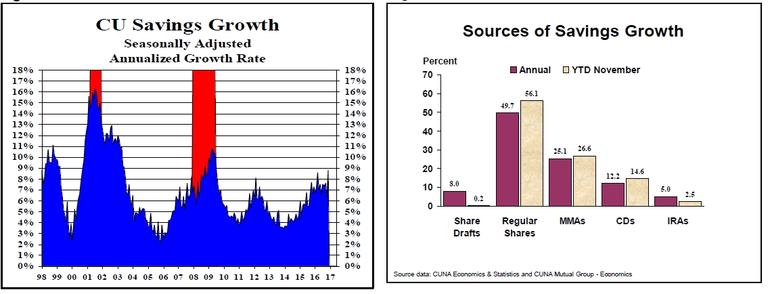
Credit union savings balances rose 0.2% in November, better than the 0.3 decline reported in November 2015, the Trends Report found. Savings balances typically decline 0.2% in November due to recurring seasonal factors. Savings balances are currently growing at an 8.8% seasonally adjusted annualized growth rate due to low fuel prices and rising household incomes.
CUNA Mutual said credit unions reported a savings inflow of $77 billion during the last 12 months, a 7.6% increase. Almost 50% of this inflow ($38.2 billion) was deposited into low-cost regular share accounts.
Capital and Other Key Measures
The loan delinquency rate (loans two or more months delinquent as a percent of total loans outstanding) rose to 0.81% in November from the March low of 0.71%, demonstrating its seasonal pattern, according to the Trends Report. On a year-over-year basis, the loan delinquency rate is one basis point lower than the 0.82% reported in November 2015. Expect loan quality to improve slightly in 2017 as the unemployment rate falls below 4.6% by the end of the year and loan growth exceeds 10%, CUNA Mutual is forecasting.
Credit union return-on-asset ratios came in at 0.77% (annualized) for the first nine months of 2016, similar to the rate set during the previous three years. CUNA Mutual is projecting that CU ROA ratios will fall slightly in 2017 to 75 basis points as rising net interest margins are offset by rising loan loss provisions, increasing employment costs, falling mortgage fee income, and lower gains on the sale of mortgages.
Credit Unions and Members
As of November 2016, CUNA estimates 6,028 credit unions were in operation, down 247 from November 2015, CUNA Mutual said. Through November, the number of credit unions fell by 208, slightly lower than the 238 reported in the first 11 months of 2015, according to the Trends Report. The annual contraction rate of the credit union industry reached 3.9% in 2016, faster than the 3.5% average pace set over the last 25 years. NCUA’s Insurance Report of Activity showed 18 mergers were approved in November with an average asset size of $23.7 million. This is down from the 19 mergers reported in November 2015 with an average asset size of $18.3 million.
Credit union memberships grew 376,000 in November, or 0.35%, which is much better than the 131,000 new members, or 0.12%, added in November 2015. Through November, CUs added 4.2 million new members, faster than the 3.3 million members added during a similar period in 2015. During the last 12 months, credit unions memberships rose 3.8%, the fastest pace in more than 20 years, CUNA Mutual reported.
Total credit union memberships reached 109.1 million in November, 4.369 million more than November 2015.