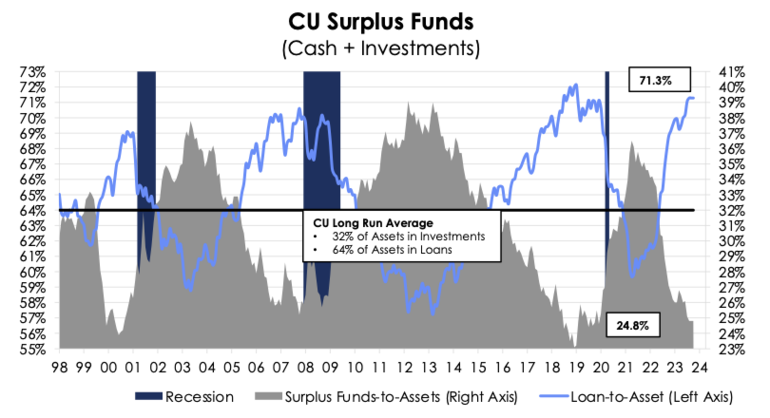
MADISON, Wis.–Credit union liquidity has dropped to the lowest level since October 2019, and is close to the lowest level in credit union history, according to TruStage’s newest Trends report, which is also projecting net interest margins could tighten, noting member demand for certificates is strong, and that credit unions are increasing provisions in anticipation of growing delinquencies and charge-offs.
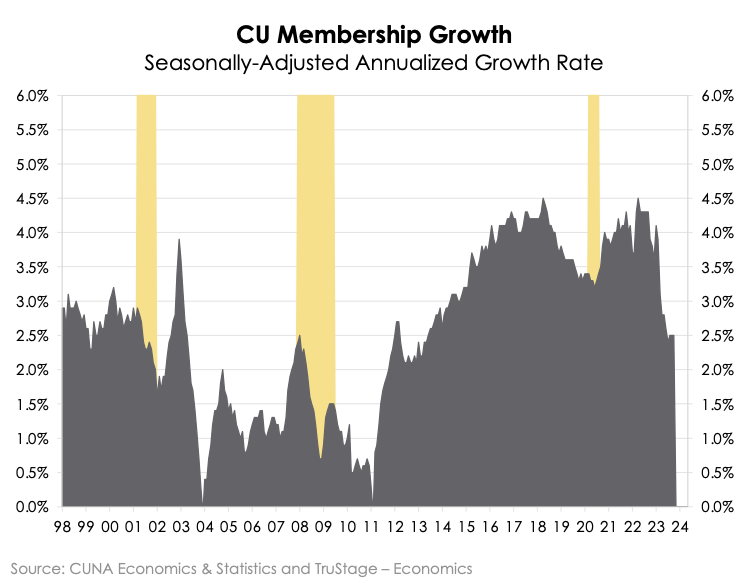
Meanwhile, the Report shows membership has now topped 140-million in the U.S.
With CUs feeling the liquidity pressures, the Trends Report, which is based on credit union data through August of this year, further found cash plus investments as a percent of assets fell from 28.9% in August 2022 to 24.8% in August 2023, which is only slightly above the record low of 23.1% reported in December 2018.
Liquidating Investments
“This 4.1 percentage point drop in liquidity is due to credit unions liquidating their investment portfolio as a means of funding continued loan growth (10.7% year over year) in the face of weak deposit growth (0.6% year over year),” wrote TruStage Chief Economist Steve Rick in the Trends report.
Rick noted that members continue to draw down some of their excess savings built up during the COVID-19 pandemic to spend on goods and services.
“The average credit union member reduced their total credit union deposits by $430 over the last year, from $13,879 in August 2022 to $13,449 in August 2023,” the report states. “Despite this deposit headwind, total deposits have grown 0.6% due to new members bringing in new deposits.”
23-Year-Low
The analysis further found year-to-date savings balances grew only 0.7% in 2023, significantly below the past 23-year average of 5.7%. And when adjusted for inflation, savings balances are growing at their slowest pace during this 23-year time period.
“Weak year-to-date savings growth has crashed head-on with a 5.3% year-to-date loan growth rate, pushing up the loan-to-asset ratio to 71.3%, which is above the long run average of 64%,” the report states. “This pattern is good for credit union net interest margins as more assets are placed in higher-yielding loans and out of lower yielding investments. But with the Federal Reserve expected to raise short-term interest rates by another 25 basis points later this year, credit union net interest margins could tighten as funding costs rise faster than asset yields.”
Performance by Category
Here’s a look at how credit unions performed by category through August, according to the Trends Report.
Total CU Lending
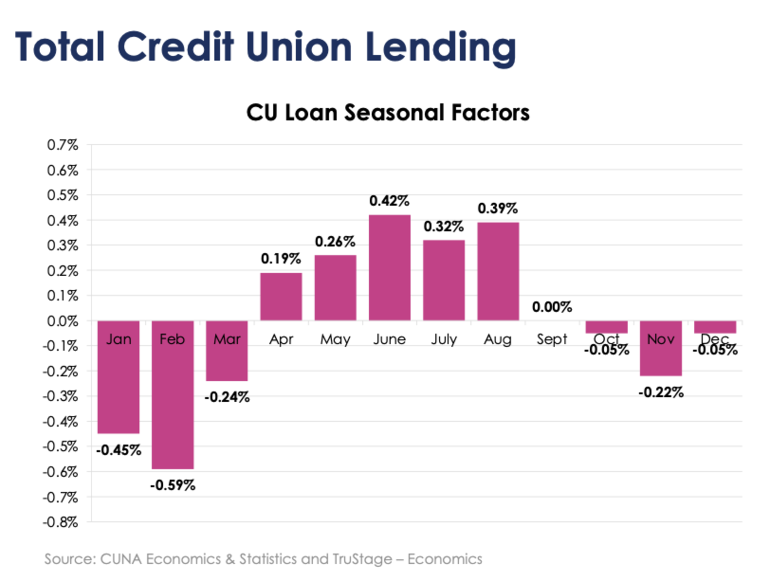
Credit union loan balances rose 0.8% in August, half the 1.6% pace set in August 2022 as higher loan interest rates curtail credit demand.
“Much of this monthly growth was due to adjustable-rate mortgage lending increasing 3.1%, second mortgage lending increasing 4.0%, home equity lending increasing 2.4%, used-auto lending increasing 0.6%,” the report states. “The strong credit union lending season of April through August is now over as loan seasonal factors turn negative for the rest of the year.”
According to the Trends Report, during the last 12 months, credit union loan balances increased a strong 10.7%, which is above the 7% long-run annual loan growth rate.
“But loan growth has slowed recently. Credit union loan balances grew at a 6.2% seasonally-adjusted, annualized growth rate in August, significantly below the 18.3% pace set in August 2022,” the report states.
TruStage is forecasting below-trend credit union loan growth for the next two years (4% in 2024 and 6% in 2025) due to higher loan interest rates on new loans, a shift in consumer spending from goods to services, higher debt servicing costs on existing adjustable-rate loans, satiated demand for goods, the resumption of student loan payments, falling consume confidence and the exhaustion of stimulus/pandemic related “excess savings” that could have been used for loan down payments.
Consumer Installment Credit
The new Trends report shows credit union consumer installment credit loan balances (auto, credit card and other unsecured loans) rose 0.5% in August, a deceleration from the 1.3% pace set in August 2022. During the last 12 months, credit union consumer installment credit grew 9.8%, greater than the total market excluding credit unions and government student loans at 9.5%, the report adds.
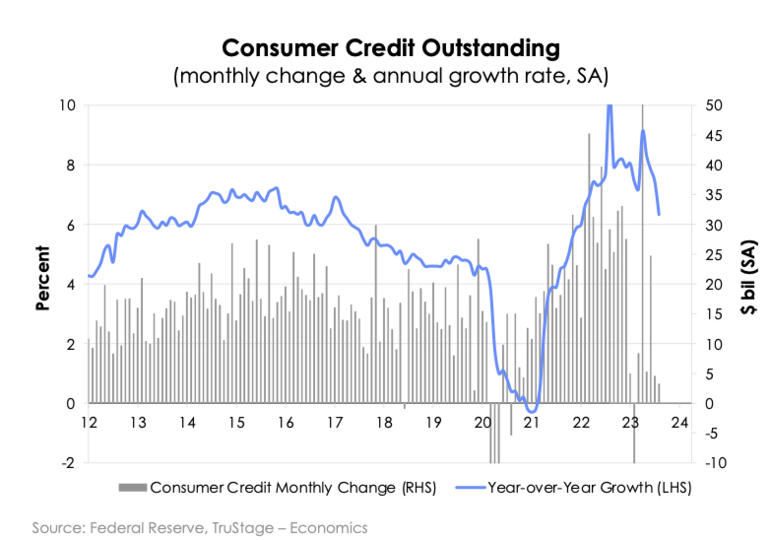
“According to the Federal Reserve, consumer credit outstanding for all lenders rose a small $3.3 billion in August, a significant slowdown compared to the last few years; non-revolving credit (large loans such as automobile and student loans) fell $16.1 billion while revolving credit (credit cards and home equity lines of credit) rose $19.6 billion,” the report observes. “The decline in non-revolving credit was due to federal student loan forgiveness, rather than nervous consumers. With the federal portion of nonrevolving debt stripped out, non-revolving credit would have posted a gain of $10.7 billion.”
Looking Forward
The report further notes consumer credit balances grew only 6.3% during the last 12 months due to the federal student debt relief, the slowest pace since the spring of 2022, but above its long run average of 5.6%.
“Going forward, expect consumer credit growth to decelerate into 2024 as consumer demand becomes satiated, higher interest rates make debt less attractive and economic uncertainty increases,” the report forecasts.
Vehicle Loans
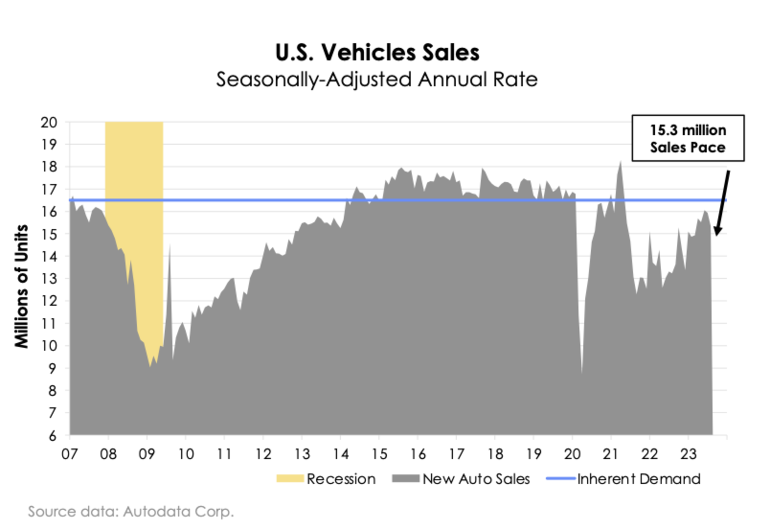
Vehicle sales fell in August to a 15.3 million unit seasonally-adjusted, annualized sales rate, which is down 4% from July, but up 16% from August 2022 when slightly more than 13.2 million units were sold, the report notes.
“New vehicle sales are still well below the pre-pandemic level considered to be the market equilibrium,” according to the analysis. “Approximately 16.5 million is considered the inherent demand for new vehicles. High auto loan rates will ensure that new-vehicle sales remain below the 16.5 million pace through 2025.”
The Trends Report said high vehicle prices are leading some prospective buyers to postpone purchasing a new vehicle, but predicts new vehicles will keep vehicle sales around the 15.5 million pace for the remainder of 2023.
“Credit union new-auto loan balances rose only 0.2% in August, below the 2.3% pace set in August 2022,” the report states. “New-auto loan balances declined 0.2% in August on a seasonally-adjusted annualized rate. With auto loan interest rates now in the 7-8% range, auto demand is being curtailed. Used-auto loan balances didn’t fare much better with balances rising only 0.6% in August, down from 1.6% in August 2022. Used-auto loan balances rose a small 0.7% in August on a seasonally adjusted annualized rate.”
Real Estate Information
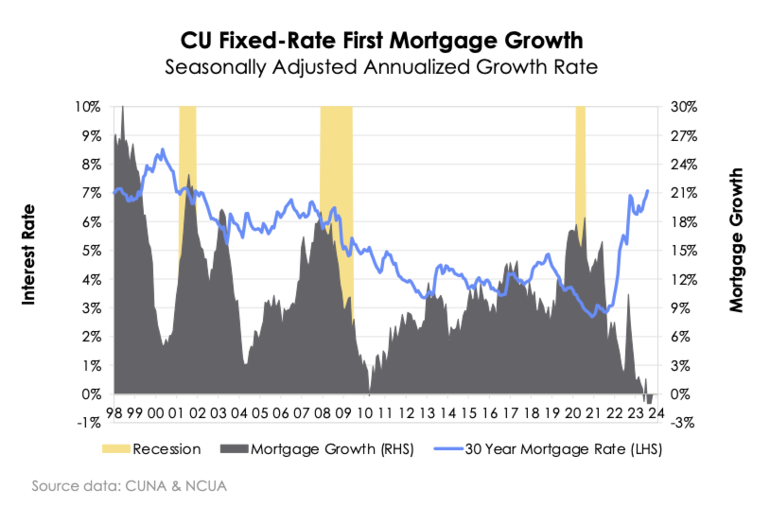
The Trends Report found credit union fixed-rate, first mortgage loan balances fell 0.05% in August, lower than the -0.01% pace reported in August 2022. When comparing year-to-date growth, fixed-rate first mortgage balances fell 0.63%, below the -0.07% reported during the first 8 months of 2022, the report added.
“The drop in mortgage loan balances is due to the rise in interest rates,” the report continued. “The contract interest rate on a 30-year, fixed-rate conventional home mortgage rose to 7.07% in August, from 6.84% in July, and above the 5.22% reported in August 2022.”
Home prices rose 0.6% in July, according to the S&P Core Logic Home Price Index and rose 1% year-over-year despite the worst housing affordability in almost 40 years. Home prices are now back to their June 2022 peak. In the five years preceding the pandemic the average monthly price appreciation was just over 0.4%.
Noting current homeowners have a strong incentive to stay in the homes because of the large spread between the effective mortgage rate and the current mortgage rate, the report forecasts that home prices will fall 3-5% in 2024.
Savings & Assets
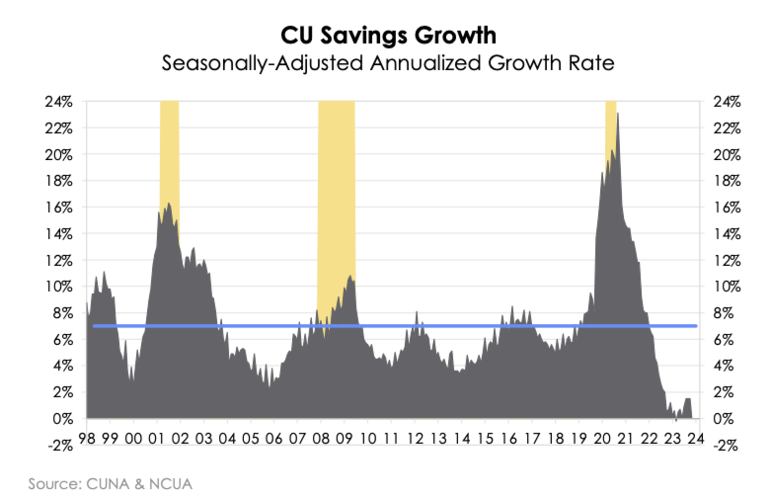
Credit union savings balances rose 0.1% in August, above the 0.3% decline in balances reported in August 2022.
“August is normally one of the weakest months of the year for savings growth due to seasonal factors (vacation spending and auto loan down payments) typically shaving off 0.33% from the underlying trend growth rates,” the report explains.
Meanwhile, it further noted credit union deposit growth is under downward pressure due to the Federal Reserve reducing the money supply with their “Quantitative Tightening” program. During the first eight months of the year, credit union deposits rose only $12.4 billion, down from the $60 billion increase reported during the first 8 months of 2022, according to the Trends Report.
“Credit union members demand for share certificates is exceptionally strong due to the surge in short-term market interest rates,” Rick wrote in his analysis. “Share certificate balances are up 48% ($143 billion) during the first eight months of this year, reaching a record $444 billion. During the same time share draft balances fell $13 billion, regular share balances fell $69 billion and money market account balances fell $50 billion.”
With savings balances growing at a below-trend 1.5% seasonally-adjusted, annualized growth rate in August, the report said credit union should expect savings balances to grow 0% in 2023 and 3% in 2024, below the long-run average of 7%.
Capital and Other Key Measures
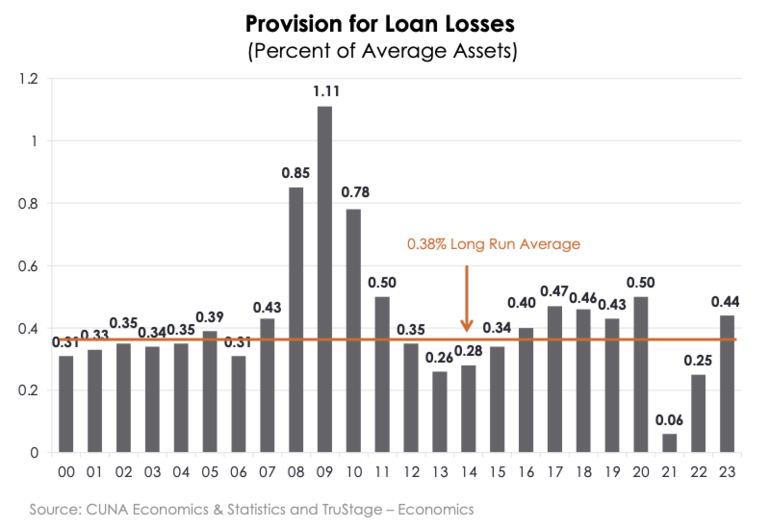
Credit union provisions for loan losses, as a percent of assets, rose to 0.44% in the second quarter of 2023 from the relatively low 0.18% set in the second quarter of 2022 and the 0.25% set for all of 2022, according to the Trends Report.
“Historically, credit unions set aside 38 cents for every $100 in assets to account for loan losses,” the analysis states. “This surge in provisions was one factor reducing credit union return-on-assets ratio from 0.84% in the second quarter of 2022 to 0.77% in the second quarter of 2023.
“Provisions are rising this year as net loan charge offs rise above their 0.50% long run trend rate,” the report continues. “Net loan charge offs to average loans rose to 0.54% in the second quarter, almost twice the 0.29% set in the second quarter of 2022.”
The report states many credit union members are experiencing financial difficulties due four factors:
- High inflation
- Higher interest rates
- High gas prices
- The exhaustion of “excess savings”
“With the economy expected to slow in 2024, expect the unemployment rate to rise from the 3.8% rate today,” the report states. “This will increase loan charge offs and provision for loan losses next year.”
Credit Unions & Members
Credit union memberships rose by 225,000 in August, or 0.2%, below the 472,000 new members, or 0.4%, added in August 2022.
“This has pushed credit union memberships to over 140.7 million,” the report states.
According to the Trends Report, year-to-date credit union memberships rose 2.9%, below the 3.4% pace in the similar time in 2022. Slower loan growth is a major factor contributing to the membership growth slowdown.
“Memberships grew at a 2.5% seasonally-adjusted, annualized growth rate August a deceleration from the 4% pace reported in 2022,” the Trends Report states. “The slowdown in credit union membership growth to 2.5% was to be expected as the average growth rate during the last 20 years was about 2.3%. The recent pace of 2.5% is still five times faster than the overall U.S. population growth rate of 0.4%. Therefore, credit unions are still picking up market share from banks and other depository institutions.”