

MADISON, Wis.–Credit union lending is likely to continue to slow throughout 2023, to approximately 9%, while the credit union average return on equity (ROE) ratio—considered one of the more important credit union metrics because it determines the long-run sustainable asset growth rate--fell to -7.0% in 2022, from 7.8% in 2021, as rising interest rates reduced the value of available-for-sale investments, according to CUNA Mutual’s latest Trends Report.
The Trends Report, based on data through January of this year and with analysis by CUNA Mutual Chief Economist Steve Rick, also shows credit unions added 161,000 memberships in January 2023, significantly below the 320,000-gain recorded in January 2022.
Here's a look at how credit unions through January, according to the latest Trends Report:
Total Credit Union Lending
Credit union loan growth rose to 19.4% during the last 12 months, almost 3 times faster than the 7.2% long-run average, the Trends Report notes.
“Driving the very strong performance was strong growth in the consumer credit loan categories: auto and credit card loans,” the Trends Report states. “Used-auto loans make up around 21% of all credit union loan balances and rose more than 20% in 2022. New-auto loans make up 11.5% of all credit union loan balances and rose more than 22.6% in 2022. So, these two loans categories contributed 4.2 and 2.6 percentage points to the overall 19.4% loan growth.”
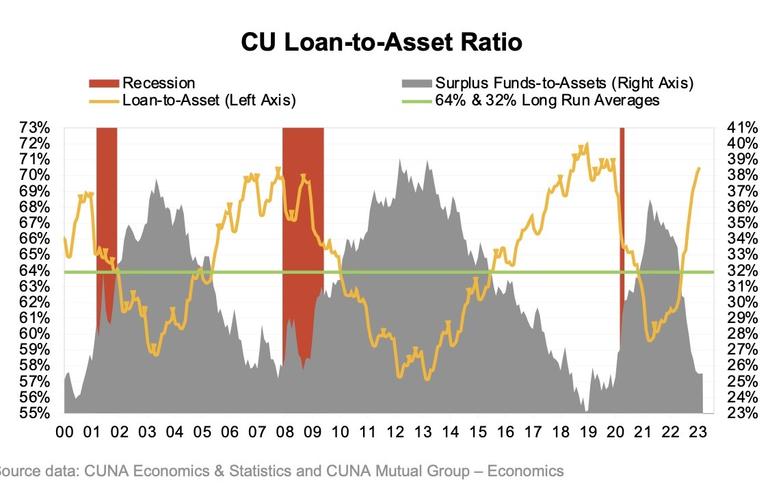
As Rick noted in the Trends report, with loans growing faster than assets during the last 12 months, credit unions’ loan-to-asset ratio rose to 70.5% in January 2023, up from 61.8% one year ago and the highest since January 2021.
Increase in Cost of Funds
“The long run average for the loan-to-asset ratio is 64%,” the report states. “Higher loans as a percent of assets during the fourth quarter of 2022 and rapidly rising interest rates led to a rising credit union yield-on-asset ratio. Credit unions earned a 4.0% yield-on-assets ratio in the fourth quarter, up from 3.0% in the fourth quarter of 2021.
“Higher loan-to-asset ratios imply lower surplus funds-to-assets ratios, which fell to 25.5% in January, indicating a very tight liquidity position at many credit unions,” the report continues. “Credit unions are responding to this tighter liquidity by raising the interest rates on their deposit accounts, which will increase their overall cost of funds this year.”
Consumer Installment Credit
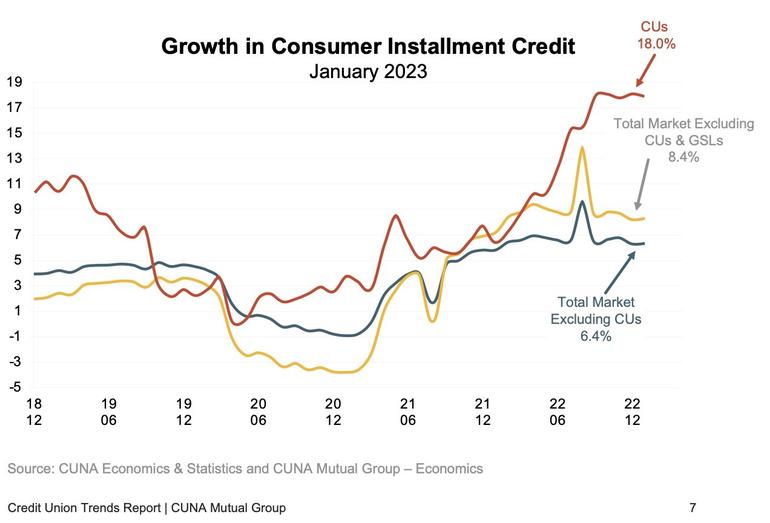
Credit union consumer installment credit balances (auto, credit card and other unsecured loans) fell 0.2% in January, below the 0.03% fall set in January 2022, due to the paying down of credit card balances by many credit union members, according to the Trends Report.
Among the specific data points:
- Credit card loan balances fell 0.2% in January, slightly above the 1% drop in credit card balances reported on average over the last 10 years as members use excess savings to pay down high-rate credit card debt.
- During the last 12 months, credit union consumer installment credit grew 18%, greater than the total market excluding credit unions at 6.4%, and above the total market excluding credit unions and government student loans at 8.4%. “Very competitive auto loan pricing is increasing credit union auto lending market share,” the report states.
Vehicle Loans
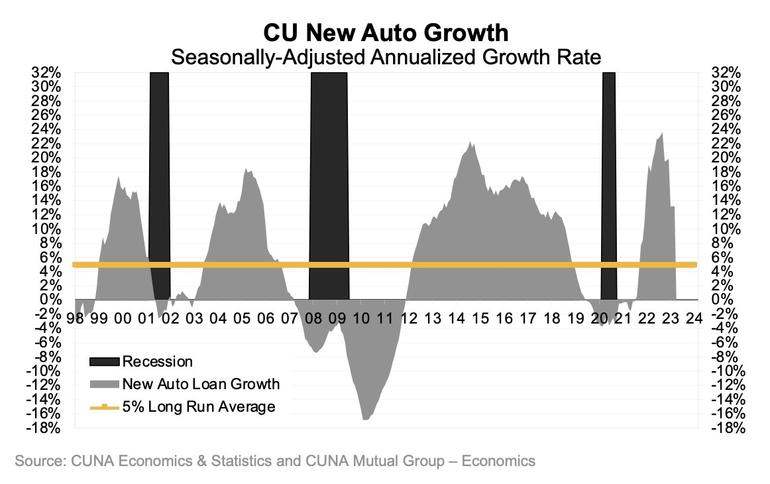
Through January, the Trends Report notes credit union new-auto loan balances rose 0.3% in January, higher than the 0.2% rise set in January 2022, and rose 22.6% during the last 12 months.
“On a seasonally-adjusted annualized basis, new-auto loan balances rose at a 13.2% pace in January, which is slower than the very rapid pace set over the last 12 months,” the report states. “The first quarter of the year is typically the weakest quarter for credit union new-auto loan growth due to various seasonal factors.
“Higher lending interest rates continue to moderate consumer demand for new vehicles, but less-stressed supply chains are also increasing production and therefore sales,” the report continues. “Despite improvement, vehicle production remains below its 2019 average by 7.5%. And with the supply of new vehicles still falling below the demand, auto prices continue to reach new highs, but at a slower pace than before. Vehicle prices are up 4.9% year over year, and with higher interest rates, monthly car payments are up 13%. We expect vehicle production to improve throughout 2023, so supply will catch to demand, price growth will slow significantly, and vehicle sales will approach 15.5 million for the full year.”
Real Estate Information
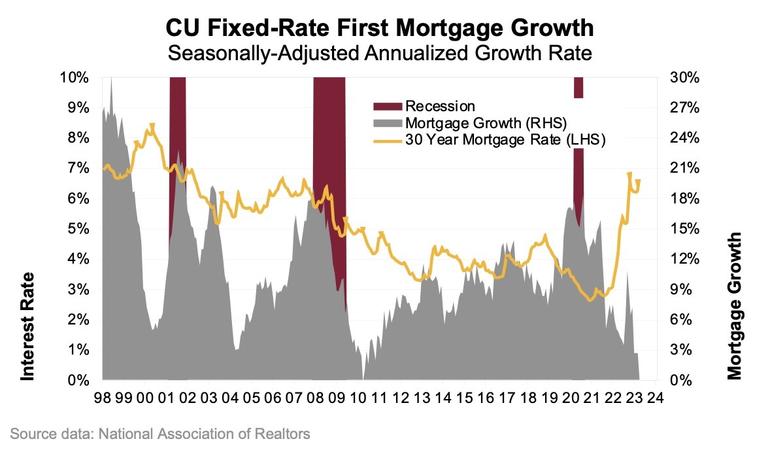
Credit union fixed-rate first mortgage loan balances fell 3.3% in January, like the 2.8% decrease reported in January 2022, due to credit unions selling off fewer loans to the secondary market, according to the Trends Report. Credit union fixed-rate first mortgage loan balances rose 2.7% at a seasonally-adjusted annual rate in January, the report adds.
“The mortgage credit-risk premium (the difference between the 30-year mortgage interest rate and the 10-year Treasury interest rate) rose to 2.74% in January above the average of 2.38% during 2022, and 1.51% in 2021,” the report states. “Expect mortgage interest rates to average 5.5-6.5% for the remainder of the year….Expect home prices to decline 5-10% over the next two years, but not as bad as during the housing bust in 2007-2011 when home prices fell more than 30%.
Savings and Assets
The new Trends Report data show credit union savings balances fell 0.9% in January due to members paying down credit card balances (which declined 0.2%) that were built up during the 4th quarter of 2022. The savings growth rate was less than the 0.1% decrease reported in January 2022. January savings balances have historically declined 0.2% due to recurring seasonal factors, the report adds.
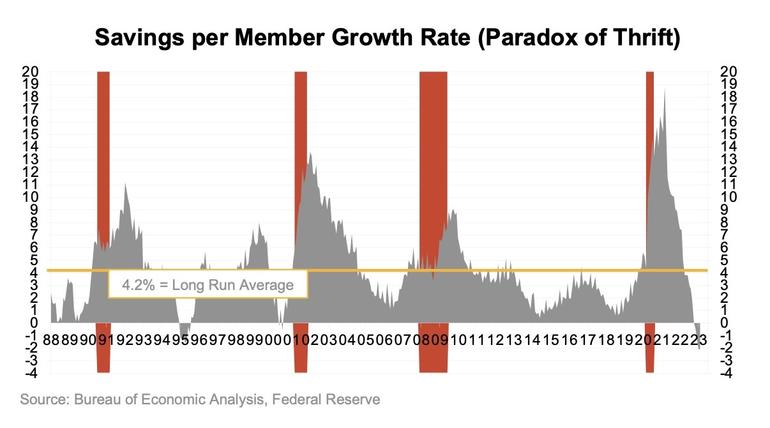
“The savings-per-member ratio fell 2.1% during the last year, the first time since 1995, due to the denominator or the ratio growing faster than the numerator,” the report states. “Savings balances, the numerator of the ratio, rose only 2.3% during the last 12 months, the slowest pace since the summer
of 2006 when stock and home prices were rising rapidly, creating a large wealth effect and discouraging savings accumulation by members. Today, weak savings growth is due to some members spending some of their ‘excess savings’ accumulated over the last few years from stimulus checks and reduced consumption spending. Other members can’t save due to rising inflation and some members are moving funds to higher-yielding money market mutual funds. The denominator of the ratio, members, grew a strong 4.5% as many Americans joined credit unions to take out new-auto loans at very competitive loan rates.”
Average Balances
The report notes that currently, the average credit union member has a total of $13,438 on deposit at their credit union, down from the $13,732 in January 2022.
“We expect credit union deposits to increase only 5% this year, below the long-run average of 7%, as Treasury interest rates move higher, and interest-rate sensitive deposits move to higher yielding alternatives,” wrote Rick.
Capital and Other Key Measures
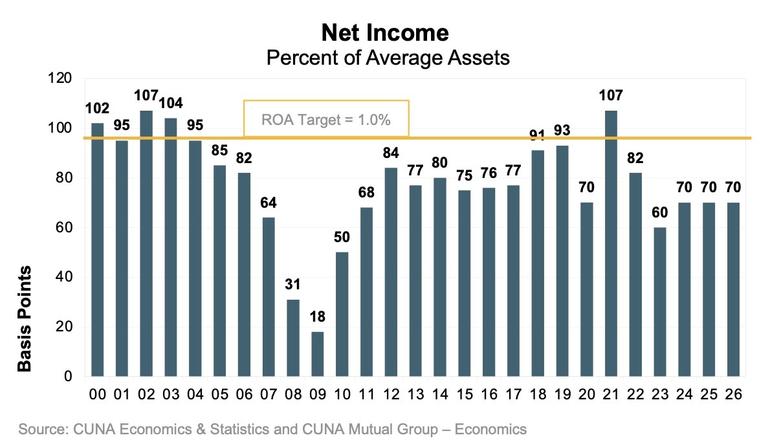
The credit union industry’s net income to average asset ratio, return on assets, fell to 0.82% in 2022, down from 1.07% in 2021, according to the Trends Report.
The report explained that a 25-basis point increase in net interest margins, combined with a one-basis point decrease in operating expense ratios was more than offset by a 25-basis point decrease in fee and other income and a 15-basis point increase in provision for loan losses.
“Expect return on asset ratios to fall to 0.6% in 2023 due to an increase in provision expense (due more to a rise in charge-offs than the effects of CECL), pressure on net interest income caused by an inverted yield curve, and the scarcity of the income that flows from mortgage refinances,” the report projects. “It will be difficult to lower operating expenses this year considering the need to increase compensation in response to the inflation of the past 18 months.”
ROE Ratio
According to the report, credit union average return on equity (ROE) ratios fell to -7.0% in 2022, from 7.8% in 2021, as rising interest rates reduced the value of available-for-sale investments. Credit union net capital (Other Reserves + Undivided Earnings + Unrealized Gains/Losses on Available for Sale Securities) fell -$14.6 billion in 2022 due to losses on securities (-$32.2 billion) outweighing net income ($17.6 billion).
“The ROE ratio is one of the more important credit union metrics because it determines the long-run sustainable asset growth rate,” the report states. “For example, credit unions’ long run average ROE ratio is around 7%, which is the growth rate of their capital. This indicates their assets can grow 7% while maintaining a constant capital-to-asset ratio.”
Credit Unions & Members
Credit unions added 161,000 memberships in January 2023, significantly below the 320,000-gain recorded in January 2022.
“One factor driving membership growth is job creation. In January, the economy added 504,000 jobs, and averaged 344,000 jobs during the last three months, according to the Bureau of Labor Statistics, which is less than the 516,000 three-month average job creation ending in January 2022,” the report states. “Expect monthly job growth to slow over the next few months as the economy slows and move toward a recession in the second half of 2023.”
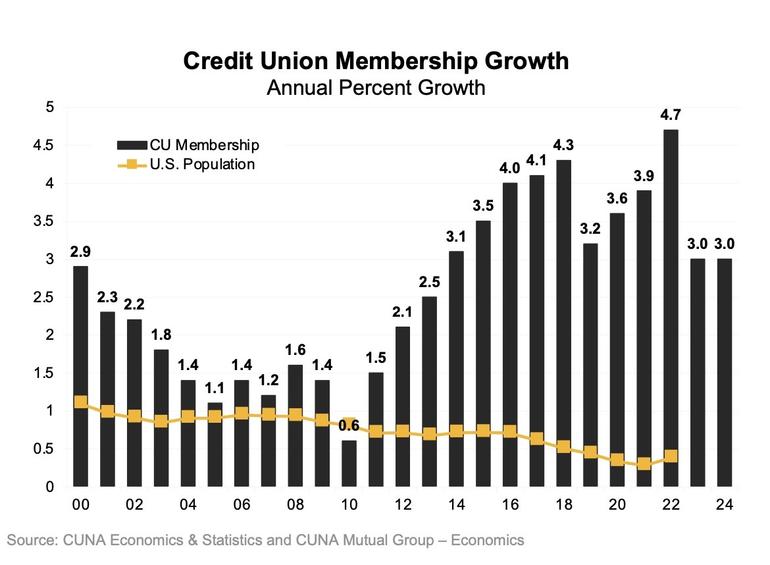
According to the Trends Report, total credit union memberships reached 138.4 million in January 2023, which, in percentage terms, rose 0.1% in January and 4.5% during the last 12 months.
“Credit union memberships surged in 2022 due in part to credit union pricing their auto loans very competitively compared to banks, which allowed them to pick up market share,” the report states. “We expect membership growth to slow to around 3% in 2023, which is above the 0.4% U.S. population growth. After a historically low growth rate of 0.3% in 2021, the U.S. resident population increased 0.4% in 2022, according to the U.S. Census Bureau.”