MADISON, Wis.–Overall credit union lending was up a strong 2.3% in May. Buy with fixed-rate mortgages also hitting their highest mark credit union history, that raises “concerns” about interest rate risk as rates rise, according to CUNA Mutual’s latest Trends Report.
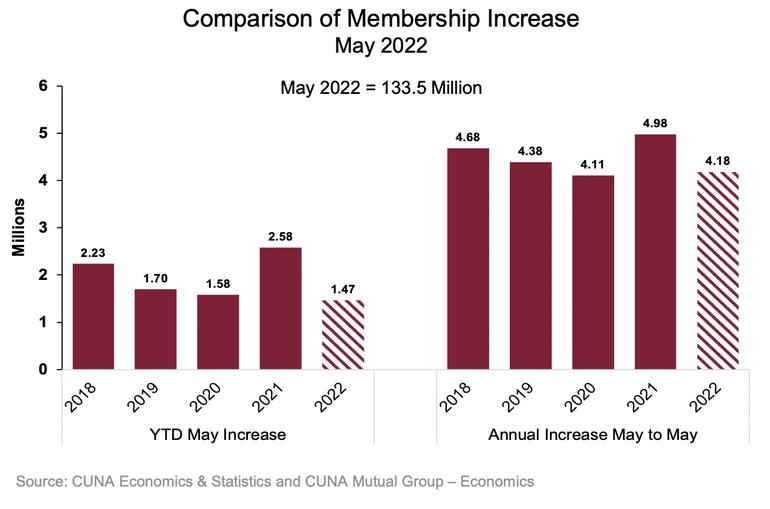
The Trends Report also notes that through May membership in credit unions slowed to 1.47 million new members, down from 2.58 million during the same period in 2021, but faster job growth should boost that number in the year’s second half.
The July Trends Report is based on data through May.
Here’s a look at how credit unions performed by category through May, according to the Trends Report.
Total Credit Union Lending
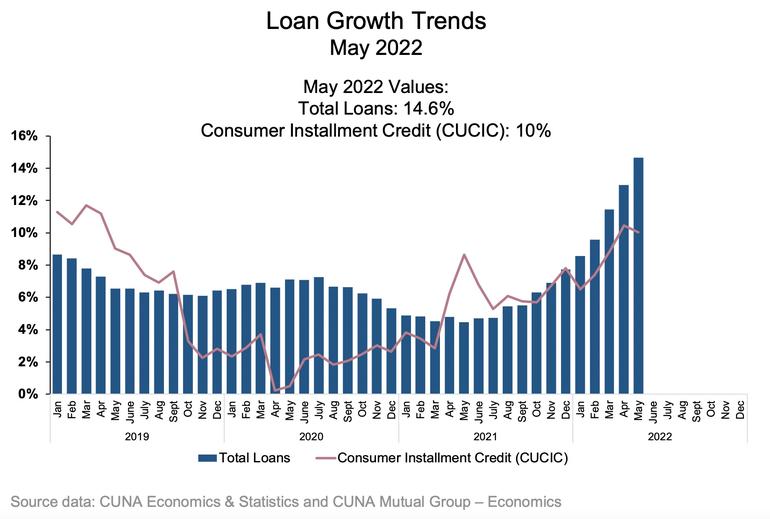
Credit union loan balances rose 2.3% in May, faster than the 0.8% pace reported in May 2021 and 14.6% during the last 12 months, due to consumers taking advantage of still relatively low interest rates, according to the Trends Report. Every loan category reported strong growth rates in May, with unsecured personal loans leading the way reporting 3% monthly growth.
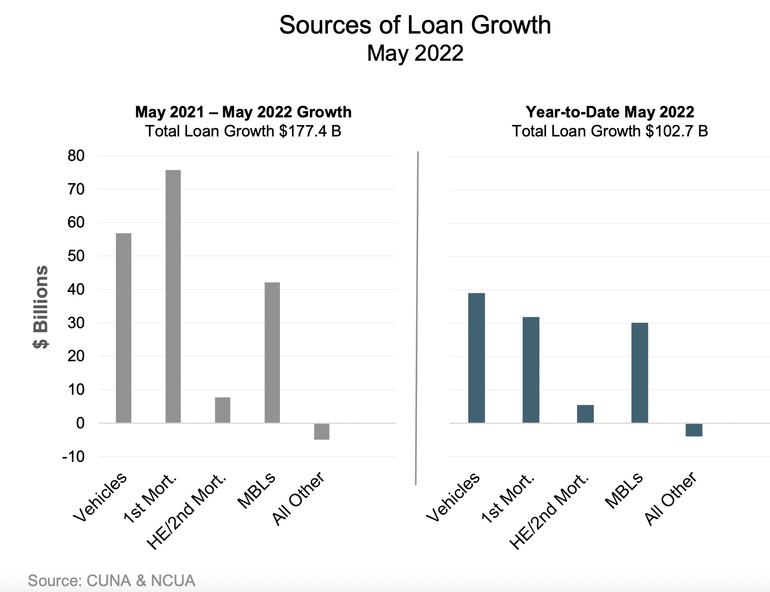
“Vehicle lending made up the lion’s share of loan growth over the last five months. Since the end of 2021, credit union vehicle loan balances increased by $39.1 billion, while first mortgage loan balances rose by $31.9 billion,” the Trends Report stated. “Home equity/second mortgage loan balances rose by $5.5 billion as consumers took advantage of the recent surge in home prices to borrow against their homes. Higher yielding unsecured and credit card loan balances made up only 9.1% of all loan balances in May, the lowest in credit union history. This is one of the factors pushing credit union yield on asset ratios to record lows this year.”
Consumer Installment Credit
According to the Trends Report, credit union consumer installment credit balances (auto, credit card and other unsecured loans) reported an increase of 1.9% in May, similar to the 2.2% increase set in May 2021, due to an acceleration in auto and credit card loans. Over the last 12 months, credit union consumer installment credit grew 10%, which is below the total credit union loan growth of 14.6%, the Trends Report added.
“Credit union consumer installment credit grew faster than the rest of the market, excluding credit unions, which increased 6.9% over the last year,” the report stated in its analysis.
The Trends Report further noted that for all lenders, outstanding consumer credit rose by $22.3 billion in May, according to the Federal Reserve, which is more than 50% above the $14.7 billion average monthly growth reported during the years 2015-2019. With a $14.9 billion increase, nonrevolving credit accounted for an outsized share of May’s growth, while revolving credit expanded by $7.4 billion.
“Rising interest rates threaten to curb demand for credit over the next few months. But demand for travel and new autos should keep consumer installment credit growth strong through the remainder of 2022,” stated CUNA Mutual Economist Steve Rick in his analysis.
Vehicle Loans
Credit union new-auto loan balances rose 2.8% in May, a big increase compared to the 1% gain reported in May 2021, the Trends Report observed.
On a seasonally-adjusted annual rate, new auto loan balances rose 28.3% in May, the fastest pace in over 25 years.
“The month of May is historically the beginning of the new- auto lending season, so we expected a credit union lending turnaround,” the Trends Report stated. “New auto loan balances rose 11.1% year to date, significantly better than the 0.3% drop reported during the first five months of 2021.”
The Trends Report further noted vehicle sales rose to a 13.0 million seasonally-adjusted annualized sales rate in June – up 2.3% from May, but 16% below the 15.5 million sales pace set in June 2021.
“Expect new auto sales to remain below its long-run average of 16.5 million sales pace for the next two quarters due to a lack of auto inventory and high prices,” the Trends Report forecast. “Inventories are down 80% compared to their levels two years ago, and transaction prices are up 20%. On a brighter note, auto production increased to a SAAR of 10.7 million units, which is only down 2% from the 10.9 million average monthly productions in the year before the pandemic.”
Real Estate Information
According to the Trends Report, credit union fixed-rate first mortgage loan balances rose 1.9% in May, above the 1% increase reported in May 2021. Credit union fixed-rate first mortgage loan balances rose 21.6% at a seasonally-adjusted annual rate in May, the fastest pace since 2001. Adjustable-rate first mortgage balances rose 1.9% in May, better than the 1.4% decline reported in May 2021, and have declined 6% over the last year, the report stated.
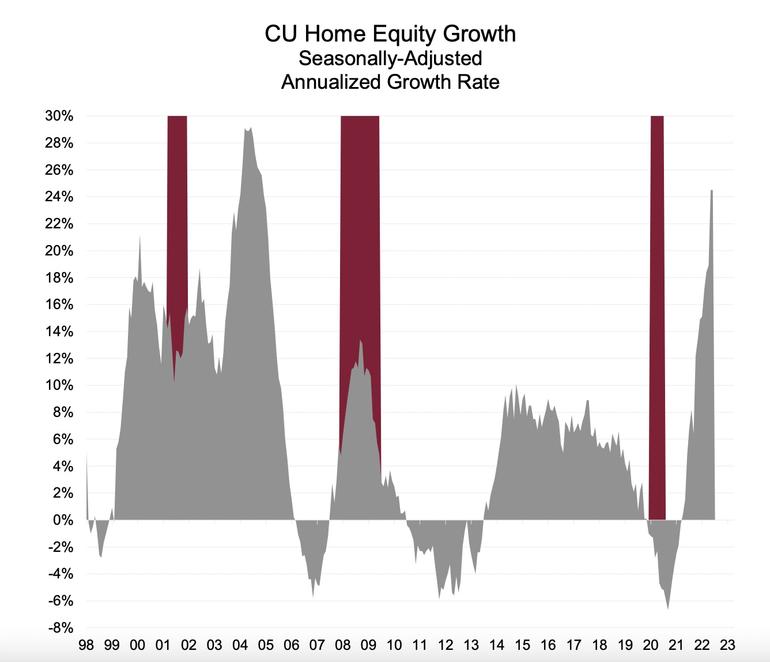
Credit union home-equity loan balances rose 24.2% at a seasonally-adjusted annual rate in May, the fastest pace since 2005.
“Fixed-rate first mortgages now make up 36.3% of all credit union loan balances, up from 34.7% last May and the highest in credit union history,” the report noted, before cautioning, “This raises concerns about interest rate risk as market interest rates rise.”
Single-family home prices rose a remarkable 1.8% in May from April, according to the Core Logic Home Price Index. Over the last 12 months, home prices rose 20.2%, which is “clearly unsustainable,” the report added.
Savings & Assets
Credit union savings balances grew at a 5.8% seasonally-adjusted, annualized growth rate in May, significantly below the 13.4% pace set in May 2021 when the COVID-19 pandemic was still impacting households’ spending and savings patterns, according to the Trends Report.
“The deposit growth slowdown was caused by increased member spending as the economy reopened,” Rick stated. “The growth in savings per member over the last year fell to 4.5% in May, below the 11.2% reported in May 2021, but above the 30-year average of 4.3%.”
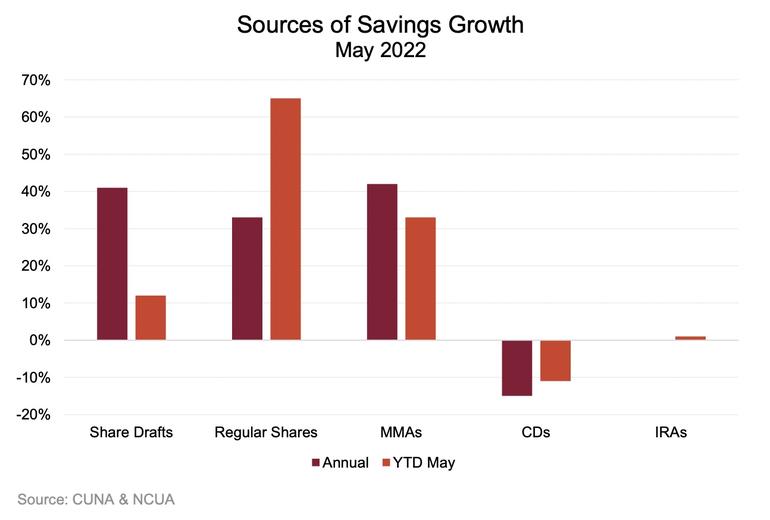
The data show regular share accounts obtained 65% of all new savings flowing into credit unions during the first five months of 2022, up from 33% during the last 12 months. This growth in low- interest rate deposits lowered credit unions’ average cost of funds to 0.35% in the first quarter, the lowest in credit union history, and below the 0.48% reported in the first quarter of 2021.”
With market interest rates rising, Rick is forecasting that share certificate accounts will begin rising soon, after falling 11% in the first five months of 2022.
“Expect total credit union deposits to rise only 5% in 2022, before accelerating slightly to 6% in 2023,” he stated.
Capital & Other Key Measures
The credit union loan delinquency rate (loans two or more months delinquent as a percent of total loans outstanding) fell to 0.42% in May, down from 0.43% in April and from 0.47% in May 2021, the Trends Report stated, noting delinquency rates are below the 0.75% long-run natural delinquency rate due to the unemployment rate of 3.6% being below the natural unemployment rate of 4.5%.
Meanwhile, credit union loan net charge-offs as a percent of average loan balances fell to 0.28% in the first quarter of 2022, down from 0.32% in the first quarter of 2021, according to the Trends Report.
“This charge-off rate is almost half the long-run average charge-off rate of 0.50%,” the Trends Report pointed out. “Credit union asset quality is expected to remain healthy if the labor market remains strong. In May, the number of job openings was 11.3 million, only slightly below the record high of 11.9 million set in March. The job openings rate (the number of job openings divided by the sum of employment and job openings) came in at 6.9% in May, significantly above its long-run average of 3%. Therefore, credit unions should expect loan credit quality to remain strong for the remainder of the year.”
ROA? Depends on Asset Size
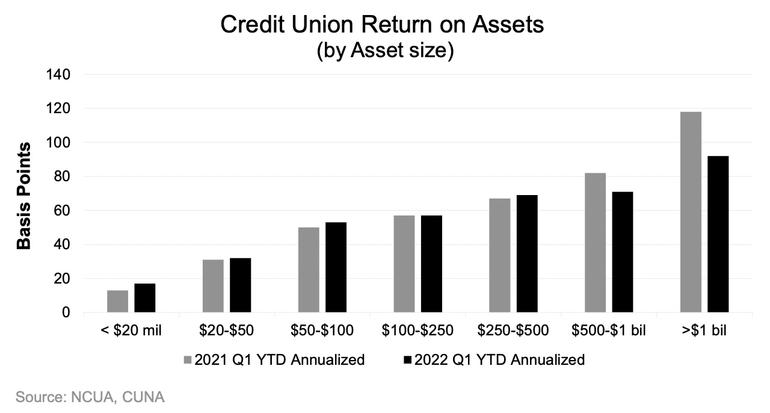
Credit union return-on-assets ratios fell to 85% in the first quarter of 2022, down from 1.04% in Q1 2021, due mainly to falling fees and other income (111-basis points in Q1 2022 versus 136-basis points in Q1 2021), according to the report.
Other income fell as mortgage originations fell and “gains on the sale of mortgages” declined.
As the report has consistently noted and was true again in the May data, “the disparity between small and large credit unions’ return-on-asset ratios decreased significantly over the last year as smaller credit unions generally reported an increase in ROA while larger credit unions reported a decline.”
Credit Unions & Membership
Credit union membership grew by 276,000 in May, or 0.2%, down from May 2021 when the movement added 712,000 memberships at an increase of 0.55%, the report found.
“The membership gain year-to-date slowed to 1.47 million, down from 2.58 million for a similar period in 2021,” according to the report. “Credit union memberships grew by 4.17 million during the year ending in May 2022. Total credit union memberships have surpassed 133.5 million and are expected to reach over 135 million by the fourth quarter of 2022. Faster loan growth and strong job creation are two factors boosting credit union membership growth.”
The report added that credit union memberships grew at a 2.5% seasonally-adjusted, annualized growth rate in May, slower than the record-setting pace of the last few years.
“However, the current pace is similar to the 2.5% pace that began after Bank Transfer Day on November 5, 2011. Expect credit union memberships to grow 3.5% in 2022 and 2023,” the Trends Report forecast.