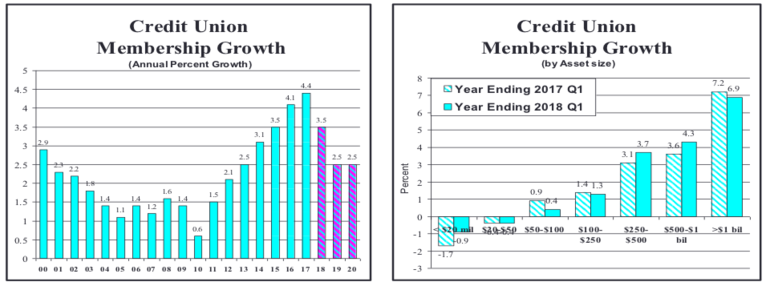
MADISON, Wis.–Total borrowing at credit unions was up 1.1% in April over one year earlier, while the pace of new credit union memberships cooled a bit over the previous month, with CU membership up a modest 358,000.
The latest CUNA Mutual Trends Report, which reflects data compiled through April 2018, once again shows nearly all the growth at credit unions is taking place at credit unions with assets over $1 billion due to organic growth and mergers. In fact, the data show credit unions with less than $50 million in assets lost members.
CUNA Mutual is projecting the economy will grow 3.0% during 2018 and 2.25% in 2019 with an economic contraction anticipated in 2020, a forecast that has also been made at several recent credit union meetings.
Here's how credit unions performed by category:
Total Credit Union Lending
Credit union loan balances rose 1.1% in April, greater than the 0.9% pace reported in April 2017 and 3.4% year-to-date, CUNA Mutual reported, noting April is, historically, the first month of the loan growth season as the monthly loan seasonal factors turn positive.
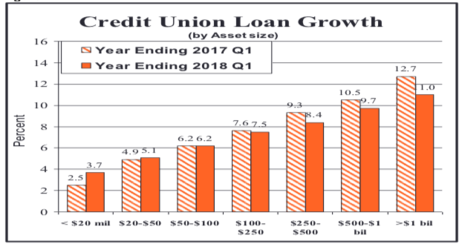
“In the year ending in the first quarter of 2018, total credit union loan balances rose 9.6%, slightly slower than the 10.8% pace set for the similar period last year,” according to the Trends Report. “This has pushed the loan-to-asset ratio to 69.5%, above the 66.7% reported in April 2017. A greater proportion of loans on the balance sheet increased the yield-on-asset ratio 22 basis points to 3.63% in the first quarter.”
Once again, CUNA Mutual noted, industry average loan growth rates “mask big disparities between large and small credit unions. In the year ending in the first quarter of 2018, credit unions with assets greater than $1 billion reported an 11.0% increase in loan balances. Meanwhile, credit unions with assets less than $20 million reported loan growth of only 3.7%.”
Credit Union Consumer Installment Credit (CUCIC)
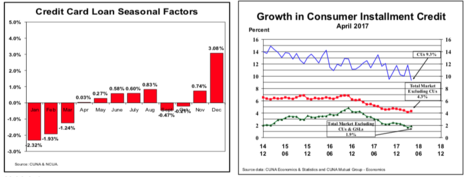
Credit union credit card loan balances grew 7.8% during the last 12 months, above the credit union 20-year average growth rate of 5.75%, due to rising consumer confidence and sustained job growth, according to CUNA Mutual. Seasonal factors boosting credit card balance growth begin in April and run through August. Credit quality deteriorated somewhat over the last year, CUNA Mutual said.
Credit card annualized net charge-off rates rose to 2.86% in the first quarter of 2018, up from the 2.56% reported in the first quarter of 2017. Credit union consumer installment credit (auto, credit card and other unsecured loans) grew 9.3% during the last year, more than double the 4.3% for the total market excluding credit unions, CUNA Mutual said.
Vehicle Loans

Credit union new-auto loan balances grew 1.2% in April, below the 1.7% reported in April 2017, due to two fewer selling days, CUNA Mutual said. April’s new-auto loan seasonal factors usually subtract 0.12 percentage points from the underlying trend growth rate.
“Another factor driving the strong new-auto lending at credit unions is very competitive interest rates; according to DATATRAC, the average interest rate on a credit union four-year new-auto loan is 2.7% compared to the bank average of 4%, which is a 1.3 percentage point rate advantage for credit unions,” CUNA Mutual said.
Real Estate Secured Lending – First Mortgages and Other Real Estate
Credit union fixed-rate first mortgage loan balances rose 0.1% in April, slower than the 0.5% reported in April 2017. The first month of each quarter traditionally reports the weakest growth rate of each quarter. However, adjustable-rate first mortgage balances rose a strong 2.9%, CUNA Mutual said. Adjustable-rate mortgages now make up 29% of all credit union first mortgage loan balances, according to the Trends Report.
During the last 12 months, fixed-rate first mortgage balances rose 10.4%, slightly less than the 11.5% increase in adjustable-rate mortgage balances, CUNA Mutual said. Improving household balance sheets, rising consumer incomes and a rising capacity to service debt has decreased mortgage credit risk and, therefore, encouraged credit union lenders to loosen lending standards, the Report said.
“Improving economic fundamentals bode well for home sales and house price appreciation,” CUNA Mutual said. “Credit union real estate lending will remain robust through 2018 because the fundamental drivers of housing demand are moving in the right direction: strong labor market, rising real weekly earnings, increasing household formation, lower secondary-market down-payment requirements, improving household balance sheets and rising consumer confidence.”
Surplus Funds (Cash + Investments)
According to the Trends Report, credit union surplus funds as a percent of assets fell to 26.4% in April, down from 29.2% last April, as credit unions’ loans grew faster than investments. During the last year, credit unions added $98 billion in loans to their balance sheets, the fastest in credit union history, and lost $16 billion in investments, CUNA Mutual said. The lion’s share of new loans was funded with $63 billion in new savings deposits.
“The flatter yield curve caused credit unions to decrease the percentage of surplus funds with a maturity of greater than one year to 52% – down from 53% last December,” CUNA Mutual reported.
Savings and Assets
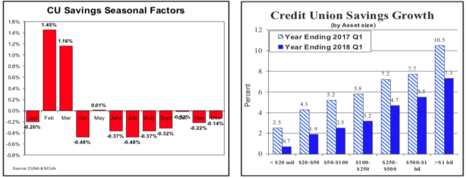
Credit union savings balances fell 0.7% in April, significantly below the 0.3% drop reported in April 2017, due to savings balances in March being artificially high because the month ended on a payroll Friday, according to the Trends Report.
“In the year ending in the first quarter of 2018, credit union savings balances rose only 5.4%, significantly below the 7% growth rate reported for the year ending in the first quarter of 2017, due to rising gas prices and high levels of consumer confidence leading to strong retail spending by consumers,” said CUNA Mutual. “Savings growth decelerated for all asset size categories during the last two years; however, larger credit unions reported faster growth than smaller credit unions.”
Capital and Other Key Measures
Credit union return-on-asset ratios averaged 0.9% in the first quarter of 2018, above the 0.71% reported in the first quarter of 2017, due to NCUA’s $736 million Stabilization Fund dividend distribution, CUNA Mutual reported.
However, CUNA Mutual again noted that the credit union movement’s average return-on-asset ratio masks large disparities between large and small credit unions. Beyond the dividend, net interest margins rose 14 basis points over the last year due to rising loan-to-asset ratios pushing up the yield-on-asset ratio faster than higher funding costs.
The credit union net charge-off-to-average-loan ratio rose to 0.6% in the first quarter, up from the 0.58% reported in the first quarter of 2017 due to rising credit card charge-offs (2.56% to 2.86%) and rising charge-offs on all other consumer loans (1.12% to 1.17%), CUNA Mutual said.
Credit Unions and Members
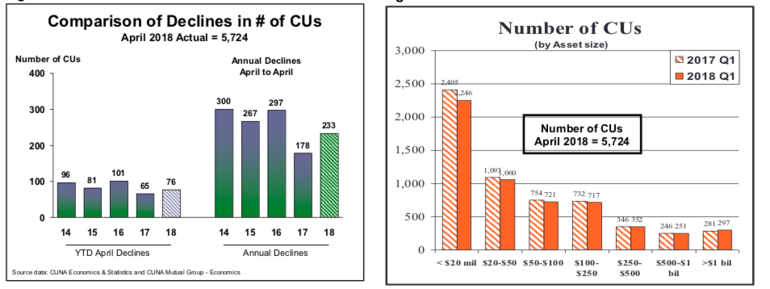
As of April 2018, CUNA estimates 5,724 credit unions were in operation, three fewer than March. During the first four months of 2018, approximately 76 credit unions ceased to exist because of mergers, purchase and assumptions or liquidation, CUNA Mutual reported.
“Expect the annual decline in the number of credit unions to be about 250 per year over the next two years as competitive pressures rise on smaller institutions,” CUNA Mutual said.
At the end of the first quarter of 2018, 2,246 credit unions reported assets less than $20 million, down from 2,405 one year earlier. “These small credit unions make up 40% of all credit unions but control only 0.9% of all credit union loans,” noted CUNA Mutual. “Large credit unions enjoy significant economies of scale advantages over smaller institutions. Higher levels of productivity raise the barrier to entry for new credit unions and increase the competitive pressure on smaller credit unions.”
Meanwhile, credit union memberships grew a modest 358,000 in April, or 0.31%, down from April 2017 when the movement added 432,000 memberships at an increase of 0.39%, according to the CUNA Mutual data. In the year to April 2018, credit union memberships rose 4.5% faster than the 4.4% pace set in the year to April 2017, the fastest pace in in the modern credit union era.
The membership gain was partly driven by the 159,000 new jobs created in April, according to the Bureau of Labor Statistics, CUNA Mutual said.
The Trends Report is forecasting credit unions should expect membership growth to exceed 3.5% in 2018 and 2.5% in 2019 as the economic expansion and credit demand continue for the next two years. Once again, the Trends Report noted that most of the membership growth is taking place at credit unions with assets over $1 billion due to organic growth and mergers. Credit unions with less than $50 million in assets lost memberships during the last two years.