MADISON, Wis.–Credit union lending grew again in October, while the pace of membership growth cooled a bit, according to the latest data released as part of the CUNA Mutual Trends Report.
Among the numbers released as part of the report, which reflects the first three quarters of the year:
Total Credit Union Lending
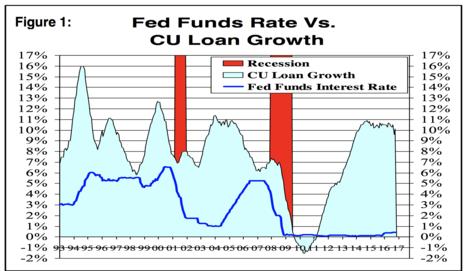
Credit union loan balances rose 0.9% in October, faster than the 0.6% pace reported in October 2015, CUNA Mutual said. Driving overall loan growth was strong growth in home equity loans (3.4%), adjustable-rate first mortgages (1.7%), and new-auto loans (1.1%), the company said. CUNA Mutual is projecting loan growth to slow to 9% in 2017 from 10% in 2016.
CU Consumer Installment Credit (CUCIC)
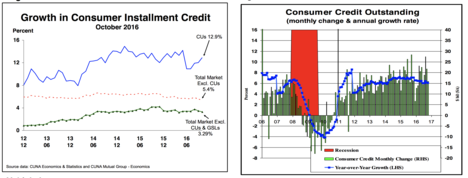
Credit union consumer installment credit balances (auto, credit card and other unsecured loans) rose a strong 1.4% in October, faster than the 0.6% pace set in October 2015, due to acceleration in auto and credit card lending, according to the Trends report. During the last 12 months, credit union consumer installment credit grew 12.9%, which is more than twice as fast as the rest of the market.
“The rise in the Federal Funds interest rate will increase credit card interest rates in the near term and to a lesser extent auto loan rates,” CUNA Mutual said in its analysis. “This will boost credit union yield on assets and net income in 2017.”
Vehicle Lending
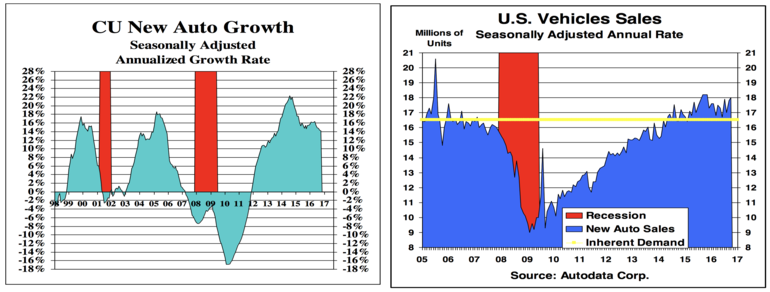
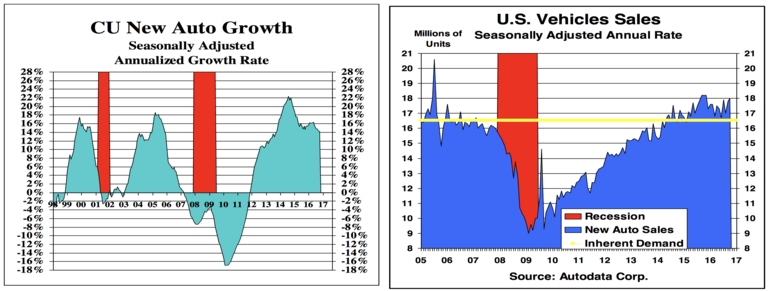
Credit union new auto loan balances rose 1.1% in October, faster than the 1.0% pace set in October 2015, and increased 16.3% during the last year, CUNA Mutual said. On a seasonally-adjusted annualized basis, new auto loan balances rose 14.2% in October, down from the 14.7% pace reported in October 2015, the Trends report said.
The company said the number of new auto loans as a percent of members in offering credit unions – the penetration rate – rose to 5.3% in the third quarter, up from 4.9% one year earlier.
Real Estate Secured Lending, 1st Mortgages and OREO
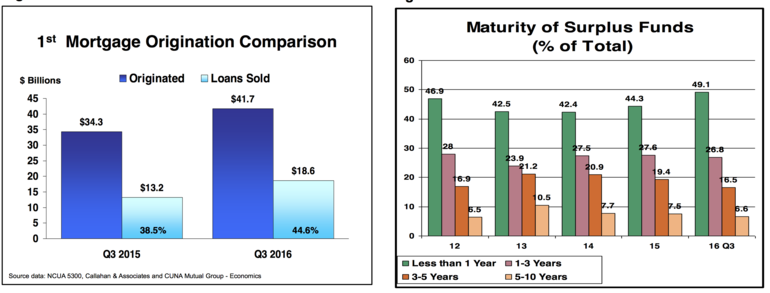
Credit unions originated $41.7 billion in first-mortgage loans during the third quarter of 2016, 22% more than the third quarter of 2015. Credit unions sold 44.6% of all originations into the secondary market, up from 38.5% in Q3 2015, to reduce the interest rate risk exposure from holding fixed-rate long-term real-estate loans in a rising rate environment, the CUNA Mutual Trends Report states.
“We don’t expect the interest rate rise to have a significant negative impact on housing demand in 2017 due to the still historically low level of interest rates in 2017,” the Trends Report states. “Rising interest rates will lead to a pullback in refinancing applications; however, improving consumer balance sheets and tightening labor market conditions should boost purchase activity.”
Surplus Funds (Cash + Investments)
Credit union surplus funds fell in October by $3 billion due to a $7.7 billion surge in loan growth and zero growth in deposits, the Trends Report shows. Credit union surplus funds as a percent of assets fell to 28.8% in October, from 29.2% in September to reach $377.7 billion. This is the lowest liquidity position since January 2009. The lion’s share of surplus funds (44.6%) are invested in federal agency securities, down from 48.2% at the end of the third quarter of 2015. The second largest surplus funds category, cash deposits in financial institutions, rose from 15.9% in Q3 2015 to 19.5% today, CUNA Mutual said.
Savings and Assets
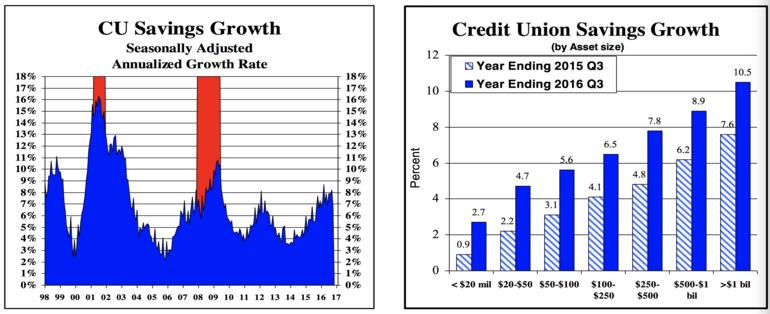
Credit union savings balances fell slightly in October (-0.01%) as the deposit surge in September, due to that month ending on a payroll Friday, reversed itself, according to the Trends report. Savings balances grew at a 6.8% seasonally-adjusted annualized growth rate in October due to falling fuel prices and rising household incomes. As has been the case, CUNA Mutual noted savings growth is highly correlated with asset size. Large credit unions (assets > $1 billion) reported savings balances rising 10.5% in the year ending in the third quarter of 2016, up from 7.6% in the year ending the third quarter of 2015 (Figure 9). Credit unions with less than $20 million in assets reported a 2.7% increase in deposits in the year ending in the third quarter 2016, up from 0.9% one year earlier, CUNA Mutual said.
Net Charge-Offs
The credit union loan net charge-off rate rose to 0.58% in the third quarter, up from 0.46% in Q3 2015, CUNA Mutual said. “This jump in the charge-off rate is somewhat surprising given that historically this ratio falls to its lowest level of the year in the third quarter due to rapid loan growth over the summer months,” CUNA Mutual said.
Credit Unions and Members
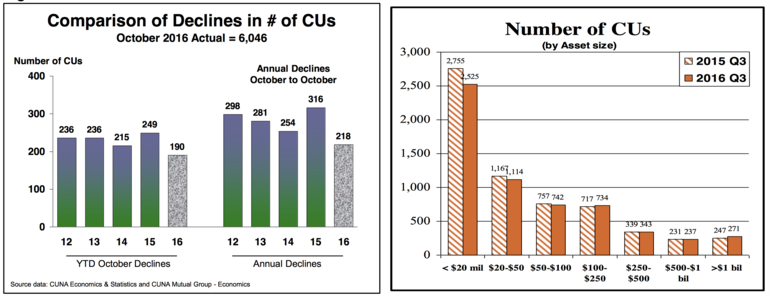
As of October 2016, data from CUNA, which is used for the Trends Report, estimates 6,046 credit unions were in operation, down 218 from October 2015. Year-to-date the number of credit unions fell by 190, significantly less than the 249 reported in the first 10 months of 2015. NCUA’s Insurance Report of Activity showed 11 mergers were approved in October with an average asset size of $7.9 million. Just released third quarter NCUA call report data shows 271 credit unions with assets in excess of $1 billion and 237 credit unions with assets greater than $500 million, but less than $1 billion. The greater than $1 billion asset category represents 4.5% of all credit unions, but more than 60% of the credit union system’s total assets and 62% of the credit union system’s total loans, the Trends Report states.
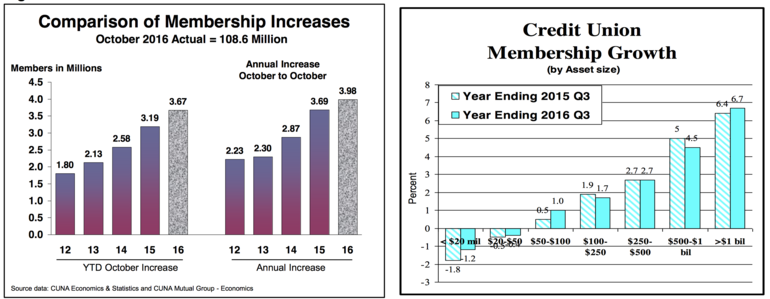
Meanwhile, the data show credit union memberships grew a modest 199,000 in October, or 0.18%, less than the 255,000 new members, or 0.24%, added in October 2015. October’s seasonal factors typically shave off 0.23 percentage points from the underlying trend membership growth rate. Year-to-date credit unions added 3.67 million new members, faster than the 3.19 million members added during the similar period in 2015.
Total credit union memberships reached 108.6 million in October, 4% more than October 2015 and the fastest pace in more than 20 years. Just released third quarter NCUA call report data shows credit unions with assets greater than $1 billion reported membership growth of 6.7% during the 12 months ending in the third quarter of 2016, slightly faster than the 6.4% reported one year earlier.