

SAN DIEGO--With the average price of a new vehicle now topping $50,326, credit unions are leaning more heavily on vehicle leasing as a way to help members manage affordability—and auto dealers are emerging as a critical partner in that strategy, according to a new report from Credit Union Leasing of America (CULA).
The firm’s latest findings suggest that the strength of dealer-credit union relationships is becoming a competitive advantage at a time when consumers are increasingly priced out of traditional auto loans.
CULA reported that its number of auto dealer partners grew 38% year over year in 2025, reaching the highest level in company history. The surge reflects growing demand for leasing as shoppers seek lower monthly payments amid rising vehicle prices, higher interest rates, and broader economic uncertainty. Leasing is also gaining traction with Gen Z car buyers, who show a stronger preference for leasing over ownership—a shift that presents credit unions with a chance to capture younger members earlier and build longer-term loyalty.
The report points to leasing as a mutually beneficial tool for both credit unions and dealerships. From the credit union side, stronger dealer relationships help institutions better understand local market conditions, tailor financing offers, and streamline approval processes, improving speed and member experience. Dealer insights can also support smarter risk management, allowing credit unions to balance profitability with portfolio discipline while strengthening long-term member relationships and reinforcing their community presence.
For auto dealers, leasing partnerships with credit unions provide a practical alternative to captive finance programs. Dealers benefit from the ability to offer lower monthly payments, more flexible terms, bundled protections such as Gap coverage and wear-and-tear protection, and additional options for used-vehicle leasing and remarketing. Leasing also helps dealers manage inventory more effectively, particularly in markets where certain models remain constrained and resale value planning matters more than ever, CULA said.
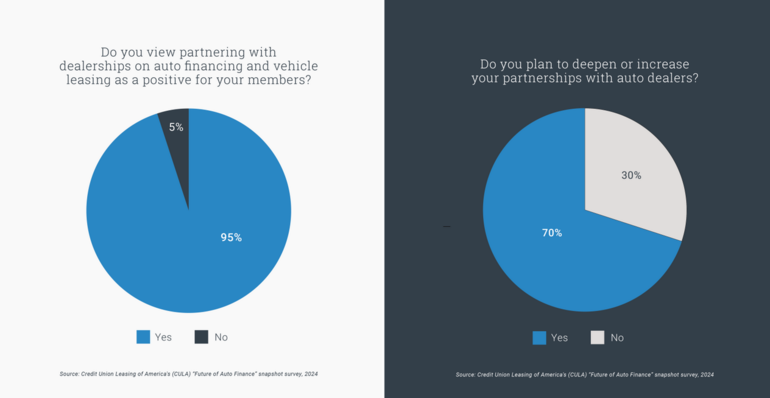
CULA’s survey of credit union professionals underscores the depth of this collaboration. Ninety-five percent of respondents said dealer partnerships in auto financing and leasing benefit their members, and 70% plan to deepen those relationships. The data suggests credit unions increasingly view dealerships not just as distribution channels, but as strategic partners in reaching price-sensitive borrowers and sustaining loan and lease growth.
The report concludes that human-driven partnerships may matter more than ever, even as technology and AI reshape financial services. While automation continues to transform underwriting and servicing, CULA argues that real-world dealer relationships remain a proven engine for efficiency, flexibility, and member value. In today’s affordability-strained auto market, the firm frames the dealer-credit union leasing model as a three-way win—for consumers, credit unions, and dealerships alike.