

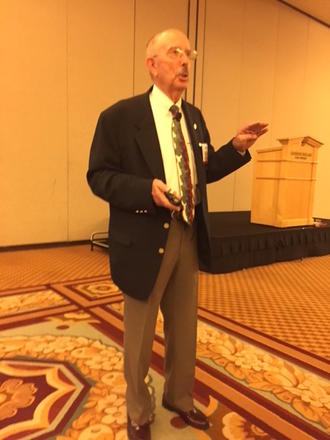
Bob Kravetz
LAS VEGAS–It’s been nearly seven years since the largest fraud perpetrated in credit unions took place, but the egregiousness of the board’s failures in doing their jobs still rankles one former board member.
The failure was St. Paul Croatian FCU, which was liquidated in 2010 at a cost to the National Credit Union Share Insurance Fund of $170 million. That it was never caught—or really even suspected—for an extended period by either the credit union’s board or examiners is among the most amazing—and depressing—frauds in CU history.
“It’s very simple,” said Bob Kravetz, a former director at Department of Labor FCU who participated as an expert witness in a lawsuit that had been filed by CUMIS related to the case. “I was going to call this session ‘How a board of directors can destroy a credit union.’ Because that’s what essentially happened. A $70-million fraud that cost the NCUSIF $170 million.”
As part of his participation in the case, Kravetz reviewed the CU’s annual reports from 2005-10, all the meeting minutes, depositions, exam reports and more. Kravetz shared his perspective during the Directors & CEOs Leadership Conference here.
“What I found was the St. Paul Croatian loan policy required that all loan requests over $25,000 were to be brought to board for review and discussion,” said Kravetz. “Suffice it to say, it wasn’t done. All the loans also required shares to secure them. Again, that didn’t happen.”
Over a five-year period, years during which loan volume soared to as much as $42 million annually, there were years in which no loans were reviewed by the board.
“Would the board have discovered the fraud? I don’t know, but it still should have been brought to the board’s attention and the board should have been asking where are these loans going?” Kravetz said.
Kravetz said the CEO, Anthony Raguz, provided the board with the same boilerplate language in reports year after year, and no one raised a question. Nor did the independent auditor used by the credit union. Nor did the NCUA examiners.
Why didn’t the board notice?
“The excuse presented at trial was that the CEO told the board these loans are share-secured. And the board said OK. But it was impossible for it to be share-secured, as they had less money on deposit than loaned out.”
Perhaps the most amazing red flag that went completely unnoticed, however, said Kravetz: From 2002-09, the credit union reported no delinquent loans. None. “And this is even during 2007-08 when the bottom was dropping out of the economy,” said Kravetz. “This includes all loans: credit cards, auto loans, etc. And in the examiner’s report they noted that, too. So NCUA is not off the hook on this, either.”
Kravetz noted the year-end 2007 NCUA exam report did finally say “There is a problem in the reporting of loans by type. As of 12/31/07, share-secured loans are reported as $131 million. However, the combined total amount of member (deposits) is only $122.5 million. This needs to be investigated and corrected.”
Kravetz said that finally, in early 2008, the board directed the CEO to tell the board why this discrepancy was happening. The CEO failed to provide any information to the board, and the board didn’t follow up.
The fraudulent loan scheme at St. Paul Croatian, which involved constantly resetting loan due dates and other paperwork, eventually led to convictions on numerous charges for more than two-dozen people. The CEO is currently serving a 14-year sentence in federal prison. CEO Raguz got 14 years in federal prison. More than a dozen defendants also convicted.
“No board member faced any criminal charges,” Kravetz told an audience that was mostly made up of board members. “But by keeping their heads in the sand they destroyed their credit union. What’s the moral to this story? It’s incumbent upon all of you to pay attention. You’ve been elected by your members to protect them and their assets. It is your responsibility to have oversight over the CEO. About 10 years ago I did a session on board governance and what directors should and should not do, and one thing I talked about was how many of you show up for the board meeting and you hear the ripping sound of people opening their board packets for the first time. You can’t do that. You need to look at it before you ever get to the board meeting.”