MADISON, Wis.–Another month, another report of robust industry performance that masks the struggles some credit unions are having.
CUNA Mutual’s latest Trends Report for data through April, 2016 shows loan balances continue to grow and membership remains strong, with 353,000 new members added during April. But behind the numbers, the report again shows the growth is overwhelmingly being driven by large CUs.
Here’s a look at each of the performance metrics, with CUNA Mutual’s analysis of each.
Lending
Credit union loan balances rose 0.5% in April, which is half the 1.0% pace reported in April 2015, and 2.7% year-to-date. April is, historically, the first month of the loan growth season as the monthly loan seasonal factors turn positive, CUNA Mutual said.
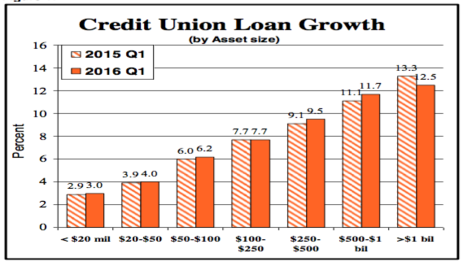
In the year ending in the first quarter of 2016, total credit union loan balances rose 10.7%, the fastest pace since 2005. CUNA Mutual said that has pushed the loan-to-asset ratio to 64.4%, above the 63% reported in April 2015. A greater proportion of loans on the balance sheet increased the yield-on-asset ratio five basis points to 3.38%.
However, CUNA Mutual noted that the trend continues, and industry average loan growth rates mask big disparities between large and small credit unions. In the year ending in the first quarter of 2016, credit unions with assets greater than $1 billion reported a 12.5% increase in loan balances, while CUs with assets less than $20 million reported loan growth of only 3.0%.
CU Consumer Installment Credit
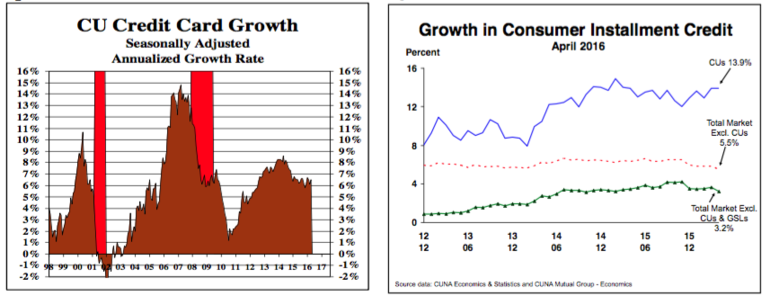
Credit union credit card loan balances grew at a modest 6.5% seasonally adjusted annualized growth rate in April due to low gas prices reducing the amount of credit used at gas stations, CUNA Mutual said. Credit quality also deteriorated somewhat over the last year. Credit union consumer installment credit (auto, credit card and other unsecured loans) grew 13.9% during the last year, which is better than the 5.5% for the total market excluding credit unions.
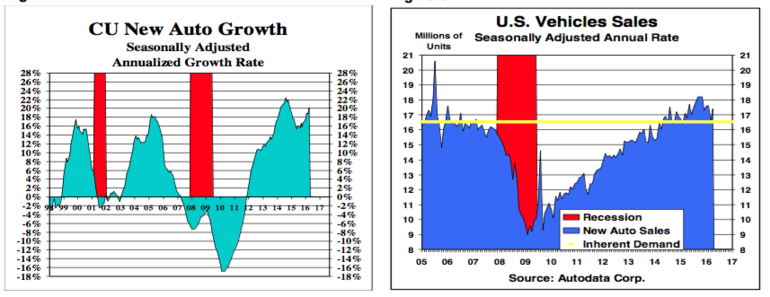
Credit union new auto loan balances grew at a 20.2% seasonally adjusted annualized growth rate in April.
Real Estate-Secured Lending – 1st Mortgages and Other Real Estate
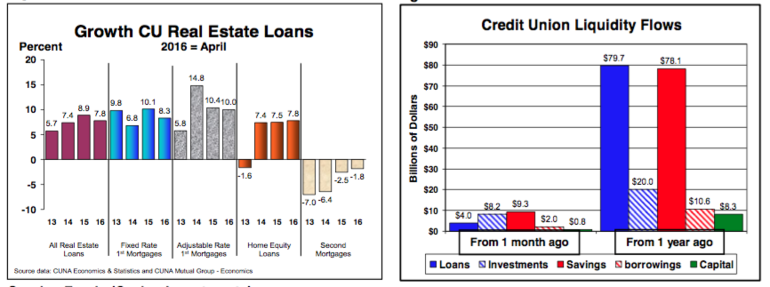
Credit union fixed-rate first mortgage loan balances fell 1.3% in April, below the no change reported in April 2015. However, adjustable-rate first mortgage balances rose a strong 2.5%. CUNA Mutual reported adjustable-rate mortgages now make up 31% of all credit union first mortgage loan balances. During the last 12 months, fixed-rate first mortgage balances rose 8.3%, slightly less than the 10% increase in adjustable-rate mortgage balances.
“Credit union real estate lending will remain robust through 2016 because the fundamental drivers of housing demand are moving in the right direction: improving the labor market, rising real average weekly earnings, increasing household formation, lowering secondary-market down-payment requirements, improving household balance sheets, and rising consumer confidence,” CUNA Mutual said in its Trends Report.
Surplus Funds (Cash + Investments)
Credit union surplus funds as a percent of assets fell to 31.9% in April, from 32.8% last April, as credit unions’ loans grew faster than investments. During the last year, credit unions added $79.7 billion in loans to their balance sheets, the fastest in credit union history, and $20 billion in new investments, CUNA Mutual said. The lion’s share was funded with $78.1 billion in new savings deposits. The remainder was funded by $10.6 billion in additional borrowings, and $8.3 billion in additional capital (net income), according to the Trends Report.
Savings and Assets
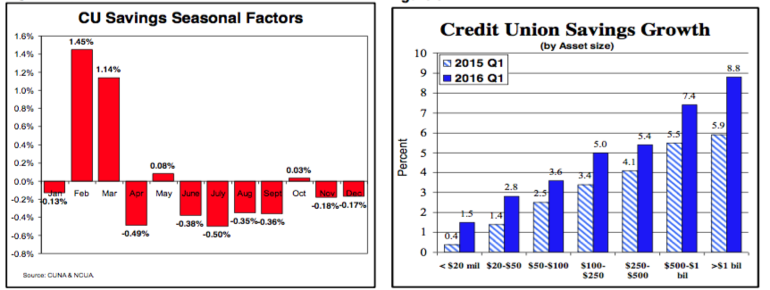
Credit union savings balances rose 0.8% in April, significantly above the -0.1% drop reported in April 2015, due to lower oil prices resulting in a savings windfall for credit union members. In the year ending in the first quarter of 2016, credit union savings balances rose 6.7%, significantly above the 4.4% growth rate reported for the year ending in the first quarter of 2015. Asset growth accelerated for all asset size categories during the last two years; however, again, larger credit unions reported faster growth than smaller credit unions, CUNA Mutual said.
Capital and Other Key Measures
Credit union return-on-asset ratios averaged 0.75% in the first quarter of 2016, slightly below the 0.78% reported in the first quarter of 2015 and below the long-run average of 1.0%. A five-basis point increase in net interest margins (due to a rising loan-to-asset ratio pushing up the yield-on-asset ratio) were more than offset by an eight basis point increase in provision of loan loss expense. However, the credit union movement’s average return-on-asset ratio masks large disparities between large and small credit unions, CUNA Mutual said.
The credit union net-charge-off-to-average-loan ratio rose to 0.52% in the first quarter, up from the 0.47% reported in the first quarter of 2015, the company said.
Credit Unions and Members
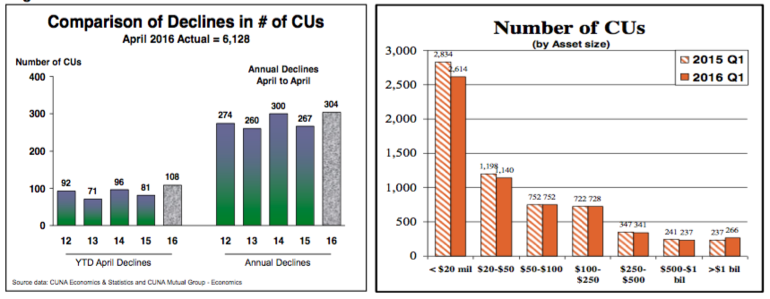
As of April 2016, CUNA estimates 6,128 credit unions were in operation, 35 fewer than March. During the first four months of 2016, approximately 108 credit unions ceased to exist because of mergers, purchase and assumptions, or liquidation, the Trends Report said.
“Expect the annual decline in the number of credit unions to rise over the next two years as competitive pressures rise on smaller institutions,” CUNA Mutual forecast.
At the end of the first quarter of 2016, 2,614 credit unions reported assets less than $20 million, down from 2,834 one year earlier. These small credit unions make up 43% of all credit unions, but control only 1.1% of all credit union loans.
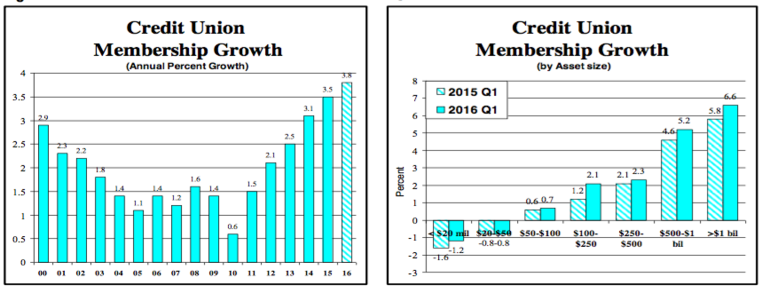
Credit union memberships grew a strong 353,000 in April, or 0.33%, down from April 2015 when the movement added 388,000 memberships, an increase of 0.38%. In the year to April 2016, credit union memberships rose 3.8% faster than the 2.9% pace set in the year to April 2015, according to CUNA Mutual.
“Credit unions should expect membership growth to exceed 3% in 2016 and 2017 as the economic recovery and credit demand continue for the next two years,” CUNA Mutual forecast. “Most of the membership growth is taking place at credit unions with assets over $500 million, due to organic growth and mergers. Credit unions with less than $50 million in assets lost memberships during the last two years.”