ST. PETERSBURG, Fla.–Overall card payment volume fell in the latest weekly analysis of member payment behavior released by PSCU, with the Labor Day weekend cited for the slowdown.
PSCU’s Advisors Plus and Data & Analytics teams released year-over-year weekly performance data trends, with the latest installment comparing the 35th week of the year (the week ending Aug. 30, 2020, compared to the week ending Sept. 1, 2019).
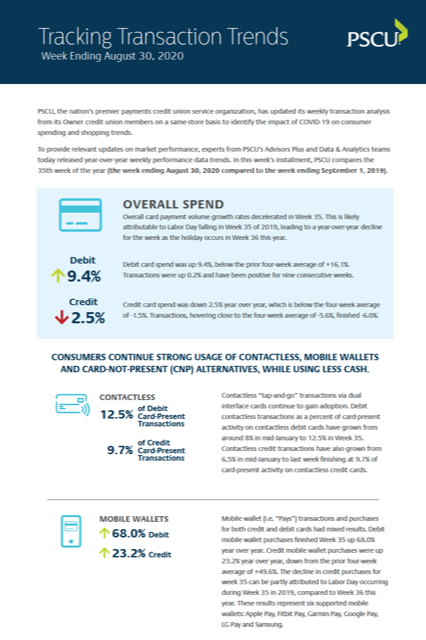
PSCU noted overall card payment volume growth rates decelerated in Week 35. “This is likely attributable to Labor Day falling in Week 35 of 2019, leading to a year-over-year decline for the week as the holiday occurs in Week 36 this year,” PSCU said.
The report found debit card spend was up 9.4%, below the prior four-week average of +16.1%. Transactions were up 0.2% and have been positive for nine consecutive weeks.
Credit card spend was down 2.5% year over year, which is below the four-week average of -1.5%. Transactions, hovering close to the four-week average of -5.6%, finished -6%.
Card Not Present Data
According to PSCU, consumers continue strong usage of contactless, mobile wallets and card-not-present (CNP) alternatives, while using less cash.
- Contactless “tap-and-go” transactions via dual interface cards continue to gain adoption, PSCU said. Debit contactless transactions as a percent of card-present activity on contactless debit cards have grown from around 8% in mid-January to 12.5% in Week 35. Contactless credit transactions have also grown from 6.5% in mid-January to last week finishing at 9.7% of card-present activity on contactless credit cards.
- Mobile wallet (i.e. “Pays”) transactions and purchases for both credit and debit cards had mixed results. Debit mobile wallet purchases finished Week 35 up 68% year over year. Credit mobile wallet purchases were up 23.2% year over year, down from the prior four-week average of +49.6%. The decline in credit purchases for week 35 can be partly attributed to Labor Day occurring during Week 35 in 2019, compared to Week 36 this year. These results represent six supported mobile wallets: Apple Pay, Fitbit Pay, Garmin Pay, Google Pay, LG Pay and Samsung Pay, PSCU said.
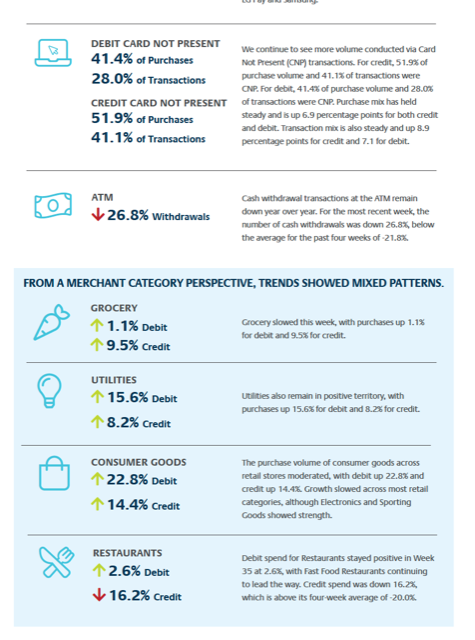
- “We continue to see more volume conducted via CNP transactions. For credit, 51.9% of purchase volume and 41.1% of transactions were CNP. For debit, 41.4% of purchase volume and 28% of transactions were CNP,” the company stated. “Purchase mix has held steady and is up 6.9 percentage points for both credit and debit. Transaction mix is also steady and up 8.9 percentage points for credit and 7.1 for debit.
- Cash withdrawal transactions at the ATM remain down year over year. For the most recent week, the number of cash withdrawals was down 26.8%, below the average for the past four weeks of -21.8%.
Merchant Categories
From a merchant category perspective, trends showed mixed patterns, PSCU reported, including:
- Grocery slowed this week, with purchases up 1.1% for debit and 9.5% for credit.
- Utilities also remain in positive territory, with purchases up 15.6% for debit and 8.2% for credit.
- The purchase volume of consumer goods across retail stores moderated, with debit up 22.8% and credit up 14.4%. Growth slowed across most retail categories, although electronics and sporting goods showed strength.
- Debit spend for restaurants stayed positive in Week 35 at 2.6%, with fast food restaurants continuing to lead the way. Credit spend was down 16.2%, which is above its four-week average of -20%.
Regional Spending
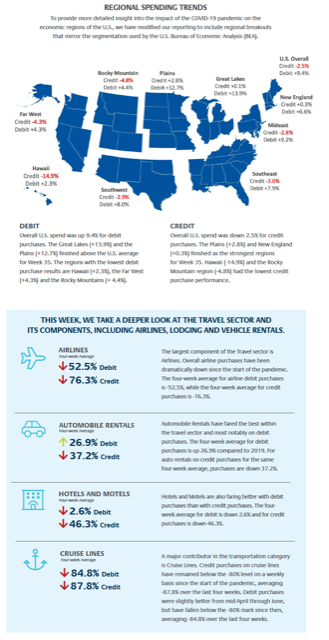
- Overall U.S. spend was down 2.5% for credit purchases. The Plains (+2.8%) and New England (+0.3%) finished as the strongest regions for Week 35. Hawaii (-14.9%) and the Rocky Mountain region (-4.8%) had the lowest credit purchase performance, PSCU said.
- Overall U.S. spend was up 9.4% for debit purchases. The Great Lakes (+13.9%) and the Plains (+12.7%) finished above the U.S. average for Week 35. The regions with the lowest debit purchase results are Hawaii (+2.3%), the Far West (+4.3%) and the Rocky Mountains (+ 4.4%).
- PSCU’s noted its Weekly U.S. State/Territory Analysis is available at www.PSCU.com/COVID19, ranking U.S. states and territories by year-over-year performance for debit purchases, credit purchases and ATM transactions.
A Deeper Look
In its newest analysis, PSCU said it took a deeper look at the travel sector and its components, including airlines, lodging and vehicle rentals. Among the findings:
- The largest component of the Travel sector is airlines. Overall airline purchases have been dramatically down since the start of the pandemic, PSCU said. The four-week average for airline debit purchases is -52.5%, while the four-week average for credit purchases is -76.3%.
- Automobile rentals have fared the best within the travel sector and most notably on debit purchases. The four-week average for debit purchases is up 26.9% compared to 2019. For auto rentals on credit purchases for the same four-week average, purchases are down 37.2%.
- Hotels and motels are also faring better with debit purchases than with credit purchases. The four-week average for debit is down 2.6% and for credit purchases is down 46.3%, according to PSCU.
- “A major contributor in the transportation category is cruise lines,” PSCU said. “Credit purchases on cruise lines have remained below the -80% level on a weekly basis since the start of the pandemic, averaging -87.8% over the last four weeks. Debit purchases were slightly better from mid-April through June, but have fallen below the -80% mark since then, averaging -84.8% over the last four weeks.”
‘Expect a Rebound’
“Card payment volumes decelerated in Week 35, which can likely be attributed in part to Labor Day falling a week later this year,” said Glynn Frechette, SVP, Advisors Plus at PSCU. “Debit continues to outperform credit across most categories, buoyed by the impact of economic stimulus monies and deferral programs. The travel sector, which we look at in more detail in our analysis this week, remains down while slowly trending upward, with pockets of strength in automobile rentals as consumers begin to feel comfortable resuming various degrees of domestic travel. We expect a rebound in overall transactions and spend next week and will monitor consumer spending from the holiday weekend with interest.”