

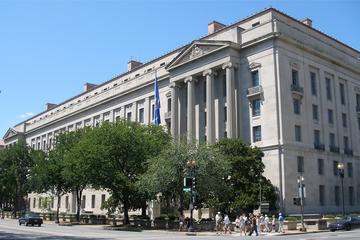
The Department of Justice offices in Washington.
WASHINGTON–The Justice Department has filed an amicus brief in a lawsuit against the Consumer Financial Protection Bureau that argues the CFPB’s structure is unconstitutional.
The lawsuit, filed by PHH Corp., a mortgage lender, challenges the management structure of the watchdog regulator, which is overseen by a single director, Richard Cordray. Its structure has also been challenged by credit union trade groups, which have lobbied for a five-person board to oversee the agency.
In its lawsuit, PHH had also called for the elimination of the CFPB, but the Justice Department brief does not go that far, although President Trump has called for it to be shut down. The PHH lawsuit was filed after the CFPB levied a $109-million fine against the company over what the agency alleged were illegal kickbacks. PHH filed an appeal in which it challenged the Bureau’s statutory authority to impose the penalty.
In October of 2016, a three-judge panel from the United States Court of Appeals for the District of Columbia Circuit ruled that Congress had overstepped its authority in how it set up the CFPB, and that the president should be able to remove the director at will. That ruling was vacated last month, when the court granted the consumer bureau’s request for a rehearing.
Oral arguments are now set to be heard by the court’s full slate of active judges in May.
In its brief the Justice Department says the president should be able to remove the CFPB director at will. Currently Cordray can only be removed in cases of "inefficiency, neglect of duty or malfeasance in office," according to the Dodd-Frank Act, which created the CFPB.
The single director structure runs the risk of engaging in "extreme departures from the president's executive policy," the Justice Department argued, adding that an agency run by a single person is "unchecked by the constraints of group decision-making among members appointed by different presidents."
Supporters of the current CFPB structure say it protects the agency’s independence. Earlier this month, in a media interview, Cordray said, “I think that the independence of a consumer watchdog is very much worth fighting for. It's really important work.”