

WASHINGTON – A new report from the National Consumer Law Center illustrates just how much worse debt becomes as the rate on a loan rises, noting that even in states that have newly instituted 36% rate caps the result can be explosive and unaffordable interest on a larger loan.
The NCLC released the report, Larger Loans Need Lower Rates: A 50-State Survey of the APRs Allowed for a $10,000 Loan, which looks at a five-year, $10,000 loans and finds that, “while a majority of states cap the interest rate and fees, many permit interest rates that are too high for these larger loans with longer terms.”
According to the NCLC, three states that failed to cap interest rates at the time of NCLC’s 2018 survey have since enacted 36% rate caps, a rate it said is still very high for loans of this size but a significant improvement nonetheless. Seven states have increased rate caps and weakened consumer protections over the same period, and a handful of others still fail to provide any protections at all, the report adds.
‘Too High for Larger Loans’
“While 36% has become the widely accepted metric for an affordable small dollar loan, states must recognize that it's too high for larger loans,” said Andrew Pizor, senior attorney at the National Consumer Law Center and co-author of the report. “A borrower who repays a $10,000 loan over five years at 36% APR will face $11,680 in interest charges, repaying more than double the amount borrowed. For example, by increasing its rate from 25% to 36%, Oklahoma added over $4,000 to the cost of a $10,000, 5-year loan. And some states permit rates that are even higher.”
Additional Findings
Among the other findings included in the report:
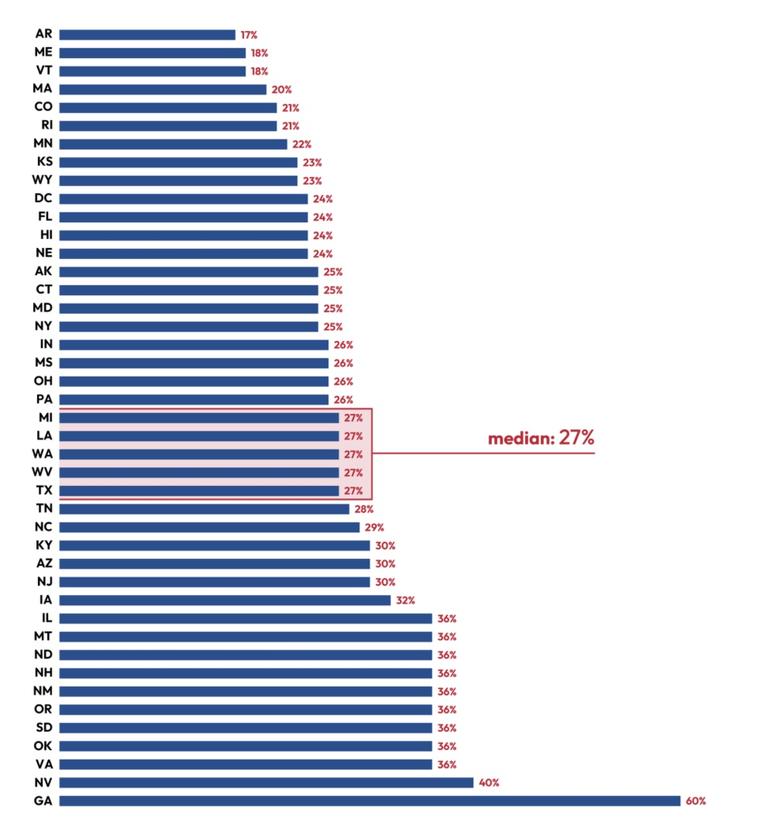
- Forty-two states and the District of Columbia cap the interest rate and fees for a $10,000 loan, with a median cap of 27% APR. Six states, Alabama, California, Idaho, South Carolina, Utah, and Wisconsin, do not place any numerical cap on interest rates and fees for a loan of this size at all. These states only require that the interest and fees not be unconscionable–so high that they “shock the conscience,” NCLC said. Two states, Delaware and Missouri, have no interest rate limit or even a bar on unconscionability.
- The longer terms on larger loans amplify the impact of interest rates on a consumer’s ability to repay a loan and increase the risk that the consumer will fall into a debt trap. For example, if a $10,000, 5-year loan carries 36% interest, after a full year of payments the consumer will have only reduced the principal by $870. Borrowers in Nevada and Georgia are even more exposed, as state law allows excessive rates as high as 40% and 60%, respectively, according to the organization.
- Since NCLC’s 2018 report analyzing loans of this size and duration, 12 states have made significant changes to their lending laws. “The most dramatic positive changes were in New Mexico, North Dakota, and Virginia, where lawmakers and voters approved 36% rate caps in states that previously had none, and in Ohio, where the legislature closed a loophole that had enabled high-cost lenders to evade the state’s rate cap,” the NCLC said.
- Another seven states—Indiana, Kentucky, Michigan, Minnesota, North Carolina, Oklahoma, Tennessee, and Texas—went in the wrong direction by increasing their rate caps. Some of these states made relatively small increases of no more than one percentage point by applying inflation adjustments to fee caps.
- “Kentucky and Oklahoma, however, significantly increased their rate caps. Kentucky increased its interest rate cap for a 5-year $10,000 loan from 24% to 29%,” the NCLC said. “And Oklahoma’s increase was even bigger. Oklahoma’s maximum rate increased from 25% APR to just over 36% APR, primarily due to new legislation adding the Federal Funds rate to the pre-existing maximum rates. That change adds over $4,000 to the cost of a $10,000, five-year loan.”
Now With Free Shipping! The CUToday.info Daily News Email Keeps Getting Better!
The biggest, best and freshest news reporting in credit unions remains free, and now has an added bonus---free shipping to your email address! That’s right. Each morning CUToday.info delivers its daily Fresh Today news update offering the latest headlines and breaking news right to your email, with the easy-to-read headlines format allowing you to click on the stories that interest you most in order to learn more. So stop paying those bank-fee-like subscription prices from other so-called “news” publications!
If you haven’t yet signed up for the new email solution on which CUToday.info has partnered with ResponseGenius, you can do so here. Signing up requires less than one minute of your time—and it’s free!
Please note that after signing up you may need to go to your Spam/Junk folder and mark the morning headlines email as safe. CUToday.info does not provide its list of readers and emails to outside parties, and we will not be contacting you to sell you an extended warranty or sending you any links so you may cash in on an inheritance you didn’t know was coming.
And did we mention it’s free?