

NEW YORK–A new study offers insights into just how much inflation is costing depositors when it comes to their funds in interest-bearing accounts.
The latest MagnifyMoney study examined personal and online savings, standard and reward checking, money market and certificate of deposit (CD) accounts — as well as the largest exchange-traded funds (ETFs) — to see how they fared during the 12 months ending March 31, 2022.
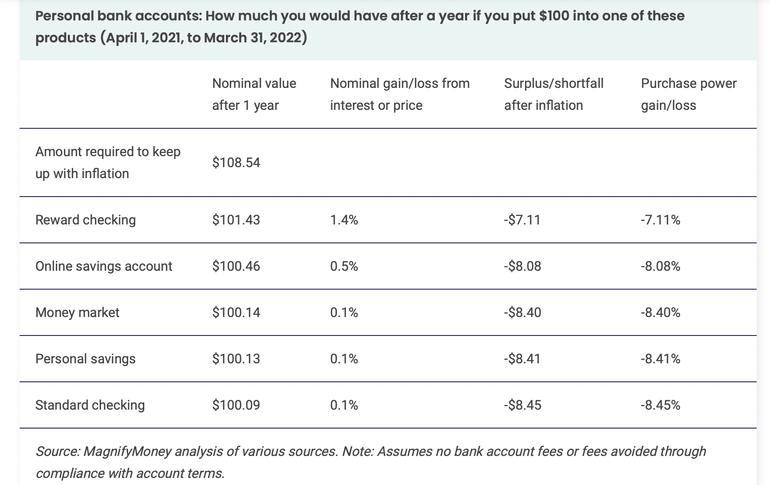
Among the findings, according to MagnifyMoney:
- Consumers are undeniably feeling the effects of inflation, starting with personal savings accounts. “Americans who put $100 into one of these a year ago (April 1, 2021) would have lost the equivalent of $8.41 to inflation by March 31, 2022. This is due to a tiny 13 cents in compound interest and an 8.54% increase in the consumer price index — which tracks the changes in prices paid for goods and services — in that period,” the report stated.
- Standard checking account holders lost the most, while rewards checking account holders lost the least — but still a lot. “Money in standard checking accounts saw the biggest drop — $8.45 for every $100 deposited — while rewards checking had the best outcome among personal accounts at a still-bad loss of $7.11. However, consumers have lost more if they didn’t do what was required to waive fees.”
- Consumers who put their money in CDs fared about the same. “Someone who rolled over a three-month CD four times would have lost 8.40% to inflation after one year,” MagnifyMoney stated. “A six-month CD rolled over once and a one-year CD would have resulted in an average loss of 8.31% and 8.18%, respectively.”
- Adding money to ETFs would have been a better bet — in some cases. “Analysts looked at the five largest ETFs at the start of the second quarter of 2021, and only one of them lost money in a year. But it lost a lot — the equivalent of $23.26 for each $100 invested after losses and expense ratios (fees),” according to the analysis. “However, two ETFs based on the S&P 500 left investors with 4%-plus more, even after inflation and fees.”
- U.S. households spent an average of $61,334 in 2020, which means they would have needed $15,334 in an emergency fund to fully fund three months of expenses in early 2021. “A household with that fund in a personal savings account would have to add $1,290 to cover the same expenses as of April 2022, or $1,239 if they’d used an online savings account. That amount increases by $430 or $413, respectively, to fund an additional month of spending.”
For additional info, go here.
Has Everyone But You Heard the News?
Don’t forget to check your Spam/Junk email folder if you haven’t been receiving your free, popular and daily CUToday.info news headlines.
And if you haven’t yet signed up for the new email solution on which CUToday.info has partnered with ResponseGenius, you can do so here. Signing up requires less than one minute of your time.
CUToday.info has received very positive response from readers following the move to an improved provider of the daily headlines, but many also noted they did need to go to their Spam/Junk folder and mark it as safe.
The new email solution has not only improved every reader’s delivery experience, but it also features a fresh, new format that is easy to read, especially on mobile devices.
Please note and/or make your IT department or email administrator aware the emails will be coming from the domains CUTodayinfo.com and CUTodayinfoReply.com.