

TROY, Mich.— Retail banks have invested heavily in financial advice and support tools designed to create a more personalized customer experience, but many are still struggling to turn those capabilities into sustained customer adoption and engagement, according to the JD Power 2026 U.S. Financial Health Support and Advice Study.
While 47% of customers recall receiving at least one form of banking advice, engagement remains inconsistent, with limited evidence that advice is driving sustained financial action. At the same time, financial well-being remains sharply divided: 38% of customers are financially healthy and 40% are financially vulnerable, which is down 3 percentage points from 2025 but still elevated when compared with long-term trends, underscoring persistent strain beneath surface-level stability, JD Power said.
“Personalization is still more promise than reality. Overall awareness of existing banking and credit card support tools is growing, but that growth is not translating into sustained engagement. Adoption continues to lag, highlighting a gap between awareness and action, while financial well-being remains polarized with nearly as many customers financially vulnerable as financially healthy,” said Jennifer White, managing director of financial services intelligence at JD Power. “In this challenging economic environment, financial institutions have a unique opportunity to connect with their customers on a meaningful, emotional level, but achieving that requires moving beyond one-off interactions and creating a more consistent, engaged customer experience.”
Following are some key findings of the 2026 study:
- Customers are seeking short-term, practical financial guidance: The most in-demand advice topics include quick tips and information to improve financial situations (26%), saving for emergencies (25%) and tips to stay on budget (23%), highlighting stronger demand for immediate, day-to-day financial support than for long-term planning. Most customers prefer to receive guidance through marketing communications, followed closely by banking representatives, yet delivery models are being challenged as 53% of customers report having turned to artificial intelligence (AI) for financial advice in the past three months, signaling a growing threat to traditional channels.
- Barriers to engagement: More than half of customers face barriers to engagement with financial support, driven largely by low awareness and limited confidence in financial literacy, with fewer than one in six bank and credit card customers aware that new financial advice and support resources are introduced. More striking, 43% of bank customers and 45% of credit card customers report no barriers to engagement, suggesting a perception gap. Many customers may not perceive financial support tools as relevant or necessary, even when underlying gaps in financial knowledge and financial behavior persist.
- Top-ranked brands excel at delivering highly personalized experiences: Overall, just 20% of bank customers and 16% of credit card customers say their provider always personalizes the information they receive. When financial institutions get the personalization formula right, however, customer satisfaction scores rise 238 points among bank customers and 219 points among credit card customers. “This personalization isn’t superficial or simply connecting communications to a customer’s product use; top-ranked brands are forging bonds with customers by sharing information relating to spending habits, tailoring advice based on account balances and tying specific communications to life events,” White added.
Index Ranking
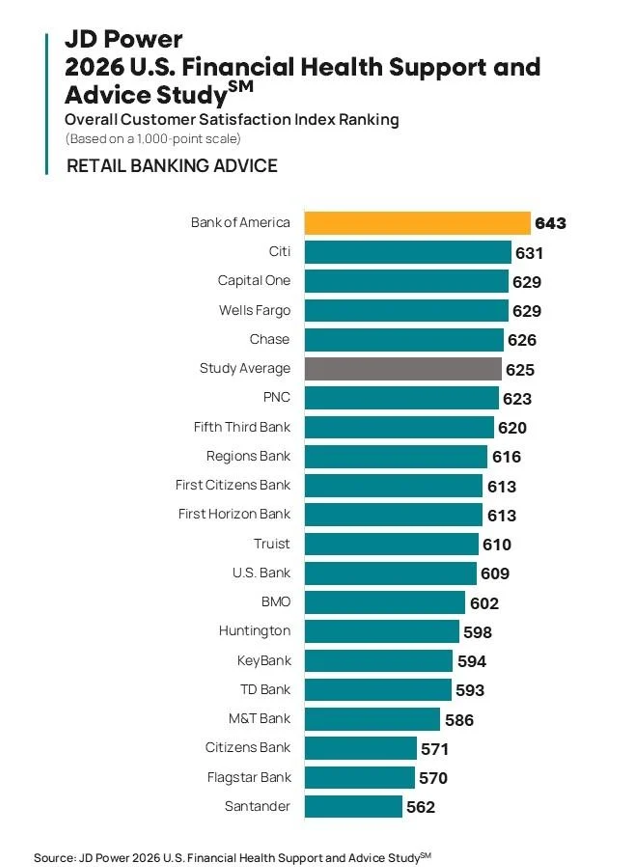
Bank of America ranks highest in customer satisfaction with retail banking advice for a second consecutive year, with a score of 643 (on a 1,000-point scale). Citi (631) ranks second and Capital One (629) and Wells Fargo (629) each rank third in a tie.
Capital One ranks highest in customer satisfaction with banking health support with a score of 621. Chase (607) ranks second and Bank of America (596) ranks third.
American Express ranks highest in customer satisfaction with credit card health support with a score of 641. Bank of America (606) ranks second and PNC (597) ranks third.
The U.S. Financial Health Support and Advice Study measures customer satisfaction with banking and credit card health support and retail banking advice. The banking and credit card support segments are based on 29,855 and 23,941 respondents, respectively, who have a primary banking or credit card relationship with a qualifying bank or issuer. Among the banking customers, 12,350 who received advice or guidance in the past 12 months are included in the retail banking advice segment.
The study was fielded from March 2025 through March 2026. The Banking Financial Health Support Index and Credit Card Financial Health Support Index are based on data fielded from September 2025 through March 2026.