

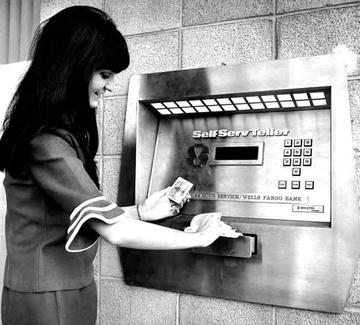
ROCKVILLE CENTER, N.Y.–Yesterday marked the 47th birthday of the ATM in the United States. Or did it?
The first machine similar to the ATMs in the market now began operating on Sept. 6, 1969, at a branch of Chemical Bank in Rockville Center, N.Y. That much is known. Who gets credit for inventing the machines is up for debate, as is much more.
Although numerous people were involved in competing visions of automated tellers, creation of the machine the bank used is largely credited to Don Wetzel, an executive at Docutel, a Dallas company that developed automated baggage-handling equipment. According to History.com, Wetzel reportedly conceived of the concept while waiting in line at a bank. The ATM that debuted in New York in 1969 was only able to give out cash, but in 1971, an ATM that could handle multiple functions, including providing customers’ account balances, was introduced.
But Wetzel had predecessors, and many credit American inventor and businessman Luther Simjian for what would become the commonplace ATM. Simjian held patents on all kinds of things–including an army flight simulator, a color x-ray machine, a self-focusing camera, an exercise bicycle and a teleprompter–but he was best known for his work on the Bankograph, a machine that could accept cash or check deposits at any hour of the day or night, History.com noted.
In 1960, Simjian managed to persuade one New York City bank to take a few of his automatic-deposit machines. “So that customers could trust that they would see their money again, there was a microfilm camera inside the Bankograph that took a snapshot of every deposit,” History.com reports. “Customers received a copy of the photo as their receipt. Still, the Bankograph did not catch on.”
“The only people using the machines were prostitutes and gamblers who didn’t want to deal with tellers face to face,” Simjian was quoted by History.com as saying, and there were not enough of them to make the machines a worthwhile investment.
Outside the U.S., in 1967 a Scottish inventor named John Shepherd-Barron said he was sitting in the bathtub when he had a flash of genius: If vending machines could dispense chocolate bars, why couldn’t they dispense cash? History.com reported that London-based Barclays loved the idea, and Shepherd-Barron’s first ATM was installed in a branch on Enfield High Street not long afterward. Unlike modern ATMs, Shepherd-Barron’s did not use plastic cards. Instead, it used paper vouchers printed with radioactive ink so that the machine could read them. The customer entered an identification code and took her cash–a maximum of £10 at a time.