

ALEXANDRIA, Va.–The NCUA board voted 2-1 to approve its budgets for 2020 and 2021, with discussion prior to the vote dominated by debate over whether NCUA is doing enough to ensure credit unions are in compliance with consumer protection laws.
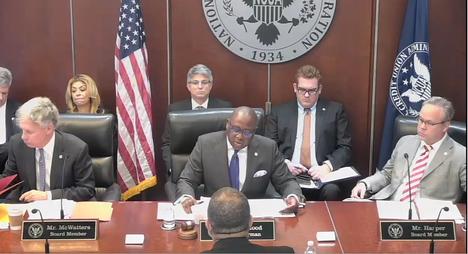
L-R: Mark McWatters, Rodney Hood, Todd Harper
NCUA Board Member Todd Harper cast the dissenting vote, which was not a surprise, as Harper had earlier proposed creation of a dedicated consumer compliance exam program for large, complex credit unions.
Harper wanted the budget to include funding to add three new full-time employees in the NCUA’s Office of Consumer Financial Protection in 2020.
More surprising was a statement during the board meeting from Board Member J. Mark McWatters who indicated he, too, could see the argument in favor of ensuring compliance with consumer protections, but he would cast his vote in favor of the proposed 2020-21 budgets primarily because not doing so would create a “nightmare” for the agency less than a month away from the new year.
In his comments prior to those made by Harper and McWatters, NCUA Chairman Rodney Hood pointed to the “overwhelming majority” of comment letters on the budget that opposed expanding the agency’s consumer compliance program. Hood said NCUA’s annual performance plan already outlines the many activities that are undertaken in furtherance of consumer financial protection.
It should be noted credit unions above $10 billion in assets must comply with consumer protection regulations put in place by the CFPB.
NCUA ‘Not Keeping Pace’
Following Hood’s comments were those made by Harper that the board meeting would be one in which it would “delay and do too little. We will delay the risk-based capital rule again (see related story) and we will do little to strengthen consumer compliance reviews,” he said.
Harper cited comments from what he said were more than 200 civil rights, community, consumer and faith-based groups that “strong consumer protections and robust supervision of financial institutions are vitally important both for individual borrowers and the health of the whole economy.”
Harper said the agency continues to focus its examination programs on traditional practices even as the number of CUs of more than $1 billion in assets has risen to 319, representing more than 73-million members.
“NCUA is not keeping pace with the growth and large credit unions and the changing dynamic in the industry that it regulates,” said Harper saying other regulators assign a separate consumer compliance team for examinations.
‘It Must Be Measured’
“If you do not measure it, you cannot manage to it and we aren't giving large, complex credit unions a tool that they need to manage consumer compliance performance,” Harper said.
Harper indicated he believed there had been an agreement at NCUA—although he didn’t say with whom—that staff would be added to the agency’s Office of Consumer Protection.
“Ultimately, I am deeply disappointed that after negotiating for almost two weeks and seemingly reaching an agreement to add staff to the Office of Consumer Financial Protection, that agreement is not reflected in the budget before us today,” he said. “In operating as a board, we need to be bringing different perspectives to the table…For the good of the credit union system, and its members, I intend to continue the dialogue I started in September about strengthening the NCUA’s consumer compliance program. As a credit union system evolves, so must its regulator. When we revisit budgetary matters in the future, I hope I am not disappointed again.”
McWatters: ‘It Ain’t Broke, But…’
In his own statement to the board meeting, McWatters said at first glance the old saying, “If it ain’t broke, don’t fix it,” would seem to apply to the agency’s consumer protection examination and supervision mandate, as credit unions have not seen “Well Fargo type frauds.”
“So everything appears OK, but is it?” asked McWatters.
Under the “ain’t broke” approach, McWatters said the NCUA would wait and take action after something “breaks,” that is, consumers are being cheated and defrauded.
“Does this approach make sense for a regulatory agency? That is, should the NCUA sit on its hands and wait until there’s a clear and demonstrable consumer protection problem before taking action?
“Clearly not,” McWatters said. “In other words, the agency should not regulate reactively, but should work proactively to anticipate future problems. This approach requires adequate resources and thoughtful leadership. Let me be clear, our consumer protection staff has done a fine job. They, however, deserve the resources to act proactively to continue to protect consumers. I have advocated for the allocation of additional resources to the agency’s consumer protection staff.”
The Need to Tailor
Noting credit unions are not banks, McWatters called for specifically tailoring NCUA’s consumer protection exams and supervision to the “actual, objective risks presented by credit unions to their members,” and “Credit unions do not operate with an equity shareholder class and their what-have-you-done for-me-lately investment philosophy. Credit unions, accordingly, have every economic incentive to treat their member consumers well…Treating consumers inappropriately is not only wrong and in violation of applicable law, it’s bad for credit union business and undermines the agency’s safety and soundness mandate….Consistent with my first board statement in 2014, we should not hesitate to add staff that are necessary to the fulfillment of our safety and soundness mission provided we can justify the expense in an objective and transparent manner.
“The proposed 2020 budget reallocates funding among different offices and categories and increases the operating and capital budgets so as to permit the agency to continue its core mission of safety and soundness. The budget for 2020 approved last year is simply inadequate for the task.”
Hood Responds
Following McWatters’ comments, Hood said he would use the “prerogative of the chair” to call an additional person to address the board, and he turned to Matthew J. Biliouris, director of NCUA’s Office of Consumer Financial Protection since August of 2018.
Hood asked Biliouris to confirm NCUA has in place a “very robust program” for consumer protection.
Biliouris responded by saying since he took office there has been a focus on consumer complaints and in ensuring examiners are aggressive in responding to related issues. He said examiners have also been told there is a minimum set of consumer protection-related standards to be looked at during every examination.
With Biliouris still at the table in front of the board, Harper asked if his office had requested any additional staff.
“We did. We requested one additional staff,” responded Biliouris.
Will you be getting that staff addition? asked Harper.
“That has yet to be determined, but it doesn’t look like it,” answered Biliouris.
Big Piece of Ice
McWatters noted in response to some of the earlier comments that “everything was great on the Titanic three minutes before it hit that big piece of ice.” Referring to Biliouris, he added, “I need guys like you out there paying attention, but I need you to have the resources to do it.”