


LAKE FOREST, Ill.—Is free checking actually aimed more toward the wealthy?
A new study indicates that free checking is offered more frequently to fully banked households, those with two or more depository services, and those in populated areas of less than two-million where the cost of living is above average.
The report shows, too, that free checking is offered less frequently in areas with a larger percentage of unbanked and underbanked households, with either one or no depository services, and in higher populated areas where the cost of living is below average.
These are among the findings from a study by Moebs $ervices that focused on demographics and types of financial services.
“The results of this study are far different than most industry executives, government officials, and consumer advocates may expect,” said Michael Moebs, economist and CEO at Moebs $ervices.
Measures Stand Out

Michael Moebs, Moebs $ervices
Moebs said the report applied several economic measures to understand the relationship between free checking and specific cities.
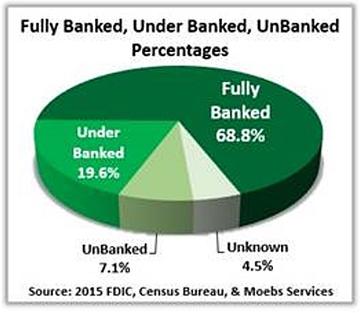
“In doing so, three distinct measures stood out with strong correlation to free checking: fully banked households, population size, and cost of living,” said Moebs. “Overall, about two-thirds of Americans are fully banked. The remaining underbanked or unbanked individuals often deal with shadow or alternative banking firms such as payday lenders, pawn shops, currency exchanges, etc.”
In cities with a high percentage of fully banked households, free checking is offered 65% of the time.
“This differs significantly when a city has a low percentage of fully banked households, where free checking is offered only 51% of the time,” explained Moebs. “Overall, depositories are offering free checking more often when they are in markets where households have multiple services.”
The second and third measures with a high correlation to free checking go hand in hand: population and cost of living, said Moebs.
“In larger cities with an average population of 4.1 million or more and a below average cost of living at 97.1, depositories offer free checking less,” said Moebs. “Conversely, in smaller cities with an average population of about 1.8 million and above average cost of living at 111.6, depositories offer free checking more.”
Moebs said that it’s clear that depositories are catering to the fully banked households, who make use of multiple services.
“In cities where the cost of living is higher, individuals generally desire other financial services than a checking account. Therefore, depositories are taking advantage of money generating services, such as a loan, and are able to appeal to consumers by also offering a free checking account,” noted Moebs. “Interestingly, depositories used this strategy in the late 1950s when free checking was first promoted, trying to find consumers who need funds instead of investing funds.”
Are Overdrafts A Factor?
Moebs said that in cities with a high number of fully banked households, the median price for an overdraft is $30.50 per item. Similarly, in cities with a low number of fully banked households, the overdraft is $30 per item.
“This is further proof overdrafts are not a factor in comparing fully banked, unbanked, and underbanked markets,” observed Moebs.
Many who believe free checking is linked to overdrafts blame banks, thrifts, and credit unions for the plight of the unbanked and underbanked, asserted Moebs.
“The report ultimately shows that free checking is linked to cities that are fully banked with a lower population and higher cost of living. So, the question then becomes are depositories only interested in fully banked households, or do they still attempt to advertise to the underbanked and unbanked?” asked Moebs. “Both cases are valid, but the ultimate factor relies on risk. Depositories often view the unbanked and underbanked as a risk – unsecured negative balances driving up the cost of checking. At the same time, the unbanked and underbanked households often view traditional depositories as risky – rejecting taking a debit card, causing them to use shadow banking sources.”