

NEW YORK--A new global sentiment poll shows institutional appetite for operational crypto adoption held steady through 2025, even as stablecoin activity surged.
Just over 40% of financial services insiders worldwide said their organizations are involved in or planning to implement crypto in core operations in both the first and second halves of the year, according to research from GlobalData. The flat reading suggests much of 2025’s stablecoin growth was driven by end-user activity rather than deeper integration into regulated financial institutions’ systems.
Blandina Szalay, banking and payments analyst at GlobalData, said positioning will be critical in 2026 as crypto use cases diverge across regions. She noted that regulatory developments in some advanced economies generated significant attention around institutional adoption, fueled by expectations that regulated players could bring scale that decentralized finance has struggled to achieve.
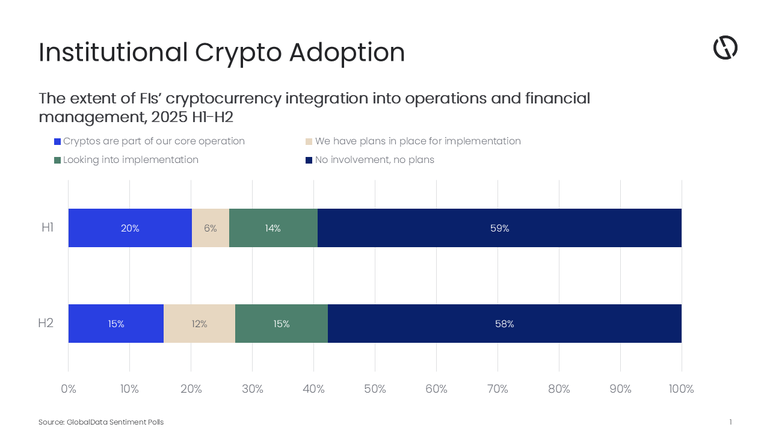
At the same time, greater institutional involvement runs counter to crypto’s original decentralized ethos. Assets initially promoted as borderless and intermediary-free now increasingly depend on national regulatory approvals and AML/KYC frameworks, potentially diluting their original value proposition. As a result, more institutional participation does not automatically translate into higher global usage.
Szalay pointed to data from Bybit showing Ukraine and Nigeria topping a crypto transactional-use index, with the highest GDP-adjusted stablecoin flows in 2025. In those markets, demand for unregulated USDT was driven largely by necessity, filling gaps left by domestic monetary systems rather than by institutional endorsement.
The U.S. stood out as the only market showing a meaningful increase in adoption plans between H1 and H2, rising from 33% to 42%. The world’s largest stablecoin issuer, Tether, responded by launching a new USAT coin tailored to the U.S. regulatory framework, while USDT continued to expand as a store of value and payment tool in other regions.
Looking ahead to 2026, Szalay said regional operators may be better positioned to tailor crypto products to local regulatory and market needs. Larger global institutions, she added, could face greater strategic challenges as regulatory regimes, consumer sentiment and market dynamics remain highly fragmented across geographies.
The poll was conducted across GlobalData’s financial services media sites, drawing 214 industry respondents in H1 2025 and 213 in H2.