

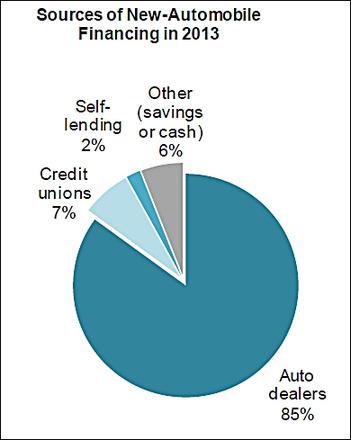
Source: Aite Group
BOSTON—A new study indicates the recession has been good to indirect auto lending.
Aite Group reports that indirect auto lending has grown from 62% of all new car financing in 2006 to 85% through 2013.
That shift has helped keep CU loan portfolios afloat in recent years, especially as credit unions stepped in to fill a void when bankers exited auto lending during the recession. But the movement is also cause for concern, notes Aite.
Senior Analyst Christine Pratt, author of a two-part report on indirect auto lending, said that with the growth of indirect, financial institutions are giving up a great deal of control over the loan decision.
“There is less of the face-to-face, in-branch decisions being made by credit unions and banks,” said Pratt. “More and more loans are being closed at the dealership.”
The decline of home equity lending has been a big boost to indirect auto, Pratt Pointed out. She explained that in 2006, home equity comprised 18% of new car financing. By 2013, the percentage dropped to less than 2%.
“A lot of people were financing their cars through their home,” said Pratt. “There is little of that today.”
Pratt said fewer car buyers, as well, are paying in cash, with consumers holding onto their money and also taking advantage of low financing rates.
Indirect’s contributions to auto lending are clear, helping to make auto loans the only loan category where balances are now above 2008 levels, according to Aite. The overall U.S. auto finance portfolio stood $809 billion in 2008 and reached $860 billion by the end of 2013.
“This means that auto finance is the only retail credit product with balance growth that has reached pre-recession levels, and it is likely to make continuing progress going forward,” said Pratt. Aite projects U.S. auto loan balances to reach $922 billion by 2014 and $958 billion by 2016.
But with the growth, and the expansion of indirect, Pratt reiterated concerns over the financial institution losing more control over loan quality.
With more credit unions turning to automated loan decisioning tools that allow dealers to input borrower credit data, there is “wiggle room” for experienced F&I departments to slip past questionable borrowers who may have been turned down face-to-face at the CU, Pratt explained.
But Pratt said that most FIs today have fraud detections tools within their automated programs to prevent such occurrences—although she is not certain how well those tools match up with the systems of some of the used car dealers.
When General Motors and Chrysler restructured following bankruptcy filings in 2009, they closed a large number of their franchises. That has led to 20,000 independent auto dealers today. Aite estimates that this group was responsible for the sale of 21 million used autos in 2013.
The Aite study, as well, reflected some of the concern over the state of auto lending shared by analysts in the last year—credit terms extending, more subprime borrowing and a trend for more borrowers going upside down.
In her study Pratt wrote: “Despite the happy growth projections, the makeup of the 2014 auto-loan portfolio begs a few words of caution about its impact on institutional profitability. The 2008 portfolio contained approximately 62-million loan accounts, and that number in 2013 stood at 64-million according to the Federal Reserve. Twenty-four million new loan accounts were added to the portfolio in 2013, however, and these loans had balances of $463 billion, accounting for more than half of the year-end balances.”
She said those results indicate a net loss in the portfolio of 22-million auto-loan accounts from 2008 to 2013.
“What this means for the credit industry is that even though balances have grown, overall returns are poorer because interest rates are much lower on new loans than in earlier portfolios. This means that the newer of the 64 million accounts carry a larger component of credit risk, and creditors can expect processing costs to increase given the uptick in longer-term and subprime loans. In short, today's portfolio signals more work and lower returns.”
Pratt offered this advice:
- Ensure the CU has a close, strong relationship with the dealership.
- Ovoid heavy indirect auto loan concentrations.
- Make sure top management is aware of the indirect loan portfolio—how it is performing and its composition.
- Be certain online lending fraud and risk tools are in place and are properly aligned to lending policies.
“These are important,” said Pratt. “You don’t want to end up with higher-risk borrowers in your portfolio just because you are not paying attention.”
Related links