MADISON, Wis.–May, 2016 was the first month in many years where every CU loan category reported positive growth, according to the latest Credit Union Trends Report from CUNA Mutual.
In addition, the report found the average loan-to-savings ratio reached 77.6% in May, but remains below the August 2009 high-water mark of 84.1%.
The number of credit unions was down again, to an estimated 6,126, while CU memberships grew a strong 421,000 in May, or 0.40%, up from May 2015 when the movement.
Here’s a look at how credit unions performed by category through May, as reported by CUNA Mutual, which uses CUNA data for its analysis:
Lending
Credit union loan balances rose 1.0% in May, faster than the 0.9% pace reported in May 2015, and 3.9% year-to-date. May was the first month in many years where every loan category reported positive growth, CUNA Mutual reported, noting that year-over-year loan growth was pushed to 11%, the fastest pace since May 2005.
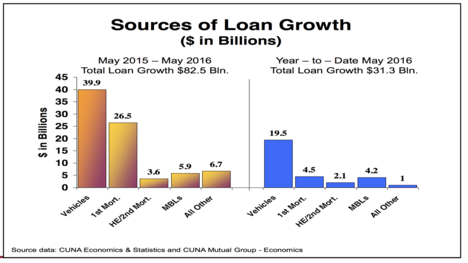
Vehicle lending has made up the lion’s share of loan growth over the last year. Since May of 2015 credit union auto loan balances rose a record $39.9 billion, followed by first mortgage loan balances rising $26.5 billion.
Loan-To-Share Ratio
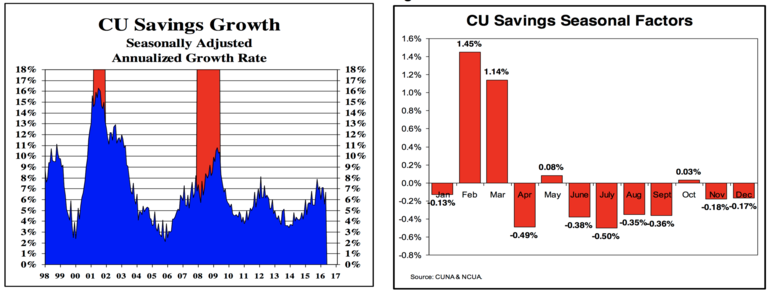
At the same time, savings balances grew 6.9% over the last year, above the 5.4% 10- year average growth rate, due to members’ accumulating their low gas price windfall, CUNA Mutual said. “
“But with loans growing faster than savings the credit union average loan-to-savings ratio reached 77.6% in May, above the 74.8% reported one year earlier,” CUNA Mutual said. “We are still below the high-water mark for the loan-to-share ratio set back in August 2009 when the credit union movement was 84.1% loaned out.”
Credit Union Consumer Installment Credit
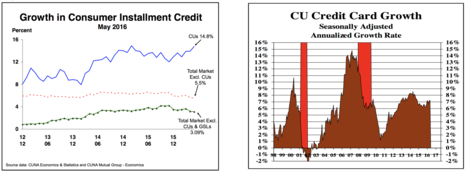
Credit union consumer-installment-credit loan balances (auto, credit card and other unsecured loans) rose 14.8% during the 12 months ending in May, the fastest pace since February 2015, CUNA Mutual reported. The 14.8% pace is more than twice the 5.5% pace of the total market, excluding credit unions, and significantly faster than the 3.09% growth rate of the total market, excluding credit unions and government student loans. Credit union credit card loan balances grew at a 7.2% seasonally-adjusted, annualized growth rate in May due to rising gas prices increasing credit used at gas stations
Vehicle Loans
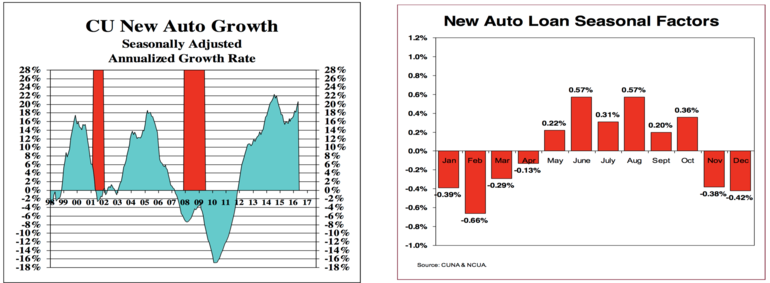
Credit union new-auto loan balances grew at a 20.6% seasonally-adjusted, annualized growth rate in May, a strong acceleration from the 15.3% pace set in May 2015, according to the Trends Report. Credit union new-auto lending is the fastest growing loan category for the first five months of 2016 and throughout the last year. Used-auto lending is the second fastest growing loan category, increasing 16% during the last year, slightly less than new-auto loan growth of 16.6%.
Real Estate-Secured Mortgages and Other Real Estate
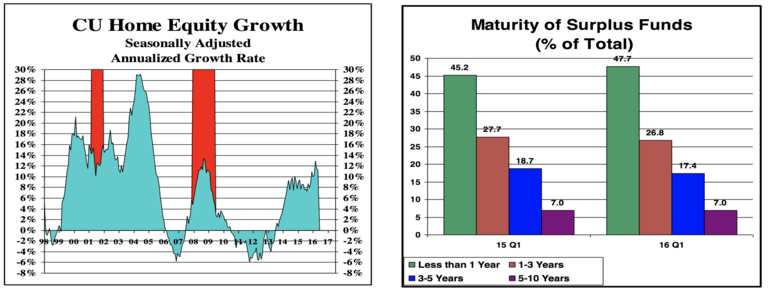
Credit union home equity loan balances grew at a strong 11.4% seasonally-adjusted, annualized growth rate in May, the Trends Report stated, due to rising home prices and improving consumer confidence.
“The demand for home equity credit will remain strong due to rising home prices, the improving job market, rising consumer confidence, consumers releasing pent-up demand for durable goods, and low interest rates,” the Report projects.
Credit union fixed-rate, first mortgage loan balances rose only 0.05% in May, down from the 0.8% in May 2015, and have showed little growth so far this year.
Surplus Funds (Cash + Investments)
Credit union surplus funds as a percent of assets fell to 30.9% in May, down from 32.8% in May 2015, due to credit union assets growing faster than surplus funds, 7% versus 0.7% respectively, according to CUNA Mutual.
“Credit union yield-on-asset ratios rose five basis points over the last year to reach 3.38% in the first quarter of 2016,” the Report states. “The ‘mix effect,’ the shift in the mix of credit union assets from low-yielding investments to higher-yielding loans, added seven basis points to credit union yield-on-asset ratios. However, the ‘rate effect’ shaved two basis points off yield-on-asset ratios due to the yield on loans falling from 4.67% in the first quarter of 2015 to 4.59% in the first quarter of 2016. Credit union cost of funds remained at 0.51% throughout the last year, so net interest margins rose five basis points.”
Savings and Assets
Credit union savings balances grew at a 6.7% seasonally-adjusted, annualized growth rate in May, a slight deceleration when compared to the last few months. However, growth is faster now than the last couple of years because of low gas prices, rising household incomes, strong job growth, and faster membership growth, CUNA Mutual said.
Contributing to the overall growth in savings balances was the 2.2% growth in share certificate balances during the first five months of 2016 as credit unions slowly increased deposit interest rates to help fund the surge in loan balances, the report found.
Credit union wholesale borrowings are up 13.6% year-to-date and 17.5% from a year ago to boost year-over-year asset growth to 7.0%. Total credit union assets should breach the $1.3 trillion mark by the end of the year.
Capital and Other Key Measures
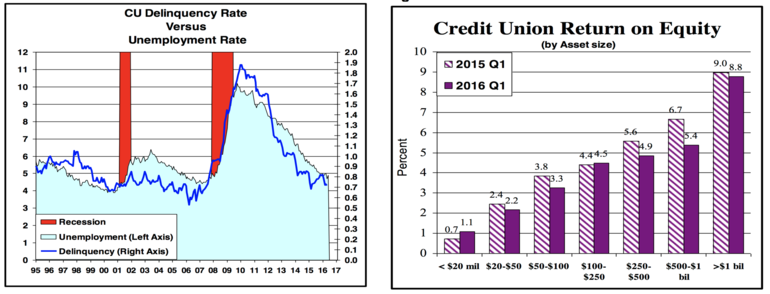
The credit union loan delinquency rate (loans two or more months delinquent as a percent of total loans outstanding) fell to 0.72% in May, from 0.73% in April, and from 0.74% in May 2015.
Today’s delinquency rate is significantly lower than the 10 year average of 1.19%, the Report stated.
Credit union return-on-equity ratios fell to 6.94% in the first quarter of 2016, from 7.22% in Q1 2015, due to falling earnings. The disparity between large and small credit unions’ return-on-equity ratios remains large.
Credit Unions and Members
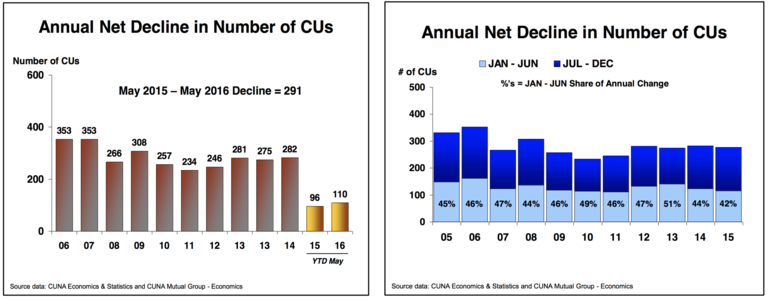
As of May 2016, the report cites CUNA data that estimates 6,126 credit unions were in operation, two fewer than April, and 291 less than May 2015. During the first five months of 2016, approximately 110 credit unions ceased to exist because of mergers, purchase and assumptions, or liquidation. This rate is faster than the 96 reported during the similar time period in 2015, the report found.
“Our 2016 forecast estimates an average annual decline of 290 credit unions through 2020, bringing the total number of credit unions below 5,000 by the end of 2020,” the report stated. “During the last 11 years, approximately 54% of the decline in the number of credit unions takes place in the second half of the year, so we should expect acceleration in mergers as we enter the third and fourth quarters.”
Credit union memberships grew a strong 421,000 in May, or 0.40%, up from May 2015 when the movement. Credit union memberships grew at a 4.3% seasonally-adjusted, annualized growth rate in May, below the record setting pace of the last few months.
“However, the rapid membership gain began with Bank Transfer Day on November 5, 2011 and is being maintained by the strong pace of new job creation over the last few years and the tremendous growth in credit union auto lending,” the Trends Report states. “During the first five months of 2016, credit unions added a record 2.2 million new credit union memberships, which has outpaced the previous record – set back in 2008 when the banking sector started to come undone and 1.6 million Americans joined a credit union.”
The full report can be found in the CUToday.info Vault here.