

KOLOA, Kauai–Just hours after the CFPB announced its long-awaited proposal around junk fees it said are proliferating or threaten to proliferate related to transactions declined at the point of swipe, tap, or click–and just a week after its proposal to cut down overdraft fees--NCUA Chairman Todd Harper and NASCUS President and CEO Brian Knight shared their views on the question of what are “junk fees.”
Their perspectives, including on how regulators balance what is an excessive fee vs. an appropriate one that covers costs, came during a session at the Volunteer Leadership Institute meeting hosted by Rochdale Paragon.
“You need to think about it in a few different ways,” said Harper. “First of all, fees have to be reasonable and proportional. Are you getting charged a $35 fee for $2.50 cup of coffee (due to an overdraft). If so, that's problematic. Second, if you authorize positive, settle negative, those are surprises. (Members) don't necessarily know they're coming. They check their accounts and then by the time it settles they get charged a fee they weren't expecting.”
Harper said he is hopeful credit unions will act in several ways, including paying attention to the studies and research showing how overdraft/NSF fees have been declining at many financial institutions.
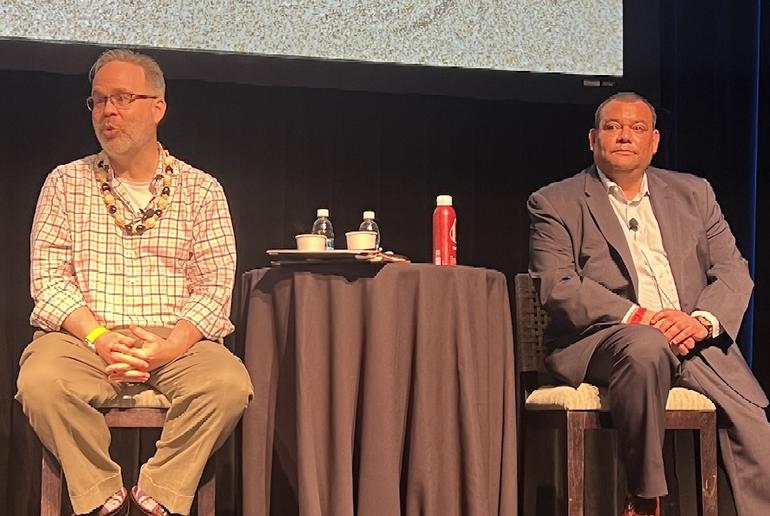
Todd Harper, left, with Brian Knight during Volunteer Leadership Institute.
Two Examples from Texas
The second thing Harper said he hopes CUs will do is recognize that its primarily lower-income people who are paying the fees, as well as younger people and people of color.
“I know of two credit unions, both in Texas, that made the decision a number of years ago to go for totally free credit unioning. Notice I said credit unioning, not banking,” Harper told the meeting. “They totally got rid of not only their overdraft fees, but they got rid of all of their fees. Overall, it took them 18 months to get to a decision about where the money was going to come from and how to make it up. They made a decision to go into a new line of lending.
“Another credit union got funds from the Emergency Capital Investment Program (ECIP), which is a phenomenal $2.2 billion investment program for low-income and minority depository institutions United States. The first thing they did is they got rid of their overdraft program and put people instead into a low-dollar revolving loan.”
‘On the Backs of Members’
Harper said credit unions that have an “excessive percentage” of income coming from such fees are likely “deriving income on the backs of their members of modest means.”
The chairman urged credit unions to “thoughtfully review” their polices and to begin thinking now about making changes to overdraft and NSF pricing and to ensure “you’ve got the revenue right.”
Understanding the Difference
Agreeing there are “equity concerns” with OD/NSF programs, Knight said an important piece of the public policy discussion also needs to be around understanding the difference between all the various fees.
“Quite frankly, there is a difference between late fees and fees that are designed to be punitive,” said Knight. “You can take all of them and say they are bad, or you can debate each on different grounds. I do think beyond any regulatory pronouncements, eventually the marketplace will probably end up kind of resolving this issue to the extent that if the public at large decides they are done with certain kinds of fees, I think we'll see that reflected in their choices.”
Questions from Audience
Later during a Q&A session with Harper and Knight, several related questions were posed. Here’s what was asked and the responses given.
Q: On fees, can you provide some of the philosophy for regulating the amount charged in a fee vs. just letting the market handle the amount charged?
Harper: The question you’re really getting to is rate setting. Under the CFPB proposal, there is a range of fees from $3 to $15, I think. It's really sort of a question of taking a look at the economics behind this and how it works, where is the consumer, and where are the costs and benefits?
The CFPB is taking a look at…where the balance is.
I will take it an extra step and say the market is changing when it comes to overdraft fees. The CFPB did a study recently where it showed four out of the five largest banks had decreased significantly their overdraft programs’ (pricing), whereas of the top 20 credit unions, there were a good number that had substantive (fees). The market is changing and you need to take a look at where the market is going, because if you don't start doing that people will start to vote with their feet.
Q: I agree it doesn’t seem fair someone should get hit with a $30 charge on a $2.50 cup of coffee. The problem is our core processor can’t differentiate (on the size of the purchase). Has anyone looked at the loss of income with this?
Harper: I think here of balloon animals, where if you press on one end the air goes to another. Overall, I recognize that revenue and costs are somewhat the same. You’re going to have to make up for it.
It's one of the reasons I have continued to speak about the need for credit unions to be looking at this more broadly.
Specifically, you were on-point about core processors. If (NCUA) had vendor authority one of the things we could be doing is working and learning about these core processors as part of the examination process and supervision process.