

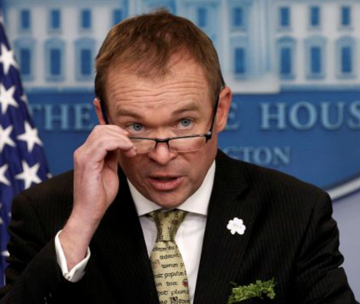
CFPB Acting Director Mick Mulvaney
WASHINGTON—In releasing the CFPB’s new five-year Strategic Plan, Acting Director Mick Mulvaney said the agency will not act outside its statutory authority or “misuse” its powers.
The plan establishes the agency’s mission, strategic goals, and strategic objectives.
“If there is one way to summarize the strategic changes occurring at the Bureau, it is this: we have committed to fulfill the Bureau’s statutory responsibilities, but go no further,” said Mulvaney in a statement. “By hewing to the statute, this Strategic Plan provides the Bureau a ready roadmap, a touchstone with a fixed meaning that should serve as a bulwark against the misuse of our unparalleled powers.”
According to the CFPB, the plan draws directly from the Dodd-Frank Wall Street Reform and Consumer Protection Act and refocuses its mission on regulating consumer financial products or services “under existing federal consumer financial laws, enforcing those laws judiciously, and educating and empowering consumers to make better informed financial decisions.” Among changes from the prior Strategic Plan, the Bureau said it will now focus on equally protecting the legal rights of all, including those regulated by the Bureau, and will engage in rulemaking where appropriate to address unwarranted regulatory burdens and to implement federal consumer financial law and will operate more efficiently, effectively, and transparently.
The Bureau is required to prepare and publish a five-year Strategic Plan in accordance with the Government Performance and Results Act (GPRA) and GPRA Modernization Act. The prior Strategic Plan was published in April 2013. The latest plan is a revision of the draft released in October 2017.
The Strategic Plan is available at: https://www.consumerfinance.gov/about-us/budget-strategy/strategic-plan
Separately, during an appearance on CBS’s Face the Nation, Mulvaney said the agency under his leadership is enforcing the law but “not being aggressive” about its mission. “We’re not pushing the envelope. We’re taking a different attitude toward the job, but the priorities have not changed.”