

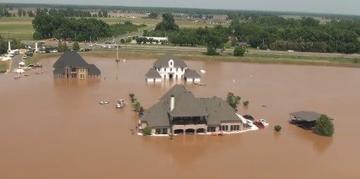
HARAHAN, La.—With floodwaters beginning to slowly recede in this state, credit unions and their members are starting to take inventory of damage to their own operations, as well as the lives of members.
The heavy rains and resulting floodwaters have affected as many as 40,000 homes in Louisiana and southern Mississippi, and 11 people have died so far.
NCUA said it is working closely with federally insured Louisiana credit unions to help protect consumers and ensure continuity of services, and is monitoring the situation to determine the operating status of CUs in the flooded areas.
Low-income-designated credit unions affected by flooding are being reminded they can apply for up to $7,500 in Urgent Needs grant assistance to repair damage or restore services to members. Information about Urgent Needs Grants is available online here.
The Louisiana league reported that at its most recent count 17 CUs had either partially or fully closed operations, down from 20 one day earlier.
The Fairhope, Ala.-based CU*South reported that it has activated its Event Response Team (ERT) to support credit unions and members in the affected areas.
Headquartered on the Eastern Shore of Mobile Bay, CU*South said it’s no stranger to providing disaster recovery and business continuity services. Support is not limited to current CU*South clients.
“We learned an important lesson in 2005,” said Leo Vaulin, CU*South CEO. “When the community needs help, you do everything you can to make sure everyone is taken care of. After Katrina, we learned how to work across core platforms to provide support. Our ERT Team is working to help as many people as we can.”
Regardless of core affiliation the CUSO Services and CUSO Development teams started collecting information. Said CU*South COO Derrick Smith: “We identified credit unions who weren’t able to open their branches, or who were operating with a reduced staff because roads were blocked, or employees were busy filling sandbags to protect their homes and their communities. We identified which shared branching outlets were open, and what ATMs were accessible in the area.”