Frank Nothaft
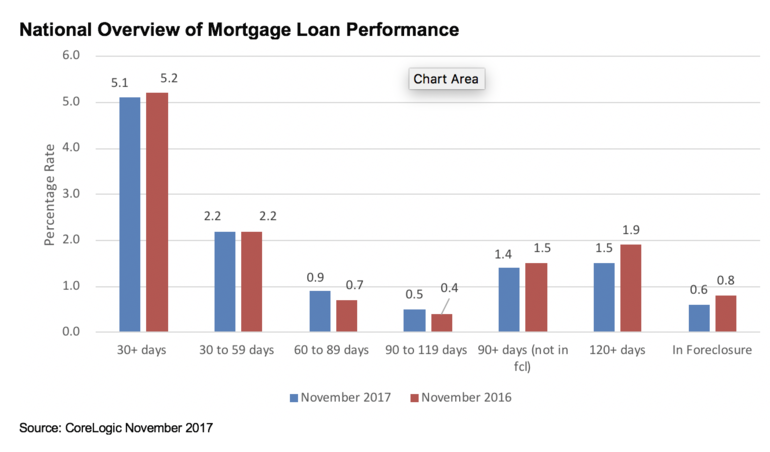
IRVINE, Calif.—New data show 5.1% of mortgages were in some stage of delinquency–30 days or more past due including those in foreclosure– November 2017, an 0.1% percentage point year-over-year decline in the overall delinquency rate compared with November 2016 when it was 5.2%.
The numbers were released as part of CoreLogic’s Loan Performance Insights Report, which notes the effects of 2017’s hurricanes can be seen in the numbers.
As of November 2017, the foreclosure inventory rate, which measures the share of mortgages in some stage of the foreclosure process, was 0.6%, down 0.2 percentage points from 0.8% in November 2016. The foreclosure inventory rate has held steady at 0.6% since August 2017, the lowest level since June 2007 when it was also at 0.6%. This past November's foreclosure inventory rate was the lowest for the month of November in 11 years, since it was also 0.6% in November 2006, the report found.
The rate for early-stage delinquencies, defined as 30-59 days past due, was 2.2% in November 2017, down 0.1 percentage points from 2.3% in October 2017 and unchanged from 2.2% in November 2016. The share of mortgages that were 60-89 days past due in November 2017 was 0.9%, unchanged from October 2017 and up from 0.7% in November 2016. The serious delinquency rate, reflecting loans 90 days or more past due, was 2.0% in November 2017, up from 1.9% in October 2017 and down from 2.3% in November 2016. Prior to November 2017, the serious delinquency rate had held steady for five consecutive months at 1.9%—the lowest level for any month since October 2007 when it was also 1.9%, CoreLogic said.
“The effects of Hurricanes Harvey, Irma and Maria appear clearly in our mortgage delinquency report,” said Dr. Frank Nothaft, chief economist for CoreLogic. “Serious delinquency rates are up sharply in Texas and Florida compared with a year ago, while lower in all other states except Alaska. In Puerto Rico, the serious delinquency rate jumped to 6.3% in November, up 2.7 percentage points compared with a year before. In the Miami metropolitan area, serious delinquency was up more than one-third from one year earlier to 5.1%, and it more than doubled to 4.6% in the Houston area.”
Since early-stage delinquencies can be volatile, CoreLogic said it also analyzes transition rates. The share of mortgages that transitioned from current to 30 days past due was 1% in November 2017, down from 1.1% in October 2017 and unchanged from 1% in November 2016. By comparison, in January 2007, just before the start of the financial crisis, the current-to-30-day transition rate was 1.2% and it peaked in November 2008 at 2%.
“Transition rates for 60-day and 90-day delinquency, while stable across most of the country, were up sharply in many areas impacted by the 2017 hurricanes,” said Frank Martell, president and CEO of CoreLogic. “In many of the harder-hit regions, such as the Houston and Miami metropolitan areas, housing stock availability has taken a hit as many homes were damaged and are no longer habitable. As a result, we expect to see further upward pressure on prices and rents for habitable homes, which will continue to erode affordability.”