OLYMPIA, Wash.–Several hundred representatives from this state’s credit unions are expected in the capital today to support several pieces of legislation, ranging from marijuana banking to municipal deposits.
As part of the Credit Union Day at the Washington Capitol organized by the Northwest Credit Union Association, credit unions will be stressing three issues:
- Marijuana banking is a public safety issue. Three Washington credit unions have accepted the regulatory risks of banking legal cannabis businesses, according to the NWCUA. “They are making communities safer by protecting hundreds of millions in cash from crime risks and securing those funds in credit union accounts,” the association said. Credit unions are backing SB 5928 and HB 2098, which will exempt financial institutions that provide services to legal marijuana-related businesses, researchers, armored car services, and laboratories, from any state criminal law.
- Credit unions should have access to municipal deposits. Credit unions plan to tell legislators that local governments are entrusted to be the custodians and stewards of municipal dollars, and as such are uniquely qualified to decide which financial institutions are best able to meet their financial needs. “They need choice in the marketplace, to ensure they are depositing in institutions that offer the best rate of return on taxpayer’s money,” the NWCUA said, adding Washington State’s $250,000 cap limits public entities’ ability to make a competitive choice. Credit unions are backing SHB/1209, which seeks to create more choice for local governments, to offer taxpayer savings, and to increase competition in the market by allowing municipal deposits in CUs.
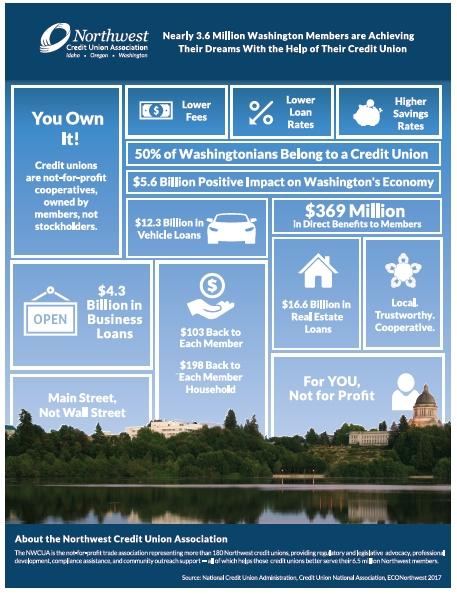
- Fifty-percent of Washington’s 3.6-million population are now credit union members. The NWCUA is using the hashtag “#CUobsessed” to stress membership and to remind that in 2017 Washington credit unions returned $369 million to their members in the form of better loan rates, returns on savings, and other perks. “That made a difference of over $100 for each and every member,” the NWCUA said.