

PHILADELPHIA–Just how fees factor into consumers’ decisions to roll over savings into an IRA versus other plan options, The Pew Charitable Trusts has released a new survey of older workers that offers some insights.
The older workers, also called “near-retirees” by Pew, and recent retirees were asked to what extent fees would be or were a motivating factor in their decision and how they would react if they learned that fees in the IRA were higher than their current plan.
“Lower fees do not appear to motivate savers to either keep their savings in a current retirement plan or to roll their savings into an IRA when they retire,” Pew Charitable Trusts said of the findings.
Unclear & Difficult to Understand
Pew noted that previous research it has conducted shows that investment fees can be unclear and difficult to understand, “which might explain why some near and recent retirees don’t give a lot of weight to fees in their decisions.
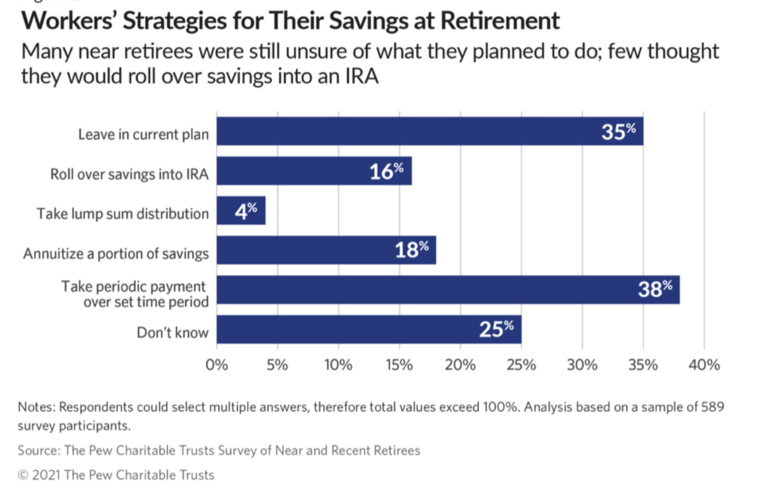
“As a result, some might roll their savings into higher-cost IRAs without fully realizing the impact this will have on their savings over the course of their retirement,” Pew reported. “Many people roll over their savings throughout their careers and not just at retirement, so the analysis in this brief does not represent a full accounting of the choices or behavior of all IRA rollovers.”
Key Findings
According to Pew, key findings in the research include:
- For both retirees and near retirees, low fees were not a significant factor in their decisions to leave their savings in their plan or roll them over to an IRA.
- Some recent retirees transferred their savings to IRAs (46%), while others reported leaving their savings in their most recent employer plan (54%). In contrast, near retirees were less likely to plan on leaving their savings with their employer plan at retirement.
- A quarter of near retirees said they were unsure about what they planned to do with their retirement savings, and only 16% said they would roll over their savings into an IRA.
- Half of near retirees and 55% of retirees cited their preference for their employer-sponsored plan’s investment options as the most important reason for not moving their retirement savings from their current plan.
- Near retirees who planned to roll over their savings into an IRA were motivated by a desire to have greater control over their investments. Although greater control was also a factor for retirees, they were more likely to say that they rolled over their savings in order to gain access to professional advice.
Demographics of Near and Recent Retirees
Pew said it surveyed 1,125 older workers and recent retirees ages 55 to 75 between May 12 and June 5, 2020. Of these, 536 were currently retired and 589 were working full time. All had at least $30,000 in retirement savings investment accounts including 401(k)s, IRAs, or other defined contribution retirement accounts.
The survey asked participants a series of questions about whom they had consulted in deciding what to do with their retirement savings and how they planned to handle their savings (in the case of those still working), or what they had done with their savings (in the case of retirees).
“Because the survey aimed to paint a picture of how people were handling their savings at retirement, the sample was limited to those who had at least $30,000 saved for retirement—so the sample is not representative of the overall population of near and recent retirees ages 55 to 75 in the United States and is generally wealthier and more highly educated than that overall population, Pew said.
The full report can be found here.